
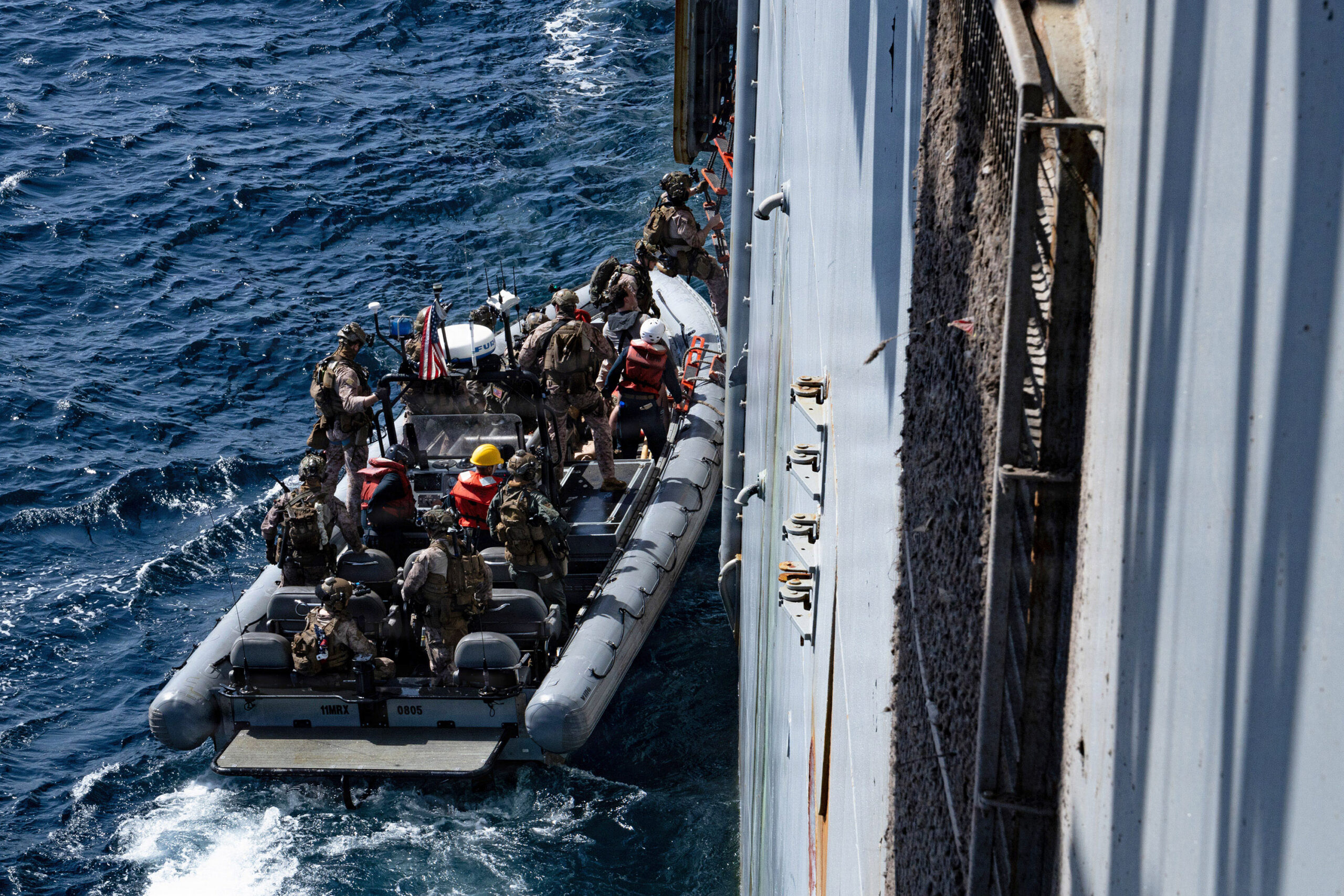
 U.S. Marines board a ship suspected of attempting to transit to Iran in April 2026. USMC Photo.
Why there are no Good Options for Finishing the Iran War
A few days ago, President Trump publicly rejected an Iranian proposal to re-open the Strait of Hormuz, and Iran has just received a formal but unspecified response. The proposal is reportedly similar to the severely flawed MOU that fell apart earlier this year, including Iranian demands to relinquish pressure on its ports and assets. With the Iran war continuing with seemingly no end in sight, the Senate also recently voted down a war powers resolution, 50-49, that aimed to have President Trump withdraw U.S. forces unless he received specific authorization to continue the conflict. But is simply withdrawing and calling it quits the right move?
After seven months of war, the United States has failed to develop a means to secure an outright victory or otherwise secure its interests in a favorable manner. Throughout the conflict, Iran has been able to exert pressure or threats that have severely restricted the flow of goods and oil compared to pre-war levels, though there are indications that this may no-longer be the case. New reports of increasing oil flow through the strait could be a hopeful sign that things are swinging in favor of the U.S., but even if so, the costs of keeping it that way will continue to persist without a diplomatic agreement.
As measured, the resources consumed on this conflict have been significant, with a direct military cost exceeding $43.6 billion. As of late September, the American people have paid an additional $117 billion in additional fuel costs in 2026 compared to an equivalent period in 2025. The U.S. has expended significant portions its arsenal of missile interceptors and other vital munitions, severely hampering its ability to respond to a potential war instigated by China. The consequences to deterrence are real, as damage to U.S. military bases in the Middle East is substantial, with at least one base rendered unusable, and exposing the potential vulnerabilities of U.S. facilities around the world. Numerous high value assets have been destroyed, and the total number of dead and wounded service members continues to rise without much explanation.
Moving forward, there are essentially three choices on how to proceed:
- Staying the course, maintaining a significant U.S. military presence in the Gulf of Arabia and trying to throttle, reduce, or continuously suppress Iran’s ability to restrict sea traffic and attack other assets in the region. This is essentially an effort to attrit the Iranians into capitulating or otherwise render them unable to threaten the region militarily.
- Expanding the conflict, by considering a ground invasion or other less-drastic options to significantly change the military situation.
- Leave. Let the region sort itself out.
Generally speaking, none of these options are ideal. All will have undesirable consequences and extract economic and human costs from the American people or others. Let’s dive in.
Staying the Course
Continuing with the current approach promises massive additional expenses as the U.S. military makes efforts to continue striking at low-cost Iranian assets and with little apparent ability to reassure the shipping industry. This sets up a scenario of perpetual conflict that diverts American attention and resources from other potentially more dangerous conflicts, thereby weaking deterrence against China. If this approach succeeds, it is based on the hope that Iran will eventually accept an unfavorable agreement due to pressure on its military and economy. But if it simply maintains the status quo, an indefinite U.S. naval and air force presence is necessary to enforce it.
Blowing Up More Stuff
Expanding the conflict by invading promises a situation that would make the Iraq war seem easy. Iran’s population of 93 million is nearly four times the size of Iraq’s in 2003, and larger than Germany’s at the end of WWII by about 10 million people. The forces necessary to establish a post-conflict order would far exceed the size of our current military. An expanded military operation that continued to rely on air and sea assets without sufficient maintenance and rest would likely exhaust munitions, equipment, and servicemembers alike, putting America’s ability to respond to a more pressing crisis in jeopardy. Short of an all-out invasion, it’s not clear what new military strategy is on the table to fundamentally alter the current state of affairs. There has been plenty of time to attempt a moderate expansion of the military option—but we have not seen such action taken, likely because the U.S. domestic political costs are too high at this point in time, the resources are unavailable, or the expected outcome is unfavorable.
Calling it Quits
It could be argued that at this point, it’s clear that the war has no effective strategy to achieve its vague remaining objectives and ultimately allow the U.S. to disengage militarily. Without a clearly defined purpose, no strategy to achieve that purpose, and U.S. public opinion standing firmly against the war, there is a strong argument to be made that the U.S. should seriously consider withdrawing its forces unless it can develop and execute a demonstrably better option. The U.S. should not engage in yet another “forever war.” It is unfair to ask our service members to put their lives on the line for an ill-defined and ill-planned conflict without a plan. It is unreasonable to ask the American taxpayer to continue expending exorbitant amounts of money for a conflict that seemingly serves no purpose other than to increase costs at the pump. While leaving means prices will likely remain high, that may be simply a consequence of the decision to launch the war.
However, the consequences of leaving means Iran is likely to completely dominate the strait and charge transit fees to any ship leaving or entering the region. This means oil and gas prices will remain elevated indefinitely, unless the nature of the global energy market acts to restrain the overall price. On the plus side, insurance costs that have increased several-fold during the conflict would likely decrease due to the lower likelihood of an Iranian attack against vessels paying the toll. But adding to the risks of leaving, Iran would be unconstrained and likely see the U.S. abandonment of the region as a strategic victory and an opportunity to re-establish arms shipments and reinvigorate its proxies. U.S. allies in the region that have been hesitant to participate in a war they didn’t ask for would stop seeing the U.S. as a reliable ally and would have to make the choice of accepting Iran’s demands or militarily opposing it. Given Saudi Arabia and the UAE’s semi-united, semi-disjointed 10-year campaign against the Houthis, their capacity for undertaking a truly successful effort to eliminate the threat without U.S. participation is questionable at best.
A Potential, but Unlikely Way Out
So how does the U.S. lead itself out of war? At this point, it’s time to ask for help—not demand it, but ask for it—hat in hand, because America’s leadership has failed to generate the ideas and policies necessary to pursue this course of action to a favorable conclusion. While President Trump harshly criticized America’s NATO allies for opting not to involve themselves in a war they didn’t want to get involved in, it’s completely understandable why they chose not to. These discussions would ideally include key U.S Middle East partners, but probably not Israel directly. The request doesn’t need to be for military assistance, but rather, for a plan—so that at least the U.S. can pursue a strategy with international approval. Of course, it’s unlikely that the administration will pursue this option.
Europe is absorbing the pain of this war as well, with an additional $113 billion in additional fuel costs of its own. It has an interest in bringing this war to an acceptable conclusion. Unfortunately, given the terrible treatment it has received from the Trump administration, Europe could also be interested in seeing President Trump face the full consequences of his failed Iran policy that began with the dismantling of the JCPOA in 2018. After receiving so much disrespect, including open threats to Greenland, America may have exhausted its goodwill from Europe. As a result, America’s European allies may be willing to continue absorbing the pain as a tolerable cost in pursuing a policy that allows the U.S. to fail and ultimately force in a change in American behavior.