
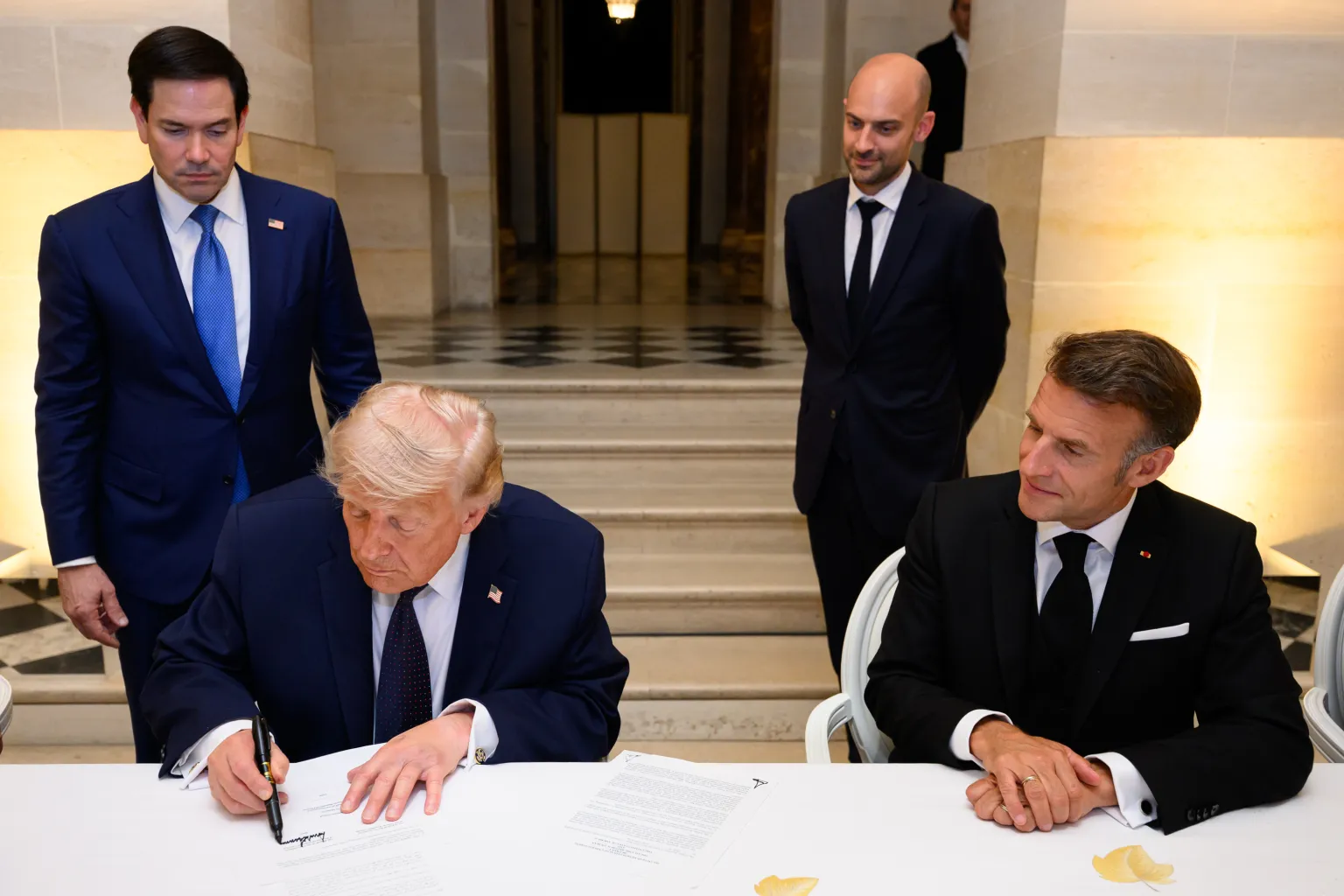
 President Trump signing the Iran MOU in Versailles in the presence of French President Macron. White House photo.
Assessing the MOU with Iran
With President Trump having signed the MOU to end the war with Iran, the two countries have entered a formalized 60 day cease fire period intended to grant a window for negotiating a final comprehensive agreement. The text of the fourteen point MOU, as verbally read by a senior administration official on Wednesday, is reproduced below, with annotated analysis of each point.
1 — The United States of America and the Islamic Republic of Iran and their allies in the current war are signing this MOU to declare the immediate and permanent termination of military operations on all fronts, including in Lebanon, and undertake from now on not to initiate any war or any military operation against each other, and to refrain from the threat or use of force against each other, and ensuring the territorial integrity and sovereignty of Lebanon. The final deal will confirm the permanent termination of the war on all fronts, including in Lebanon and other provisions of this paragraph.
On two occasions, this point declares that combat in Lebanon will end, even though neither Hezbollah nor Israel are parties to this agreement. This sets up a scenario that could easily derail the 60 day negotiation period, as Israel has demonstrated a willingness to carry out military actions independently and has long favored military action to destabilize or replace the Iranian regime. It also declares that both parties will refrain from the threat to use force, but President Trump has already claimed that the threat of violence is the means by which the agreement will be enforced. Vice President JD Vance contends that this point also forces Iran to stop funding terror groups, but due to the nature of non-state actors and terrorism, the lack of specificity in this point provides enough room for groups like Hezbollah to still conduct violent actions while Iran can claim plausible deniability.
2 — The United States of America and the Islamic Republic of Iran undertake to respect each other’s sovereignty and territorial integrity and to refrain from interfering in each other’s internal affairs.
This is a major concession by the United States, as it could potentially curtail any hope of promoting secular democracy or promoting human rights within the country. It essentially surrenders America’s ability to assist any opposition movement in Iran. After President Trump encouraged the Iranian people to stand up to their own government, this could easily be seen as a major betrayal. The gravity of this concession is extremely significant.
3 — The United States of America and the Islamic Republic of Iran commit to negotiating and achieving the final deal in maximum 60 days, extendable with mutual consent.
Point three acknowledges that this is not a final deal, and a future more comprehensive deal will be negotiated. There is no guarantee of success. The previous Iran Deal, the Obama-era Joint Comprehensive Plan of Acton (JCPOA), took 18-months to negotiate. Based on the significant U.S. concessions in this MOU, it’s possible that the U.S. will not need that amount of time because the requirements on which might insist could be significantly less stringent than what was found in that deal.
4 — Immediately upon the signing of this MOU, the United States of America will begin the removal of its naval blockade and any disturbances or impediments against the Islamic Republic of Iran, and will fully end the naval blockade within 30 days. During this period, the traffic of vessels will be in proportion to the numbers of pre-war traffic being restored by the Islamic Republic of Iran. The United States of America further undertakes to remove its forces from the proximity of the Islamic Republic of Iran within 30 days after the final deal.
This point sets the stage or a future U.S. military withdrawal, ends the naval pressure on ships traveling from and to Iran, and commits Iran to open the strait and allow for a pre-war level of ships passing through. If a final deal is signed, this wording of this point will be insufficient, as the concept of removing forces from the proximity of Iran will need to be defined in detail. This is so vaguely worded that it could result in a major U.S. withdrawal from allies in the Middle East, granting Iran a major regional power boost.
5 — Upon the signing of this MOU, the Islamic Republic of Iran will make arrangements using its best efforts for the safe passage of commercial vessels with no charge, for 60 days only, from the Persian Gulf to the Sea of Oman and vice versa. The traffic of commercial vessels will immediately start, and considering the need for removing the technical and military obstacles, and demining by the Islamic Republic of Iran will be instated within 30 days. The Islamic Republic of Iran will conduct dialog with the Sultanate of Oman to define the future administration and maritime services in the Strait of Hormuz in discussion with other Persian Gulf littoral states in line with the applicable international law and the sovereign rights of coastal states of the Strait of Hormuz.
This further commits Iran to the process of immediately re-opening the straight for the 60-day negotiating period, without charging tolls for safe passage. However, this may be a somewhat slow process as the strait may be littered with sea mines or other obstacles. It allows Iran 30 days to begin the demining process, but it will be interesting to observe shipping traffic routes through the region prior to this process being completed. Such observations could provide insight as to how thoroughly Iran mined the strait. The point also recognizes the rights of Oman, which is the neighboring country in the Strait of Hormuz.
6 — The United States of America undertakes with regional partners to develop a definitive, mutually agreed plan with at least USD 300 billion for the reconstruction and economic development of the Islamic Republic of Iran. The mechanism for the implementation of this plan will be finalized as part of a final deal within 60 days. All required licenses, waivers and permissions needed for the relevant financial transactions will be granted by the United States of America.
This provision, for lack of a better term, is absolutely wild. The $300 billion involved absolutely dwarfs anything granted to Iran as part of the previous JCPOA agreed-to by the Obama administration. The JCPOA granted Iran roughly $1.3 billion by releasing previously frozen funds plus interest, and access to $100 billion of its own money that had been internationally frozen. Half of that amount was already considered Iranian debt that it could not actually use. As written, this provision also poses a direct challenge to U.S. law that was enacted to enforce sanctions against Iran. It is unclear how this can function without Congress acting to undo the relevant sanctions.
7 — The United States of America undertakes to terminate all types of sanctions against the Islamic Republic of Iran, including the United Nations Security Council resolutions, IAEA Board of Governors resolutions, and all unilateral US sanctions, primary and secondary, in an agreed upon schedule as part of the final deal. The Islamic Republic of Iran and the United States of America acknowledge the critical importance of the sanctions termination issue above mentioned, and expressed their intentions to immediately address these issues in the negotiations in order to achieve mutual agreement on them.
Provision 7 removes any and all economic pressure the U.S. has applied to Iran if a final deal is signed. It amounts to a total surrender of all economically coercive or punitive measures. It is an enormous concession that could completely hamstring the United States and grants Iran potentially unlimited access to funding that would allow it to rebuild its conventional military assets, including its ballistic missile program. The premise of this provision essentially abandons the Trump administration’s justifications for the war.
8 — The Islamic Republic of Iran reaffirms that it shall not procure or develop nuclear weapons. The United States of America and the Islamic Republic of Iran have agreed to resolve the disposition of stockpiled enriched material pursuant to a mechanism that will be mutually agreed upon in accordance with the schedule mentioned in paragraph seven, with the minimum methodology to be down blended on site under the supervision of the IAEA. The two parties also agreed to discuss the issue of enrichment and other mutually agreed matters related to the Islamic Republic of Iran’s nuclear needs, based on a satisfactory framework being agreed upon in the final deal. The final deal will confirm the provisions of this paragraph. The United States of America and the Islamic Republic of Iran acknowledge the critical importance of the nuclear issues above mentioned. They express their intention to immediately address these issues in the negotiations in order to achieve mutual agreement on them.
That Iran has declared it will not procure or develop a nuclear weapon is not new. Iran has already agreed to this multiple times under the Nuclear Non-proliferation Treaty and in the preface of the JCPOA. Notably, this provision does not declare that Iran is barred from enrichment. “No enrichment” has been a popular rallying cry by President Trump and other opponents of the JCPOA for many years. This is a major concession that challenges the entire premise of why the JCPOA was considered inadequate and the reason a military operation was supposedly necessary against Iran in the first place. Rather than removing any highly enriched material from the country as the president previously declared would be necessary, the agreement focuses on the premise of “downblending,” a process by which the nuclear material is diluted to render it further from being weaponizable. The U.S. has previously engaged in downblending activities to convert surplus highly enriched uranium from U.S. and Russian nuclear arsenals into fuel for power plants.
9 — Pending the final deal, the United States of America and the Islamic Republic of Iran agree to maintain the status quo. The Islamic Republic of Iran will maintain the current status quo of its nuclear program, and the United States of America will not impose any new sanctions and will not deploy additional forces in the region.
This provision accepts the state of Iran’s nuclear program as it is until the signing of a final deal. It precludes any additional forces being brought to the region to exert additional leverage, or to prepare to resume military operations of the negotiations fail. No further economic leverage may be exerted either.
10 — The United States of America undertakes that immediately upon the signing of this MOU and until the termination of sanctions, US Department of Treasury will issue waivers for the export of Iranian crude oil, petroleum products, and derivatives, and all associated services, including banking transactions, insurances, transportation, etc.
This immediately lifts restrictions on Iran’s oil industry. It is a major form of immediate relief that will grant Iran major cash inflow and serve as a significant relief to the Iranian economy. It will strengthen Iran’s position and ability to resist in the short term. It represents an extremely significant concession on the part of the U.S., but can be considered reasonable as a good faith measure while conducting further negotiations.
11 — The United States of America undertakes to make fully available for use the frozen or restricted funds and assets of the Islamic Republic of Iran upon the implementation of this MOU. The United States of America and the Islamic Republic of Iran will mutually agree on the procedures related to the release of these funds during negotiations. Such funds, whether obtaining the original account or transfer, shall be made fully usable for payment to any ultimate beneficiary designed by the Central Bank, excuse me, ultimate beneficiary designated by the Central Bank of the Islamic Republic of Iran. The United States of America undertakes to issue all necessary licenses and authorizations accordingly.
This is another major concession on the part of the U.S., releasing Iran’s frozen assets for use as the negotiations unfold. It takes major pressure off the country and will allow Iran to be better prepared in the scenario that the negotiations fail. This is a step that based on past negotiations, would have normally happened after a final deal was signed.
12 — The United States of America and the Islamic Republic of Iran agree that an executive mechanism will be established to monitor the successful implementation of this MOU and the future compliance of the final deal.
This is a very weakly worded attempt at stating there will be an effort at monitoring while providing no details as to what that looks like. The inspection regime implemented under the JCPOA was extremely detailed. It is unclear what a new compliance mechanism will look like at this point in time.
13 — After signing this MOU, and subject to the beginning of the implementation of paragraphs 1, 4, 5, 10, and 11 of this MOU, and the continuing implementation of these measures, the United States of America and the Islamic Republic of Iran will start negotiations regarding the final deal exclusively on the other paragraphs.
This is a procedural element, noting the mechanisms within the MOU necessary to start the detailed negotiations for the more formal agreement.
14 — The final deal will be endorsed by a binding UNSC resolution.
This aims to make a future agreement binding. It is likely that such a deal will pass, as none of the permanent members of the UN Security Council is likely to issue a veto.
Final Takeaways
President Trump signed the MOU at Versailles, site of the disastrous peace treaty at the end of World War I that ultimately helped lead to another world war. This is a peculiar choice, given the optics.
Though President Trump has declared the current MOU as better than the JCPOA, this is demonstrably untrue. The JCPOA was a detailed multiple party agreement with little confusion or vagueness about what was expected. The MOU is only a bilateral agreement situated in a multilateral conflict—and the actions of other parties may ultimately determine the chance of a lasting peace. The inspections implemented by the JCPOA were one of if not the most extensive in history, blocking multiple pathways for Iran to obtain a nuclear weapon. As a stand-in deal with no true specifics, no established inspections, and no certainly about what a final deal looks like, the MOU offers significant U.S. concessions while committing Iran to very few actions other than opening the Strait of Hormuz. If this MOU was subjected to the same degree of political scrutiny as the JCPOA, there is no way it would pass muster at this point.
In fairness, since we have no idea what a final agreement will look like, it is too early to pass judgment on the course of these negotiations. But if the MOU is any indication, it appears the U.S. is in a hurry to conclude these hostilities and move on, surrender its leverage, and declare the problem solved, absolving itself of any responsibility in challenging the core issues that were used to justify withdrawing from the JCPOA and launching the current war. In the short term, at least the fighting has stopped, for now.