
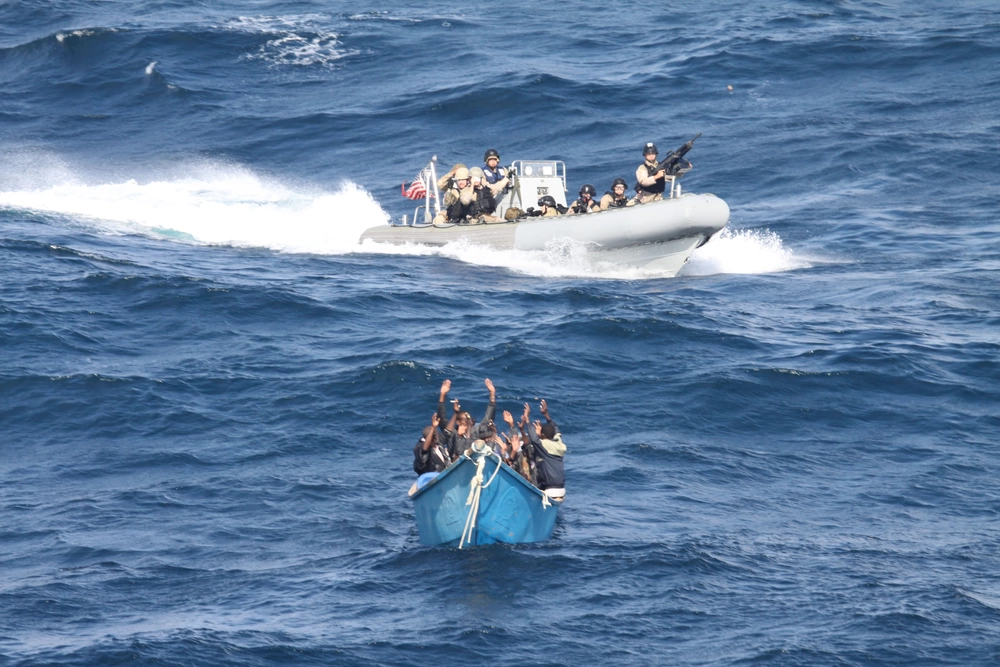
 Counter-piracy operations in the Red Sea region. U.S. Navy Photo.
Somali Piracy and Growing Militant Cooperation in the Red Sea
While international attention remains on the Strait of Hormuz amidst the ongoing U.S. and Iran discussions, piracy off the coast of Somalia has resurged at an interesting juncture. As maritime tensions continue to strain global economic conditions, a recent uptick in attack tempo by Somali pirates raises concerns about how renewed piracy may intersect with growing militant cooperation and maritime insecurity across the Red Sea region.
The increase in attacks is not unprecedented, however, as Somali piracy has historically surged in tandem with heightened maritime tensions in the Red Sea. For example, in 2023, when the Houthis began launching attacks on shipping in the Red Sea, Somali pirates conducted their first successful attack in over 5 years. The timing is notable, as international resources—both then and now—are focused on deterring Houthi hostilities in the Bab al-Mandeb Strait, reflecting a pattern where Somali pirates exploit regional security vacuums created by shifting maritime priorities and economic instability.
Despite this recent resurgence, Somali piracy remains below the levels seen at its peak between 2005 and 2011. Amid Ethiopia’s intervention in Somalia and the subsequent rise of al-Shabaab—a Somali-based jihadist insurgency and one of al-Qaida’s most lethal affiliates—Somali pirates conducted weekly hijackings resulting in several billion dollars in global economic damage, prompting an international anti-piracy coalition.
Today, renewed concerns about the resurgence of Somali piracy stem from the most concentrated attack tempo since the early 2000s peak. On April 22, pirates boarded Honour 25, an oil tanker transiting from the Gulf of Aden to the Indian Ocean, forcing its relocation off the Somali coast. Days later, a cargo ship was hijacked and subsequently diverted to the Somali coastline. On May 2, another oil tanker was hijacked in the Gulf of Aden off the Yemeni coast, with a report suggesting the potential help of Houthi intelligence. These attacks are emerging alongside reports of a growing relationship between al-Shabaab and the Houthis involving arms trafficking, smuggling networks, joint maritime disruption, and training exchanges. Al-Shabaab has functioned as both an enabler and benefactor of piracy, using piracy networks to support militant financing and regional smuggling operations.
For the Houthis, instability generated by Somali piracy provides indirect strategic advantages by increasing maritime insecurity in the Gulf of Aden without requiring the Yemeni group to assume the significant risks associated with renewed escalation in the Bab al-Mandeb Strait. A 2025 United Nations report indicated that the Houthis brokered arms transfer to al-Shabaab, in exchange for increased piracy targeting commercial vessels off the Somali coast. A report also suggests the Houthis equipped Somali pirates with advanced GPS tracking devices, enabling their disruption of commercial vessels. Speculation that the May 2 piracy attack happened in coordination with Houthi intelligence further reflects the increasing overlap between these groups. Given Somalia’s proximity to key maritime routes, the resurgence raises concerns that Somali piracy may be leveraged as a tool to advance the maritime objectives of regional non-state actors. Most notably, Houthis’ leverage of Somali piracy provides Iran and the Yemeni proxy group plausible deniability in maritime disruption amid the U.S.-Iran conflict, complicating regional security.
This growing cooperation warrants greater concern. Evidenced here is an example of a growing global trend in which ideological differences between transnational jihadist militants are increasingly becoming secondary to shared strategic interests. Though groups such as the Houthis and al-Shabaab hold distinctly different religious and political objectives, growing operational cooperation, united not in religious ideology but by shared anti-Western objectives, demonstrates the hybrid threat that these disparate actors pose against U.S. interests and security. While Somali pirates are primarily economically motivated, their activities increasingly function as a transactional tool within growing cooperation between the Houthis and al-Shabaab.
The resurgence also reflects internal disarray within Somalia. In addition to governance disputes and ongoing transnational militancy, the U.S.-Iran conflict has exacerbated Somalia’s humanitarian crisis, doubling the costs of aid transport and delaying shipments of food and medicines. On top of this, the worldwide surge in petrol prices could enable the resurgence in piracy, making commercial vessels transporting fuel and cargo increasingly attractive targets.
Though Somali piracy remains below its early 2000s peak, its sharp increase comes at a strategically complicated time against the backdrop of the U.S.-Iran conflict. More importantly, the growing overlap between regional non-state actors and criminal networks suggests that maritime insecurity in the Red Sea region is increasingly interconnected, blurring the line between crime and terrorism and complicating attribution and deterrence mechanisms. For Washington, the return of piracy may represent more than a criminal challenge, instead reflecting the convergence of several destabilizing pressures within an already fragile regional security environment.