
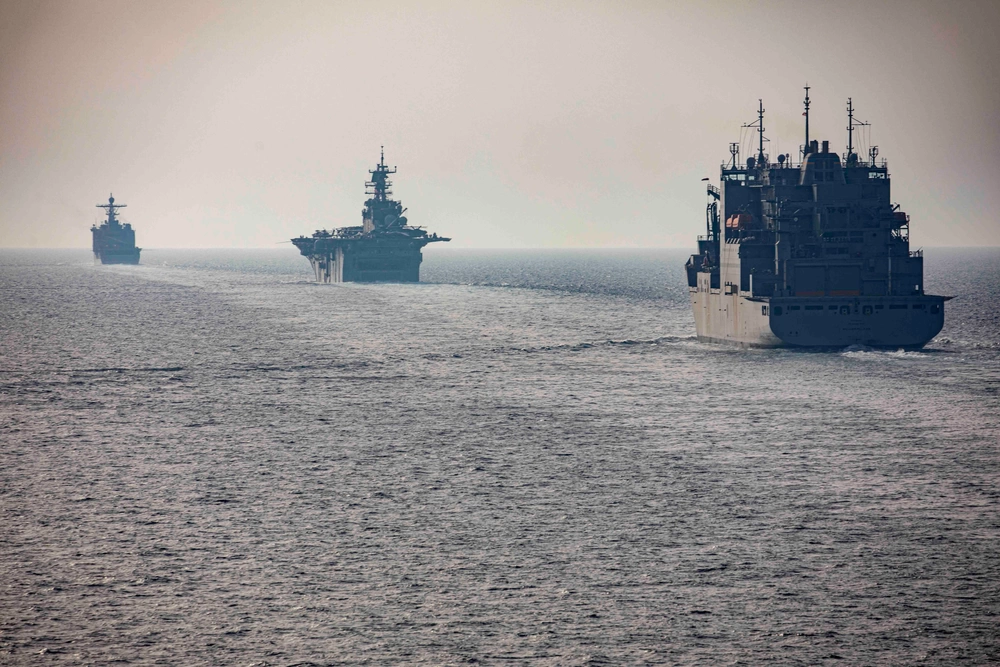
 Ships transit the Bab al-Mandeb Strait. Photo by Petty Officer 2nd Class Lyle Wilkie.
What’s Holding the Houthis Back in Bab al-Mandeb?
As the course of negotiations to reliably end the war between the U.S. and Iran continues to unfold, both countries are weighing their leverage to bring about a favorable end to the conflict. For Iran, some of the leverage comes in the form of its various proxy groups, including Yemen’s Ansar Allah—otherwise known as the Houthis. In April, Houthi threats to disrupt maritime transit through the Bab al-Mandeb Strait, a critical maritime chokepoint, raised concerns that the Red Sea could become a new front in this conflict. Despite continued rhetoric and limited maritime probing, the Houthis have yet to attack commercial shipping vessels in response to the U.S.-Iran war. At present, the Houthis’ rhetoric outpaces their operations, making a renewed campaign in the Bab al-Mandeb Strait unlikely in the near term. With attention on the increasing costs of this conflict, the U.S. should be mindful in distinguishing between rhetoric and actual escalation in order to guide the war to a more favorable end.
The Houthis’ ability to threaten the Bab al-Mandeb Strait stems primarily from geography. As a Yemeni non-state actor with close ties to Iran, the group controls territory along Yemen’s Red Sea coastline. In response to the Israel-Gaza conflict, the Houthis targeted commercial shipping in 2023, disrupting transit in the Strait through late 2025. Though undoubtedly benefiting from Iran, the Houthis remain one of the more autonomous actors in the Axis of Resistance, balancing Iranian interests with their domestic priorities. Considered the third busiest maritime chokepoint, the Bab al-Mandeb Strait is responsible for approximately 10 percent of global trade and 12 percent of global oil transport. With the Strait of Hormuz closed, reliance on alternative maritime routes has increased, making potential disruption in the Red Sea extremely perilous for global economic conditions.
Since April 8, the U.S. and Iran have been in a fragile ceasefire, but despite this, both Houthi and Iranian officials have continued threatening escalation in the Red Sea. On April 18, Houthi Deputy Foreign Minister, Hussein al-Azzi, warned on social media that President Trump must “immediately end all practices and policies that impede peace,” threatening the closure of the Bab al-Mandeb Strait. Iranian advisor, Ali Akbar Velayati, reinforced this by declaring the Strait’s security “in the hands of the Ansar Allah brothers.” Despite this rhetoric, the Houthis have not attacked a commercial vessel in the Strait since the Israel-Gaza ceasefire in October 2025. Given the unstable but nonetheless holding ceasefire between Iran and the U.S., a renewed anti-shipping campaign from the Houthis would significantly escalate the conflict.
On April 21, Houthi and Saudi Arabian representatives met to discuss peace and security in Yemen, reflecting a continued effort to stabilize a decade-long conflict. Houthi escalation in the Bab al-Mandeb Strait would directly threaten Saudi interests, more so than in the past. With the Strait of Hormuz closed, Saudi Arabia has turned to its Western coastline, rerouting shipping and oil exports through the Red Sea, while increasing its reliance on the East-West Oil Pipeline at an unprecedented rate. A renewed Houthi campaign targeting the Strait would compound Saudi economic pressure, risking the Saudi-Yemen détente that has held since the 2022 ceasefire.
A sustained campaign in the Strait would also very likely provoke U.S. and international retaliation. Previous Houthi attacks targeting Red Sea shipping prompted retaliatory strikes from the U.S. and its partners. A renewed anti-shipping campaign against U.S. assets would violate the May 2025 U.S.-Houthi ceasefire. Combined with this reality, the Houthis also face their own internal economic and military constraints. Although the group has diversified their weapons supply chain, Iran reportedly remains the group’s primary benefactor. Given the situation in the Strait of Hormuz, it seems the Houthis lack the consistent supplies they had during their previous Red Sea campaign. Additionally, the Houthis are rebuilding after incurring around $1.4 billion in damage to Houthi-controlled territory from U.S. and Israeli strikes in 2025. A prolonged campaign would require sustained missile and drone use while likely inviting additional retaliatory strikes from the international community.
This calculus, however, is contingent. Should the U.S.-Iran ceasefire collapse, Gulf states adopt an offensive posture, or U.S. forces become directly engaged inside Iran, the strategic constraints limiting Houthi escalation are likely to deteriorate, making a renewed campaign in the Bab al-Mandeb Strait more likely.
Although current conditions make a near-term de facto closure of the Bab al-Mandeb Strait appear more costly than advantageous for the Houthis, the group has previously demonstrated the capability to threaten Red Sea maritime security. Overestimating the immediacy of the threat risks unnecessary escalation, while underestimating the Houthis’ willingness to act if regional conditions worsen risks leaving the U.S. unprepared. Though the Houthis’ rhetoric currently outpaces their operations, the Bab al-Mandeb Strait remains a high-stake leverage point in the broader U.S.-Iran conflict. Any disruption would have cascading effects across global trade, energy markets, and maritime security, making it particularly important that Washington balance the Houthis’ potential red lines against broader U.S. security interests.