 Image Credit: U.S. Department of Transportation
Unequal Veteran Obesity: The Veterans Who Bear the Burden
Veterans share many things—a sense of duty and patriotism, camaraderie, and a set of shared experiences that define who they are—but one thing they do not share equally is a predisposition for obesity. Despite common characterizations of obesity in the military as an individual discipline issue, obesity is dependent upon genetics as well as an interplay of other environmental and lifestyle factors. This is especially evident for some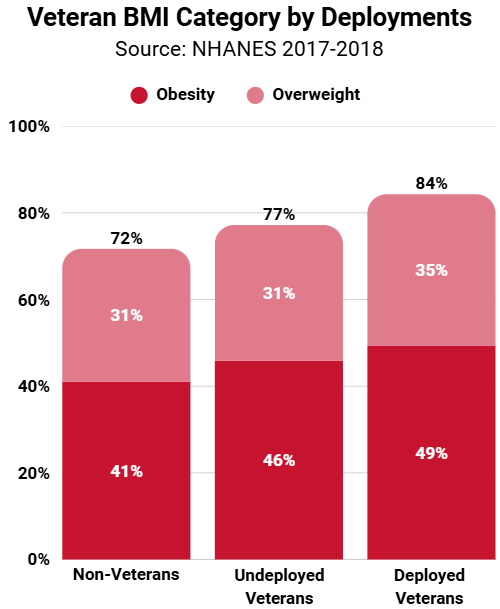 veterans of color and those who served longer and deployed more. Indeed, they have a combination of genetic predisposition and military experiences that lead to some of the highest overweight and obesity rates of any population in the country.
Deployments and Obesity
The U.S. military exposes its servicemembers to experiences and environments associated with a significant increase in obesity once they leave the service. That trend is more pronounced for veterans who deploy, and even more so for those who deploy multiple times. Many deployed servicemembers have erratic sleep schedules, decreased access to healthy or fresh food, and less structured exercise programming. Experiencing combat on deployments exposes servicemembers to higher levels of stress, injury, PTSD, and related trauma. These are all associated with unhealthy coping strategies and alcohol use. Together, these phenomena make deployments a microcosm of all the factors in the military associated with increased risk of obesity and may compound the impact of age alone.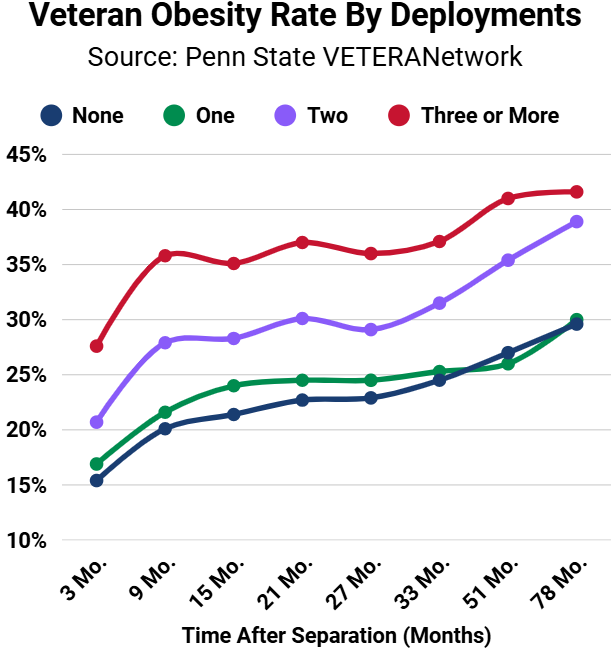
Breaking the data out by number of deployments further pronounces this pattern. The Clearinghouse for Military Family Readiness at Penn State tracked the obesity rate among a set cohort of veterans beginning in 2016. It found that veterans who had deployed multiple times had much higher rates of obesity when they left the military and several years later than those who had not deployed.
Rank and Obesity
The rank a veteran held when they left the service also evidently plays a role. Junior commissioned officers (O1-O3) are at the low end of the obesity rate scale, likely because they are earlier in their careers and in roles where fitness is emphasized. 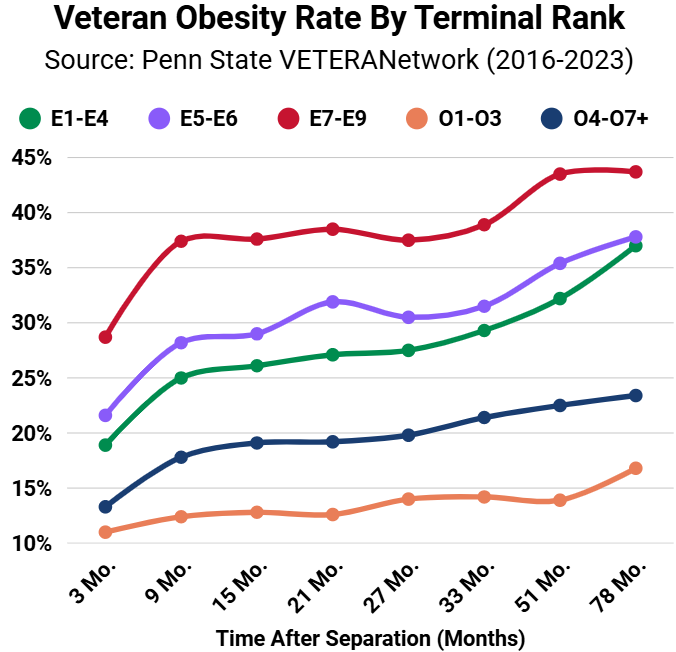 At the same time, they have more education and agency than junior enlisted servicemembers (E1-E4) and even junior Non-Commissioned Officers (E5-E6) who may be of a similar age.
Conversely, when Non-Commissioned Officers get to the E7-E9 (senior NCO) level, they are less likely to exercise in formations and have less motivation to maintain their fitness, but may have additional family and professional stressors, injuries, and other military and age-related issues that contribute to obesity when unaddressed. These largely external influences on obesity present significantly different outcomes over the years after separation. Military experiences vary greatly, and the available veteran obesity data bears this out much as it illustrates the determinative role race and genetics play in obesity.
Veterans of Color and Women
When people already genetically predisposed to obesity enter an environment that amplifies contributors to obesity across all racial groups, it adds to the issue. In 2014 (the last year for which data is available), American Indian/Alaska Native veterans receiving VA Primary Care were nearly twice as likely to have obesity as Asian veterans. Many experts even use different BMI scales to measure Asian obesity due to how significant a factor race is.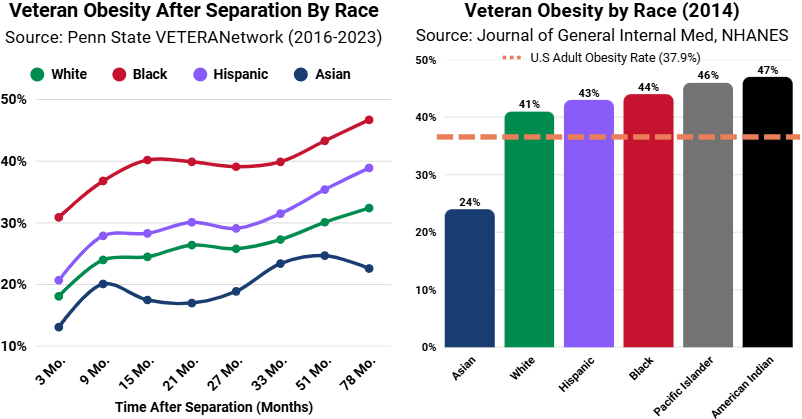
Women veterans generally had equivalent or lower obesity rates compared to veteran men of the same race but there was one significant exception. Black veteran women had an 8-percentage point higher obesity rate than Black men, with more Black veteran women (51%) having obesity than not. While the racial and gender differences illustrate the genetic determinants of obesity, there is also evidence of both a positive association between structural racism and obesity in Black people and of Black and women veterans bearing significant distress due to systemic racism and trauma. Women exposed to corollaries of war on deployments had a greater increase in obesity than any other group tracked as veterans. In addition, studies have demonstrated that PTSD and Military Sexual Trauma have their own associations with increased obesity, especially in women.
Stigma also plays an important role in the military’s obesity crisis, especially for minority groups who may feel more pressure to conceal challenges they face in order to avoid exclusion during their service. These same groups also face high disparities in access to healthcare when they leave the service and attempt to contend with the conditions they may have accumulated in the military.
Inequities in Healthcare Access
Despite having higher rates of many medical conditions, American Indian, Alaska Native, and Black Veterans have historically faced significant disparities in care quality compared with White Veterans. This is partly due to historic experiences of medical mistreatment leading to mistrust. Being Black or American Indian is also associated with higher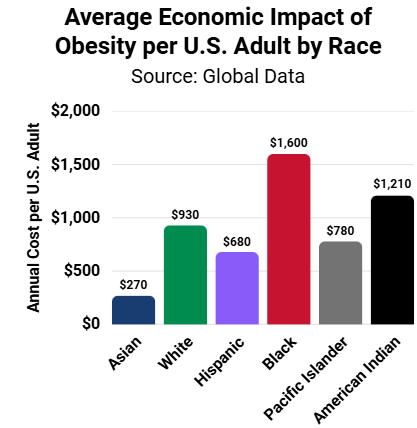 economic impacts due to obesity than any other group, placing an additional burden on them and their communities. Taken together, this means minority veterans both get less effective support and contend with higher costs related to obesity.
Finally, rural veterans have higher obesity rates than urban veterans but face their own obstacles to access treatment. Weight management programming for veterans across the board underserves some regions regardless of obesity prevalence, with many local VA MOVE! programs overwhelmed by demand. Like rural voters, racial and ethnic minorities have also benefited less from medical advances. This may stymie their access to unprecedented recent advances in obesity care. By 2040 more than one in three veterans will be a minority, meaning this issue will only increase in importance for both military and veteran systems.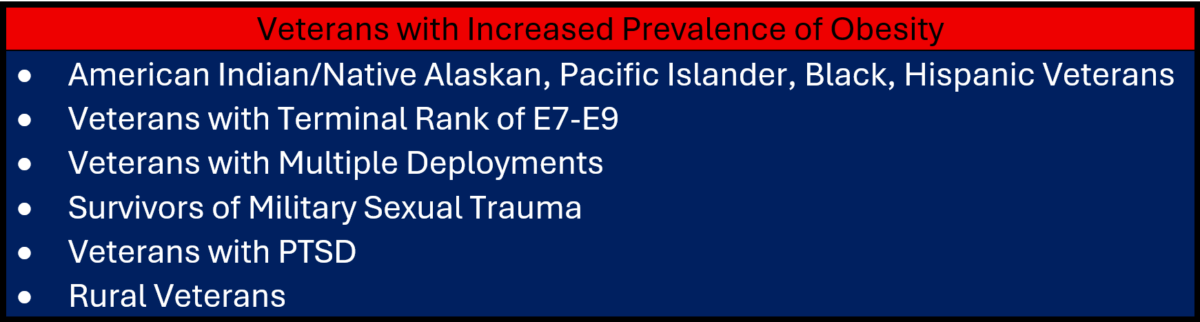
Looking Forward
There is a shortage of effective support for this issue throughout the active duty, transition, and veteran support systems. Additionally, the degradation of structures like the VA’s Office of Health Equity leaves the U.S. blind to the dimensions of this and similar issues. Fortunately, the VA still has robust Clinical Practice Guidelines that it can rely on for managing overweight and obesity, and its flagship VA MOVE! program is making advances with telehealth at the same time as obesity medication is making enormous strides. The VA, as the nation’s largest healthcare system, with its history of leadership in addressing disparities in medical outcomes, is well positioned to address this challenge if resourced and guided appropriately. This will depend on effectively implementing individualized, patient-centered care that addresses all the facets of the U.S. veteran community.