
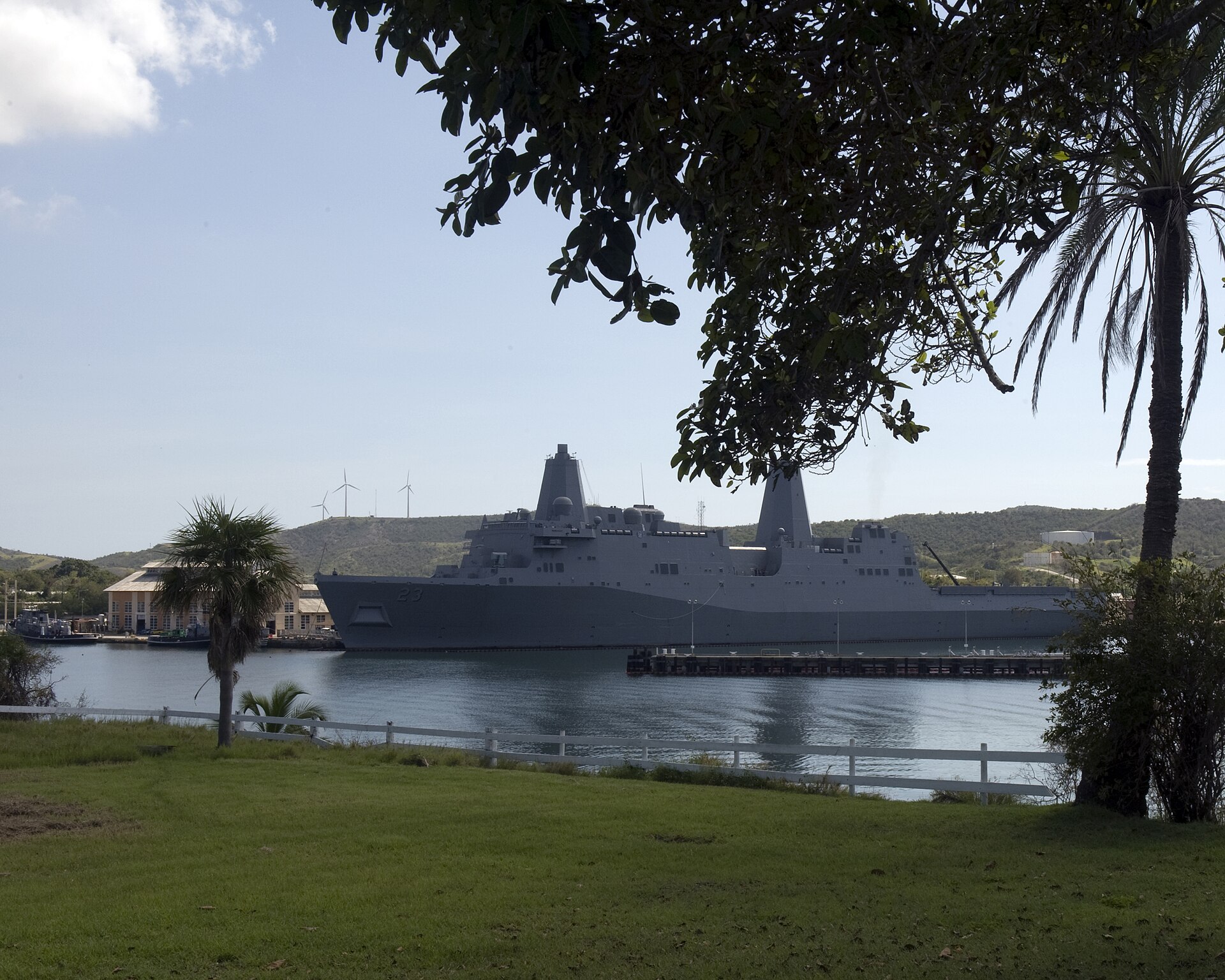
 USS Anchorage sits pier side at Naval Station Guantanamo Bay // U.S. Navy
Will the U.S. Take Military Action Against Cuba?
The U.S. Department of State recently released a report which accuses Cuba of backing protest movements and terrorist attacks on U.S. soil, acting as a forward operating base for U.S. adversaries, and serving as the “beating heart” of hatred for the West. This alarming report frames Cuba as a unique national security threat, and its talking points are markedly familiar to President Trump’s rhetoric prior to U.S. interventions in both Venezuela and Iran. After assessing recent actions made by the Trump administration, including increasing intelligence activities on the island, its rhetoric towards Cuba in this report, and feasibility considerations, President Trump seems unlikely to take any military action against Cuba prior to November’s midterm elections. Nevertheless, a post-elections military operation is highly probable.
Building a Legal Case for Attacking Cuba:
By analyzing Trump’s recent actions, it appears his administration is building a legal case for an attack on Cuba. The Department of Justice unsealed a superseding indictment against former Cuban leader Raul Castro and others within the regime for their involvement in the 1996 Brothers to the Rescue downing incident. The timing of this indictment’s unveiling is important, as it shares a striking resemblance to the Trump administration’s legal strategy for former President Nicolás Maduro’s capture. Also under a now unsealed superseding indictment, the U.S. charged Maduro and others within his regime with multiple serious crimes. In the case of Venezuela, the Trump administration argued that Maduro’s capture was an extraterritorial application of domestic law. Now, with Castro’s indictment, the administration can make the same argument.
Rhetorical Similarities to Venezuela and Iran:
The recent State Department report on Cuba recycles the same rhetorical tools used to argue for interventions in Venezuela and Iran. Namely, the report argues that Cuba is a networked enemy whose irregular tactics against the U.S. create a serious national security threat. Additionally, the administration justifies its interventions by arguing they will benefit the people of the countries in question.
The report frames Cuba as operating through a web of third parties consisting of spy networks, domestic protest movements, left-wing “extremists,” and support for U.S. adversaries. The administration similarly highlighted links between Venezuela and transnational criminal groups acting on its behalf. Meanwhile, Trump consistently framed Iran as a network of proxies and malign actors. This framing functions to legitimize interventions, as attacking nonstate actors constitutes a different legal circumstance than attacking a state directly.
By arguing that Cuba is already conducting an irregular campaign on U.S. soil, the administration can characterize its own extraterritorial actions as homeland defense. The report claims that Cuba is already operating against the U.S. without employing conventional armed forces. This mirrors the invocation of the Alien Enemies Act to claim Tren de Aragua is “conducting irregular warfare” within the U.S. In this proclamation, Maduro is directly tied to the transnational criminal group. Similarly, the administration argued Iran was operating on U.S. soil through its proxy groups.
The Trump administration has framed all three countries as national security threats. The State Department report on Cuba describes the country as an active threat due to its support of left-wing terrorists and adversarial intelligence operations. Prior to the intervention in Venezuela, the administration set the stage for a U.S. intervention by claiming that the country posed a threat due to its support of transnational criminal groups. A similar argument was made for Iran, as the Trump administration claimed Iran posed an immediate and existential danger to the U.S. due to its nuclear program and terrorist networks.
Trump’s rhetoric towards all three countries also shares the argument that his administration is acting in the best interest of their citizens. Trump argues that the government of Cuba represses its people and the U.S. is seeking to free them from this regime. Meanwhile, Trump framed his stance towards Venezuela as a battle against socialism, intended to protect Venezuelans against their socialist government. The same rhetoric was used prior to the war in Iran, with Trump repeatedly warning Iranian authorities that the U.S. would intervene unless the government ended its crackdown on demonstrators during the 2025–2026 protests.
Most clearly, the Trump administration has made explicit threats to attack all three nations. While Trump has vacillated between walking back and doubling down on these threats, such open declarations can either function as a litmus test to gauge public receptiveness or simply as threats to encourage ascension to his demands. On Venezuela, Trump said, “We’ll be starting to stop them by land also … that’s going to start very soon;” while persuading Iran to come to the negotiating table, he threatened, “The next attack will be far worse;” and in May he publicly attested, “It looks like I’ll be the one that [intervenes in Cuba]. So, I would be happy to do it.”
The following chart maps similarities between rhetoric on Cuba, Venezuela, and Iran through direct quotes from the Trump administration:
| Similar Rhetorical Points | Cuba | Venezuela | Iran |
|---|---|---|---|
Similar Rhetorical Points | Cuba | Venezuela | Iran |
Holding Adversaries Accountable | “President Donald J. Trump is holding the Cuban regime accountable for its repression of the Cuban people.” (White House Fact Sheet) | "Under President Trump's leadership, Maduro will not escape justice and he will be held accountable for his despicable crimes." (Attorney General Bondi) | “President Donald J. Trump continues to hold the Iranian regime accountable for its malign activity.” (White House Fact Sheet) |
Networked Enemy | “[Cuba’s network] serves as a force multiplier … providing it with far more power, influence and reach than it could ever leverage on its own.” (State Department Report) | “There’s not a war. We are at war against drug trafficking organizations — not a war against Venezuela.” (Secretary Rubio) | “Iran — the world’s leading state sponsor of terrorism — supports proxy terrorist groups and militias across the Middle East” (White House Fact Sheet) “Iran’s terrorist network should be neutralized.” (White House Fact Sheet) |
Irregular Tactics | “The Cuban campaign against America is unique. It is irregular and covert … Havana never possessed the capacity to defeat the United States in a conventional armed conflict.” (State Department Report) | “Tren de Aragua … infiltrated the United States and [is] conducting irregular warfare and undertaking hostile actions against the United States.” (Invocation of the Alien Enemies Act) | “Iran has also directed its proxy groups, including Hezbollah’s Islamic Jihad Organization, to embed sleeper cells in the Homeland to be activated in support of this terrorist activity.” (National Security Presidential Memo) |
Inherent Oppositional Nature | “In Castro’s Cuba, the concept would harden into … a revolutionary identity.” “[Cuba] was animated by … the radical rejection of Western culture, history and identity in all its forms.” (State Department Report) | “It is a regime that does not cooperate. It is anti-American in all its statements and actions.” (Secretary Rubio) | “Since its inception in 1979 as a revolutionary theocracy, the Government of the Islamic Republic of Iran has declared its hostility to the United States and its allies and partners.” (National Security Presidential Memo) |
National Security Threat | “I find that the policies, practices, and actions of the Government of Cuba constitute an unusual and extraordinary threat … to the national security and foreign policy of the United States.” (Executive Order 14380) | “I … find that the actions and policies of the regime of Nicolás Maduro in Venezuela continue to pose an unusual and extraordinary threat to the national security and foreign policy of the United States.” (Executive Order 14245) "Maduro uses foreign terrorist organizations … to bring deadly violence to our country.” (Attorney General Bondi) “They are bringing death and destruction to Americans.” “The action and policies of the illegitimate Maduro regime … pose an extraordinary threat to both the region and the national security of the United States.” (John Kelley) | “Executive Order 12957 … found that the actions and policies of the Government of Iran constitute an unusual and extraordinary threat to the national security, foreign policy, and economy of the United States” (Executive Order 14382)
|
Malign and Destabilizing Conduct | “President Donald J. Trump [is] … protecting U.S. national security and foreign policy from the Cuban regime’s malign actions and policies.” (White House Fact Sheet) | President Trump is promoting stability in Venezuela while … countering malign foreign influence” (White House Fact Sheet) | “President Trump restored maximum pressure on Iran to … counter its malign influence abroad.” (White House Fact Sheet) |
Protecting Foreign Citizens | “We will not rest until the people of Cuba once again have [their] freedom.” (Message on Cuban Independence Day) “The United States stands with the people of Cuba.” (Ambassador Waltz) | “The United States remains firm in its unwavering support to Venezuela’s restoration of democratic order and justice.” (Secretary Rubio) “Secretary Rubio reaffirmed the United States’ support for the restoration of democracy in Venezuela … in line with the peaceful democratic aspirations of the Venezuelan people.” (State Department Press Release) | “The United States stands with the women of Iran who face daily abuse by the regime.” (National Security Presidential Memo) “I have cancelled all meetings with Iranian Officials until the senseless killing of protesters STOPS. HELP IS ON ITS WAY.” (Trump’s Post on Truth Social) “[If Iran] violently kills peaceful protesters, which is their custom, the United States of America will come to their rescue.” (Trump’s Post on Truth Social) |
Direct Signaling | “I do believe I’ll have the honor of taking Cuba” (President Trump) “It looks like I’ll be the one that [intervenes in Cuba]. So, I would be happy to do it.” (President Trump) | “We’ll be starting to stop them by land also … that’s going to start very soon.” (Trump Call to Service Members | "As I told Iran once before, MAKE A DEAL! … The next attack will be far worse!” (White House on X) |
Feasibility of Military Action:
While the Trump administration’s recent actions and rhetoric strongly indicate preparation for an attack on Cuba, some feasibility and constraint considerations limit the probability of a forthcoming intervention. Senior U.S. military and policy planners have discussed an array of potential options, ranging from continuing a maximum pressure campaign to an extensive Army-led air assault.
The U.S. is currently constrained by the war with Iran as many American offensive capabilities are currently positioned in the Middle East. Some U.S. assets continue to operate in the Caribbean, while others remain moored at nearby ports, allowing them to be routed to the Caribbean if needed. Of the eleven American aircraft carriers in active service, three are moored within deployable range of Cuba and could plausibly be deployed by the end of the year. Additionally, Cuba lies within range of several domestic air bases—not to mention the dual nature of U.S. Naval Station Guantanamo Bay as both an asset and a target—but the ability of these bases to support a conventional invasion or other military operation may depend on what’s planned. Overall, the U.S. could realistically conduct a limited strike on Cuba in the short term; however, a full-scale invasion would require the slow and visible repositioning of military assets.
Experts disagree on the capacity of the Cuban military to successfully resist a U.S. attack. The Cuban military primarily relies on aging equipment with weakened capacity after decades of decay. Despite the significant technology gap, the island’s Revolutionary Armed Forces maintains an active-duty force of roughly 50,000 personnel—compared to America’s 2.1 million—with various paramilitary organizations and militias supplementing that figure. In terms of retaliation, the Cuban military appears incapable of significant offense, as very few combat aircraft are currently operational and its naval inventory is estimated to consist of only 33 vessels. Therefore, the primary retaliatory threat to the U.S. would be its newly acquired 300 Russian and Iranian drones, especially as Cuba only sits roughly 200 miles away from Florida. When questioned about these drones, Trump suggested that the U.S. would take action if the intel was confirmed.
Any U.S. military intervention in Cuba would likely have a mixed reaction from the international community. Considering the reactions to Maduro’s capture, in which many U.S. allies urged restraint with other countries condemning the intervention, a U.S. attack on Cuba would likely receive little support. Despite the broad disapproval of such an intervention, international condemnation is unlikely to hamper Trump’s decision making; instead, domestic opinion constitutes a more pressing concern.
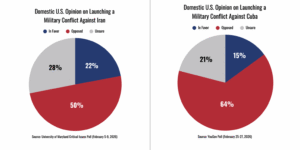
With November’s midterms approaching, both the House and the Senate have the potential to swing in favor of Democrats. At the same time, a recent poll indicates that a majority of Americans object to a military conflict with Cuba. Considering this, the Trump administration may be hesitant to launch an attack prior to the midterms. Nevertheless, a poll from before the start of the war showed that half of the country opposed a military conflict with Iran, yet the Trump administration still decided to attack. While a successful negotiated deal in Cuba could bolster faith in the president’s foreign policies, entering a protracted military conflict would likely significantly harm his chances for success in the midterms. Unfortunately for Trump, Cuba’s complete acquiescence is unlikely considering its staunch resistance to U.S. influence. The Cuban government is aware of Trump’s precarious midterm situation; consequently, it will likely seek to delay negotiations, hoping for more favorable treatment after the elections.
Final Assessment:
Considering the Trump administration’s recent actions, rhetoric towards Cuba, and the feasibility of an attack on the island, it is unlikely that Trump will pursue any military action prior to November’s midterm elections. That being said, current indications point towards a post-midterm intervention which would likely take the same form as his intervention in Venezuela: a limited special forces operation to oust or capture Cuban government leadership. Trump’s actions and rhetoric regarding Cuba directly mirrors those regarding Venezuela and Iran prior to their interventions. It seems clear that the administration is building a legal foundation for its attack and attempting to persuade the U.S. public that it would be in its best interests. Meanwhile, the constraints of limited military asset availability, public disapproval, and the upcoming midterm elections limit its ability to carry out its attack prior to November. With uncertainty regarding the end-date of the war in Iran and potentially deflated confidence in securing a rapid victory, a limited intervention, like the operation in Venezuela, is more likely than a full-scale invasion. Warning signs of such an intervention on the horizon will be visible, such as troop movements towards southeastern U.S. domestic bases, additional repositioning of naval assets into the Caribbean, and ramping up public statements against the Cuban regime. Avoiding this military action is possible in the unlikely event that Cuba accedes to all of Trump’s demands; but in any event, the future of the Cuban regime is decidedly uncertain.