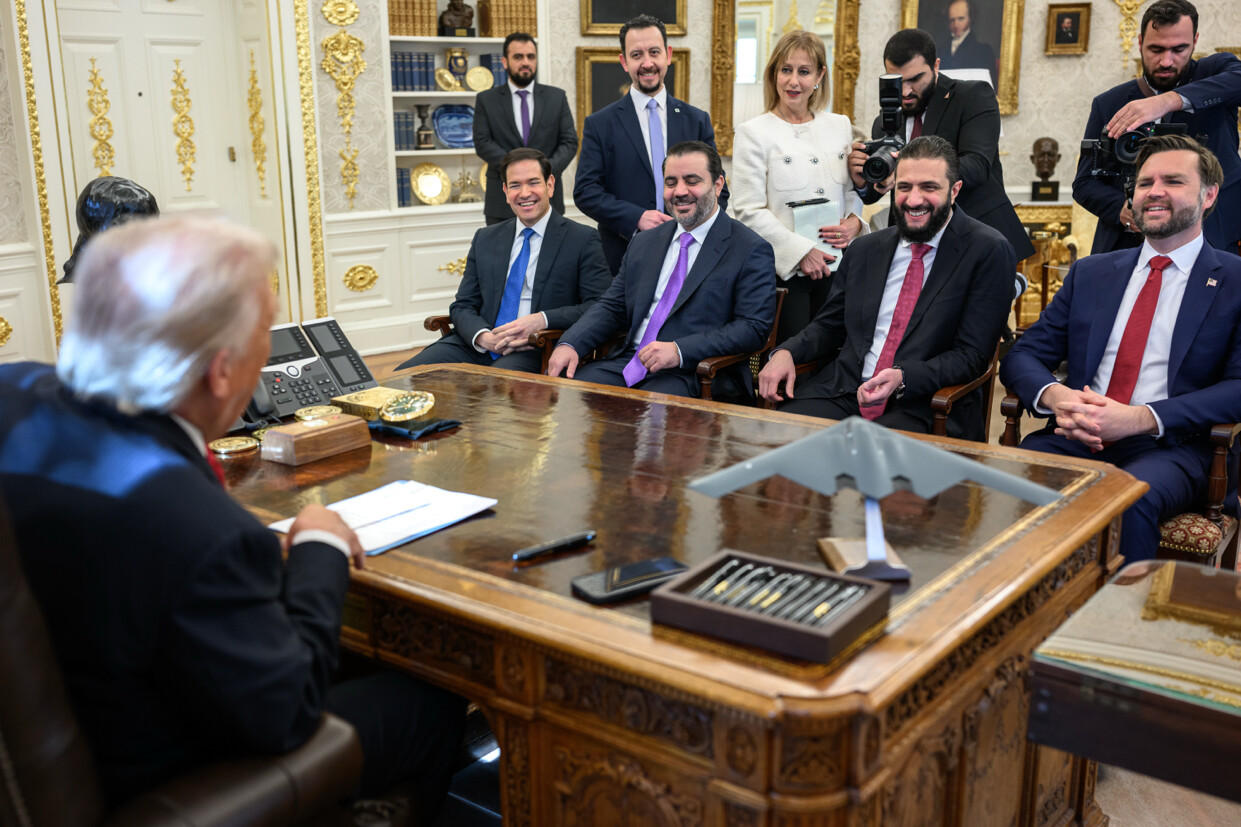
 President Donald Trump and Syrian President Ahmed al-Sharaa meet in the Oval Office // Photo from @realDonaldTrump (Truth Social)
Why Syria’s Fragile Transition Demands Restraint
In June, President Trump proposed a new solution to Israel’s war against Hezbollah, indicating his displeasure with the conflict derailing his Iran peace process. He suggested that Syria should “take care of Hezbollah,” surprising both his domestic audience and the Syrian government itself. Whether or not this suggestion was sincere, it indicates a serious lack of understanding regarding Syria’s fragility and highlights the need for a careful approach to fostering bilateral relations with the new government.
After 13 years of civil war, revolutionary forces successfully pushed President Bashar al-Assad to flee the country. Ahmed Hussein al-Sharaa, former leader of the since-dissolved Hayat Tahrir al-Sham, then assumed leadership of the Syrian transitional government. Al-Sharaa has sought to forge new connections with the West by addressing the UN General Assembly, participating in climate conferences, and coordinating combat operations with the U.S. against the Islamic State of Iraq and the Levant (ISIL). He has also sought to promote internal stability in Syria by explicitly pledging to protect minority groups and absorbing armed militia groups like the Kurdish Syrian Democratic Forces (SDF).
For its part, the West has indicated its willingness to establish a relationship with the new Syrian government by lifting sanctions and meeting publicly with the new president. Despite these positive developments, Syria remains extremely fragile as it suffers from sectarian violence, military pressure from its neighbors, and the need to manage extremist remnants within the new government’s military.
In April, U.S. forces, as part of Operation Inherent Resolve (OIR), declared victory and closed their remaining bases in Syria. This operation liberated over 110,000 square kilometers of ISIL-held territory in Iraq and Syria, dismantling the group’s territorial caliphate. OIR can serve as both a template for future cooperation and a warning of the renewed instability that could occur if the Syrian government dissolves. With concerted efforts to support the survival of this new government, ISIL will be prevented from recapturing the liberated territory and the U.S. will retain a partner for future counter-extremist campaigns.
Developing a long-term strategy of engagement with Syria is critical. The country would greatly benefit from institutional capacity-building and economic development along with military support. While planning an engagement strategy, it is important the U.S. government remembers that the fledgling Syrian state is considerably constrained by internal dynamics, meaning it cannot support objectives beyond its borders at this time. Expectations should be checked by an understanding of this reality to avoid heightening tensions by requesting too much of al-Sharaa.
If the U.S. provides holistic support for its transition, Syria’s new government can be recast as a major ally, greatly expanding foreign policy options in the Middle East. Similarly, a close relationship with Syria can enhance American ties with the Gulf States, particularly Qatar and Saudi Arabia, which are invested in maintaining a stable Syria. By promoting these relationships and forging a new web of alliances in the Middle East, U.S. optionality in response to potential regional threats is greatly improved.
Conversely, the new Syrian government will overextend and invite collapse if it accedes to Trump’s suggestion. Focusing on an external military campaign instead of prioritizing its transition would neglect efforts to reconcile with religious minorities, reconstruct government institutions, and establish territorial integrity. To achieve this, Syria is attempting to reassert control over territory held by anti-government groups, terrorist cells, and Israel. At the same time, opening a new front against Hezbollah risks igniting a broader war in the region. The resulting chaos could return Syria to the state of open civil war from which it is recovering and weaken the chances of it becoming a stable American ally.
If Syria is to be a key regional partner moving forward, the Trump administration should develop a thorough plan that addresses opportunities for collaboration while considering Syrian constraints. Doing so will contribute to a mutually beneficial and durable relationship between the two countries. This will require a keen understanding of Syria’s needs and capabilities in its fragile position. If not, continued pressure to take on roles it is not prepared for can sour the relationship entirely.
While Trump’s suggestion for a Syrian solution to Hezbollah may have simply been a way to pressure Israel, such careless statements could ruin the opportunity for the U.S. to forge a strong relationship with al-Sharaa’s government. After 13 years of civil war, Syria’s governmental transition is crucial for the stability of the region and U.S. interests within it. Now is not the time to make inflammatory proposals; instead, President Trump should seek to understand the constraints al-Sharaa faces and collaborate on feasible and mutually desirable objectives.