
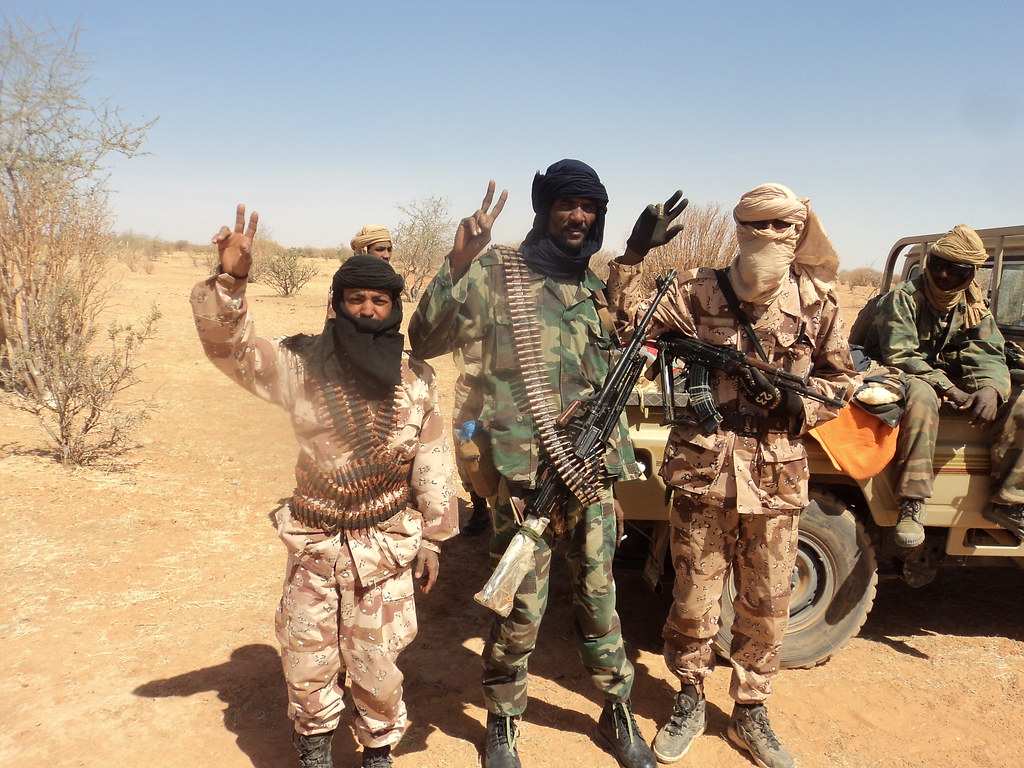
 Tuareg separatists. Photo by Magharebia, CC-BY 2.0 (https://live.staticflickr.com/8156/6972875286_8990f184df_b.jpg).
What the Mali Offensive Reveals About Russia’s Partnerships in Africa
When hundreds of overwhelmed Russian troops rolled out of the northern Malian city of Kidal in a convoy of armored vehicles last month, Western media described the affair as a “surprise.” Jihadist and Tuareg separatist forces had just overrun the city as part of a coordinated offensive that captured nearly a dozen communes, killed the country’s defense minister, and besieged the capital Bamako. But to Malian officials, who have relied on Russian military support to buttress their regime, the attack on Kidal was predictable. Three days before the assault, Kidal’s regional governor had warned Russia’s Africa Corps that an offensive was imminent, but one senior Malian official stated that “they did nothing.” A French journalist covering the withdrawal noted that the Africa Corps had already fulfilled “its part of the contract” by defending Bamako, suggesting that Russian forces considered defending the regime’s authority in the capital to be their sole obligation, regardless of what happened beyond it.
Russia’s hasty withdrawal from Kidal was more than a tactical failure; it was the result of an inadequate partnership model that Russia has applied to several war-torn African states. Unstable regimes in the Sahel have long sought security assistance free of conditions on human rights or democratic governance, and Moscow has built its regional appeal on precisely that pledge—an explicit commitment to non-interference in the internal political and social affairs of its partners. In Mali, this has effectively meant bare-bones engagement confined strictly to regime protection at the expense of national stability beyond Bamako.
Russian-backed forces arrived in Mali in December 2021, mostly in the form of Wagner Group mercenaries. They were invited by Mali’s new president, Assimi Goïta, who had seized power in a coup d’état that May and quickly adopted a pro-Russian and anti-French posture. France had maintained a military presence in Mali since 2013 as part of two anti-jihadist operations, but those interventions ultimately failed to stem Mali’s Islamist insurgency and generated widespread public resentment; in early 2022, Goïta expelled French forces, leaving Moscow to fill the ensuing security void.
Moscow was an attractive partner for two reasons: first, it had a large and capable reservoir of soldiers and mercenaries, and second, it paid little mind to the Goïta regime’s abysmal human rights record. By contrast, Western countries have increasingly pressured their partners to adhere to international human rights conventions; the U.S., for instance, is de jure barred under the Leahy Laws from providing military assistance to foreign forces implicated in human rights violations. Russia makes no such effort, framing the West’s security conditionalities as “neo-colonialism.” Presenting itself as a partner supposedly unburdened by colonial ambitions, Russia attempts to exploit Africa’s historical wounds to woo the continent’s governments into accepting Russia’s support—and its influence. As Russia’s Consul General in Cape Town, Ruslan Golubovsky, outlined at a seminar two weeks ago:
We do not seek to impose external models or intervene in the internal affairs of sovereign nations. Instead, Russia provides support upon the direct request of African governments… We do not lecture our partners on their internal affairs. We do not fetishize human rights.
Russia has learned to wield the language of sovereignty and non-interference with fluency in post-colonial contexts. In African countries like Mali, where perceived Western moralizing remains resented, the idea of a security relationship free of political preconditions was particularly appealing.
But Russia’s intentionally shallow relationship with Mali has turned into a bad bet for Goïta’s junta. Moscow’s non-interference pledge prevented the Africa Corps from building the civil-military relationships and intelligence networks that are necessary to confront the insurgency. The Africa Corps and its predecessor, the Wagner Group, have instead pursued purely military solutions with no regard for the communities in which they operate. They have repeatedly aided Malian soldiers in collectively punishing villages that have been suspected of harboring jihadist or separatist militants, like Moura, where around 300 men were summarily executed by Malian troops and Wagner mercenaries in 2022. The outrage triggered by such massacres has isolated the Africa Corps from Mali’s rural civilian population, which is a vital source for intelligence collection. At the same time, it has driven recruitment for the very groups that Russian forces are trying to fight.
When the April offensive came, the Africa Corps was unable to properly anticipate or contest it. Having determined that the regime could survive outside of Kidal and unencumbered by any strategic obligation to Mali’s territorial integrity, Russian forces simply left. Their withdrawal, now characterized as a “betrayal” by some Malian officials, has seriously damaged Russia’s credibility as a reliable partner in Africa. In trying to be everything the West was not, Russia became a detached patron whose protection of the regime entailed abandoning the country.