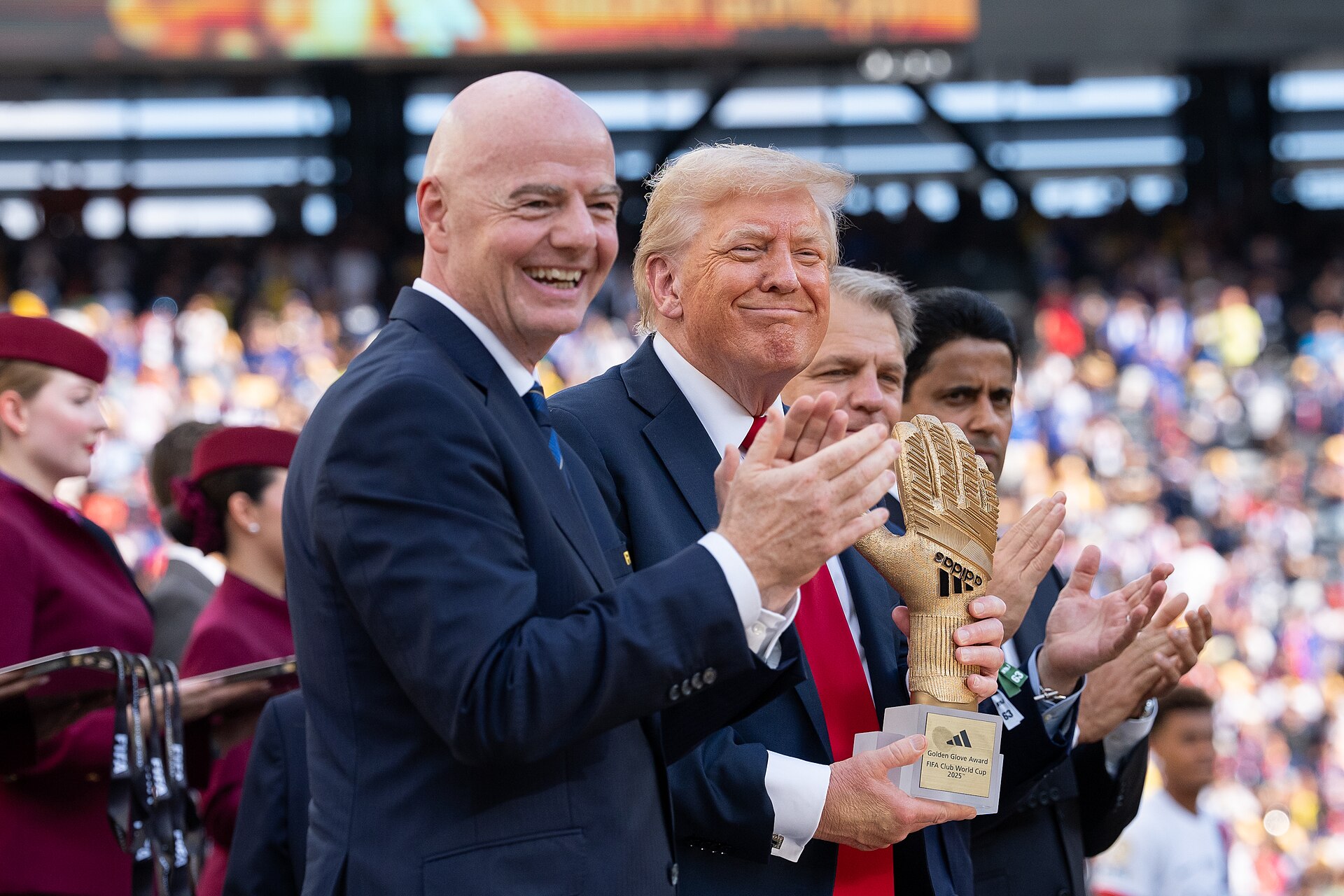
 President Donald Trump Attends the FIFA Club World Cup Final Soccer Match in 2025 // White House (Flickr)
The World Is Watching: What the 2026 World Cup Reveals About American Diplomacy
The 2026 FIFA World Cup is underway with fans from around the world traveling to the U.S. to participate in the spectacle. The Trump administration has positioned the World Cup as a central public diplomacy tool in advancing its America First agenda, yet it remains unclear how this strategy will translate into specific policy outcomes. Despite this ambiguity, the decision to promote America’s influential role in the world through sports diplomacy can be a strong choice, if utilized correctly.
In some historical cases, sports diplomacy has been chosen as a tool to bridge the diplomatic divide between parties lacking allyship or normalized relations. For instance, when the U.S. ping-pong team was invited to China in 1971, sports diplomacy was able to pave the way for President Nixon’s Beijing summit, marking the first time a sitting U.S. president stood on mainland Chinese soil. In 2026, the Trump administration is trying to use sports diplomacy to remind the world of America’s influence and leadership despite promoting policies that contradict its own public diplomacy plan.
The State Department’s public diplomacy plan identified the World Cup as an instrument to amplify America’s role in the world and advance domestic policy priorities including, “ending illegal immigration, securing borders, and driving economic growth, while advancing a vision of America as a confident and principled leader.” In practice, the administration’s travel bans and visa denials to foreign visitors—both participants and spectators—have highlighted its rejection of the tournament’s core values of international inclusivity and cultural exchange. It is unclear how stricter immigration policies can positively exemplify American excellence to foreign audiences attending the World Cup.
The World Cup is seen as a nationally unifying event for participating countries and an opportunity to explore host countries’ cities, thus boosting local economies. The White House has recognized the potential economic benefits the Cup can provide, as noted in the public diplomacy plan; however, creating higher barriers to entry in the name of securing borders has communicated a staunchly exclusionary atmosphere. With some competing countries subjected to full travel bans—like Haiti, Iran, the Ivory Coast, and Senegal—and others required to undergo heightened screening to enter the U.S., a clear disconnect exists between the administration’s intentions and actions.
On May 6, 2025, then Secretary of Homeland Security, Kristi Noem, called the World Cup an opportunity for people to bond, create a friendlier world for expanded business endeavors, and make long-lasting memories. This framing matters: it offers a chance for international visitors to come to their own conclusions about what America and its culture represents. So far, the tournament has produced a genuine shift in expectations in foreigners, one built not on messaging but on the credibility of unscripted, lived-experiences, as visitors form their own impressions of Americans simply by spending time among its people.
If this shift was a goal the administration meant to achieve with its public diplomacy plan, then this can be marked as a success. People increasingly rely on peer-to-peer experiences over official sources, making events like the World Cup a direct channel for shaping public opinion. To maximize this success in the long-term, it would serve the administration’s public diplomacy goals to make the visitation process to the U.S. easier and more welcoming, creating a positive experience that leaves a lasting impression after the World Cup ends. That would have the effect of promoting a feeling of American excellence.
With this in mind, the treatment of the Iranian national team seems like a missed opportunity to differentiate the U.S. from other host countries of international tournaments like China and Russia, and even from the experience the team sees in its own country. Andrew Giuliani, Director of the World Cup Task Force, framed the Iranian team’s participation as a chance for “for freedom-loving Iranians [and] freedom-loving Iranian Americans” to celebrate the team while looking toward the freedoms that could exist in Iran, but doesn’t seem to have taken significant action to support this. The president’s policies could have taken the opportunity presented by the World Cup to provide an exemplary American experience to the Iranian team, instead of celebrating its loss and departure.
So far, there appears to be a disconnect between what the World Cup represents and what the Trump administration wishes to achieve for its public diplomacy goals by hosting the event. There are opportunities to shift foreign expectations of the U.S in a positive direction; however, the public diplomacy plan should fully embrace the spirit of sports diplomacy if it is to guide the administration. The 2028 Los Angeles Olympics offer the administration a second chance to align its rhetoric with its policy and remind the world that the strongest form of American power has never been its borders, but its people.