
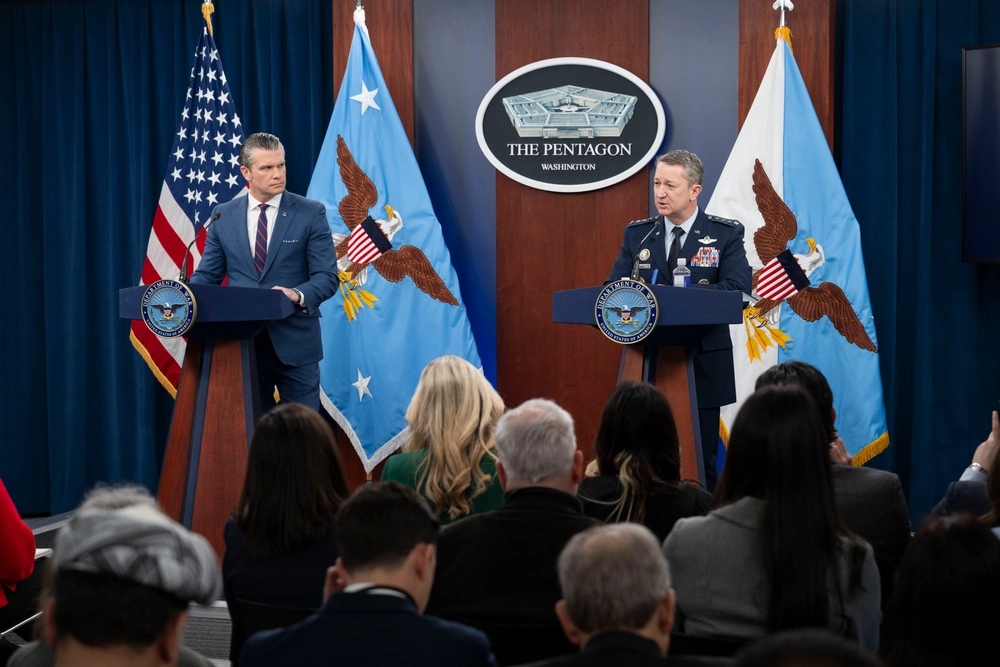
 Secretary of War Pete Hegseth and Chairman of the Joint Chiefs of Staff General Dan Caine briefing reporters on Operation Epic Fury. DoW Photo.
Unclear Justifications and Objectives Risk Operation Epic Fury Becoming an Epic Fail
The launch of “Operation Epic Fury” against Iran on February 28th has already resulted in significant military accomplishments. Supreme Leader Ayatollah Ali Khamenei is dead, as is much of the top echelons of Iran’s leadership. Iran’s air defense systems appear to be mostly decimated, partially due to the Israeli-led campaign in 2025. Iran’s Navy is being systematically destroyed, reducing the overall threat to ship passage in the Strait of Hormuz. Iran’s government is in disarray, with its military units operating independently as command and control was severely compromised.
While these accomplishments are impressive and the military planning to absolutely decimate Iran’s military capabilities appears solid, the results of this conflict are far from certain. Epic Fury risks becoming Epic Fail. The U.S. still does not appear to be prepared for a long-term, significant war with Iran. Specifically, there is no indication of preparedness for how to translate military action into effective and stable regime change, no plan to manage refugee flow or humanitarian consequences, no plan to handle arms proliferation, and no indication of a strategic direction other than blowing stuff up and seeing what happens. Destruction is easy, but as the last few decades has taught us, the rest is hard.
This lack of long-term strategic planning should lead the American public and Congress to question—and possibly challenge—the entire premise of this war. To understand why, let’s take a closer look at some of these concerns.
Questionable Justifications and Timing
The 2003 war in Iraq taught the American people to demand more accountability and demonstrable intelligence prior to launching an attack or invasion. It also taught them the dangers of thinking that simply overthrowing a murderous dictator would result in a groundswell of love for and cooperation with the United States. Since that war, the U.S. intelligence community has learned valuable lessons in its collection and processing of intelligence. Though the Bush administration engaged in a flawed but somewhat admirable process to generate domestic and international support for its plans to invade Iraq, the Trump administration hasn’t really bothered to do so at all.
The Trump administration’s justifications for this military action have been numerous and varying. After declaring “Iran’s Nuclear Facilities Have Been Obliterated — and Suggestions Otherwise are Fake News” in June 2025, the administration is now claiming that Iran was a week away from having weapons grade nuclear material.
The Trump administration’s claim that Iran would soon have an intercontinental ballistic missile (ICBM) capable of reaching the U.S. appears to be outright false according to the U.S.’ own intelligence estimates. Last year, the Defense Intelligence Agency estimated that if Iran decided to pursue an operational ICBM, it could adapt the technology behind its space launch vehicles to serve that purpose by 2035. The threat was far from imminent.
What was imminent last week was talk of an effort in Congress to force a vote on a war powers resolution this week to restrict the president’s ability to launch military operations against Iran. A cynical view would contend that if the president intended to attack regardless of negotiations, he had to do so before being hamstrung by Congress. A more generous view would contend that a war powers resolution restricting the military option would severely undercut the American negotiators’ credibility.
Unclear and Inconsistent Objectives
Members of the Trump administration have offered a variety of objectives for this operation, but the inconsistency in how they are discussed or what serves as the primary motivation raises doubts about the ultimate purpose. It has long been U.S-policy across Democrat and Republican administrations alike that Iran would never be allowed to develop a nuclear weapon.
While initially, the operation was depicted as a mission to destroy Iran’s supposed imminent nuclear capability, the explanations have been shifting. Secretary of State and National Security Advisor Marco Rubio credited some of the rationale as needing to reduce the risk of Iranian retaliation after an upcoming Israeli strike. He also explained that the U.S. aims to destroy Iran’s ballistic missile launch and manufacturing capabilities. He further identified the destruction of the Iranian navy as goal in order to protect global shipping. Undoubtedly, this is a reference to Iran’s ability to close and mine the vital Strait of Hormuz.
He also set no timetable, stating that the U.S. will “do this as long as it takes to achieve those objectives,” while simultaneously denying that the objective was regime change. Despite the President being well known for campaigning against forever wars, he has also placed no timeline, stating, “Whatever the time is, it’s OK. Whatever it takes,” and further arguing the U.S. can fight “forever” with its current stockpile of weapons.
Secretary of War Pete Hegseth mirrored Rubio, stating the goal is to destroy Iran’s missile capabilities, cripple its navy, and prevent Iran from achieving nuclear capability. Chairman of the Joint Chiefs of Staff General Dan Caine said that the mission is to “prevent Iran from the ability to project power outside of its borders.”
Clearly or unclearly, regime change seems to be a desired outcome. The Israeli attack on Iran’s leadership is irrefutable evidence of this. Immediately after launching the attacks, President Trump himself has called on the Iranian people to “take over your government,” while contending, “this will probably be your only chance for generations.” He further told the Washington Post that his primary concern is “freedom” for the Iranian people. That freedom portends a massive undertaking, and no members of the administration have offered a road map to how that is achieved. As Anne Applebaum points out, despite U.S. calls for the Iranian military and security forces to lay down their arms and receive total immunity, there is no one on the ground to surrender to, and thus no realistic way to do so. What then, should they do?
Regime Change—to What?
The elimination of an entire echelon of Iran’s top leadership has certainly not appeared to instigate a surrender of the Iranian government nor has it mobilized a significantly larger anti-regime movement ready to seize power in Iran. Given that likely more than 30,000 protestors were killed in the latest internal cycle of oppression, the leading vanguard of a mass Iranian opposition movement may simply not exist anymore. There is a possibility such a movement can emerge, but with security likely higher than it has ever been in Iranian regime history at this moment, the ability for it to grow may be severely hampered. Effective protest movements tend to develop when the individual fear of death or harm has decreased, enabled by strength in numbers. While a small amount of government violence against its people can grow a protest, a much higher level of violence tends to reduce its size. Thus, the Iranian regime’s willingness to use extreme violence has been an effective method of suppression, and the internal security forces in the country are still in control.
Even if there is a willingness to protest or somehow seize control, the Iranian opposition is also split, with no clear leadership figure offered other than Crown Prince Reza Pahlavi, the exiled son of the former Shah who was deposed by the Islamic Revolution. Given that the Iranian Revolution was launched against the Shah, in the first place, it’s doubtful that going back to the past is the appropriate solution for the country, nor would it be supported by enough Iranians to be viable long-term. The student movement, which has historically motivated action in Iran, is notably comprised of progressives and monarchists, united only by a desire to remove the regime, not what comes after. Lending to the concern that Epic Fury becomes Epic Fail, even President Trump has admitted that most of the people the U.S. believed were suitable are dead.
Provided an environment where the entire remainder of the Iranian government abdicates, the lack of a unified vision about Iran’s future is likely to doom the country to chaos—what John Ghazvinian calls the “Syrianization of Iran.” Iran is flush with weaponry, as it has produced and provided enough to supply not only its own military but multiple non-state actors outside of the country with both small arms and advanced weapons capable of threatening the U.S. Navy. Imagine a scenario where the government is deposed, but elements of the Iranian Revolutionary Guard and military seize armories around the country and subsequently open them to regime loyalists or terror groups unwilling to admit defeat. Imagine varying opposition factions laying claim to abandoned military facilities and taking those weapons for themselves. Suddenly, with the future of Iran is at stake and no one is clearly in charge, you’ve got a full-blown civil war. Welcome to Iraq in 2004, multiplied by over three times the population.
An orderly transition of power is key to success. Retaining respected military and security officers in their positions and upholding a chain of command, competent government technocrats, and other key to maintaining stability will be key in a transition. But there is no identifiable democratic force or personality within Iran seemingly able to achieve this, let alone enforce it.
A Drain on Critical Munitions
The war against Iran is severely diminishing America’s stockpile of key tactical weapons—a situation that can amount to significant strategic consequences in a future war against China. In the past four years, the war in Ukraine has clearly highlighted deficiencies in the U.S. munitions stockpile and the production capacity necessary to replace those munitions at speed. In particular, 155mm artillery rounds and air defense missiles are in short supply. While artillery rounds don’t really apply in this war (yet), anti-missile systems like the Patriot, Standard Missiles, and THAAD have been severely drained over the past several years in operations like defending Israel from Iranian and Houthi missile barrages. In particular, Mike Fredegburg of Responsible Statecraft estimated in 2025 that the SM-3 stockpile may have seen a 33% reduction in availability compared to 2023. These systems will be essential in a potential conflict with China over Taiwan where quantity is going to be a defining factor.
Patriot missiles have been in particular demand to defend Ukraine from Russia, and European countries have been purchasing significant numbers in support. This year, Lockheed Martin agreed to increase its production capacity of patriot missiles from around 600 to 2,000 units per year. When thousands of missiles are being fired at Ukraine and numerous middle eastern countries combined, it is easy to see how the rate of combat can quickly diminish the available stockpile faster than it can be replenished.
Further compounding the issue, interceptors like Patriot are expensive, running roughly $3.7 million apiece. The SM-3 block IIa runs nearly $28 million per unit. The cost of this war is mounting quickly.
Benefits of a Best Case Scenario
Iran has been an obstacle to peace in the Middle East and elsewhere for decades. Its support for terrorist groups and autocratic governments is well known. It is directly responsible for the deaths of American servicemembers by actively arming Iraqi insurgents after the 2003 invasion of Iraq. In a case where the Islamic Republic of Iran is replaced with a Western-friendly government that reflects the will of the people, there exists enormous potential to address multiple security issues for the U.S. and its allies. For instance:
- Cutting off Russia from another one of its allies, and thereby decreasing the amount of resources and weapons, like Shahed drones, available to fight the war in Ukraine.
- Putting more pressure on China, as Iran and Venezuela combined supplied 17% of Chinese oil imports in 2025.
- Eliminating the cash and weapons flow to militant groups like Hezbollah, Hamas, and the Houthis in Yemen.
- Eliminating cooperation with other American adversaries.
- Increasing political stability in Iraq, assuming Iranian support decreases. A change in regime does not necessarily mean Iranian support for Shiia groups will necessarily evaporate, but the nature of the support, especially for armed groups, might.
- Finally ending a decades-long power struggle and series of proxy conflicts.
Even with this potential, there are other consequences emanating from these outcomes which could have unintended effects:
- Removing or decreasing energy exports to China would likely lead to an even closer relationship with Russia and a subsequent boost to the Russian economy.
- Unencumbered militant groups may escalate their behaviors in retaliation for the current conflict and any restraint imposed by Iran may be lifted. This may already be beginning.
- Buoyed in confidence by its successes in military operations, Israel may opt to openly pursue its own regional objectives, leading to further military action and humanitarian catastrophes.
- An overly-confident United States which turns its back completely on diplomacy and relies on military might to solve its disputes, resulting in a total abandonment of America’s post-WWII international principles and becoming a pariah, or leading to a potential military catastrophe against a peer adversary like China.
Final Thoughts
We Americans should be proud of our servicemembers and the incredible feats they have accomplished. We should support their success in their missions and make sure they are equipped to win before, during, and after the battles they face. Not only should they be equipped with the hardware and training necessary to win, but the institutional and societal support that they deserve after. They should also be equipped with the clarity of purpose, mission, and objectives that our political leaders should be duty-bound to provide. Their missions should be achievable, based on solid information and intelligence, and supported by Congress.
Considering the options that were on the table, including a nascent diplomatic agreement that could have eliminated enriched Uranium stockpiling, the justification for Epic Fury appears to be revealed in its own namesake: wild or violent anger. Unfortunately, it appears that the desire to attack Iran, encouraged for literal decades by Benjamin Netanyahu and members of America’s political leadership, has finally overcome the desire for restraint. From Israel’s standpoint, this is understandable, as it has been undergoing its own post-9/11 style drive to eliminate threats after the brutal attacks it suffered on October 7. The success of the Israeli-initiated and U.S.-joined assault on Iran’s nuclear facilities in 2025 significantly increased American confidence that a larger operation would be successful. The weakening of Iran since then, along with the recent protest movement, provided a moment of opportunity that both countries’ leadership have decided to seize.
But without realistic, fully gamed out planning for what happens after Epic Fury’s inconsistent objectives are potentially achieved, we may be witness to one of America’s most epic fails. The servicemembers we ask to do this deserve better from our leadership. Congress should demand more from the Executive Branch.