
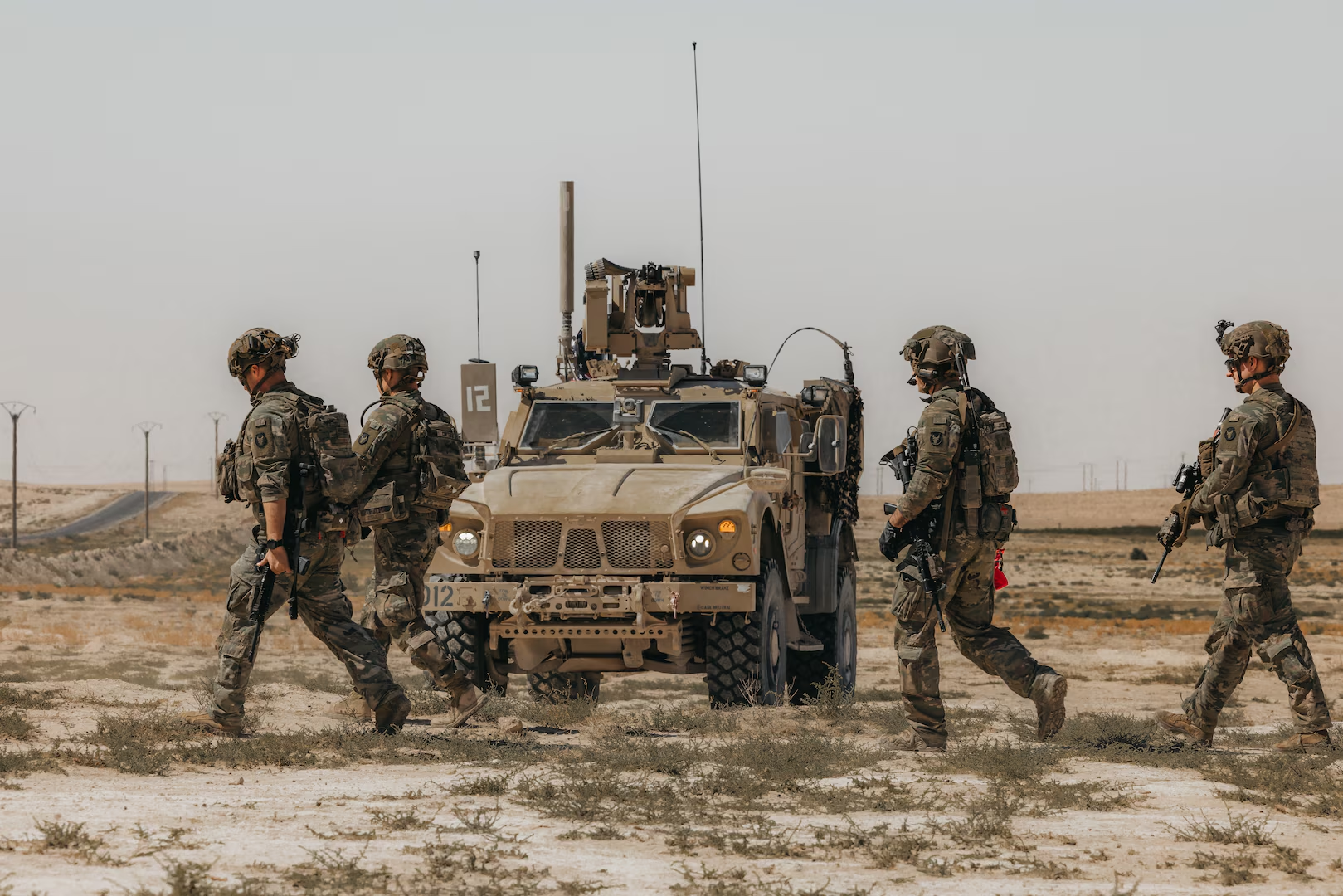
 U.S. troops supporting counter-ISIS operations in Syria. U.S. Army photo.
U.S. Withdrawal from Syria Risks ISIS Resurgence
Weeks after the United States announced plans to withdraw its remaining forces from Syria—ending a decade-long military presence against the Islamic State of Iraq and al-Sham (ISIS)—uncertainty is rising in northeastern Syria as the Kurdish-led Syrian Democratic Forces (SDF) integrate with the Syrian government. Although both share an interest in preventing ISIS’s resurgence, the SDF and the Syrian government’s history make this transition vulnerable to renewed conflict, an opening ISIS could exploit if containment efforts fall to the wayside in the absence of U.S. ground support.
After ISIS declared a self-proclaimed caliphate in 2014, it took significant territory in Syria and Iraq. By the end of the year, the United States had assembled an international coalition to destroy the group and launched operations that heavily utilized local rebel groups, particularly the SDF. Together, they dismantled ISIS’s territorial caliphate by 2019, though the group remains active in decentralized cells capable of resurgence. For these reasons, U.S. forces remained in Syria to support containment efforts.
However, Washington’s policy has shifted since Ahmed al-Sharaa’s rise to power at the collapse of the Assad regime in 2024. Despite al-Sharaa’s past involvement with several jihadist militant groups, the Trump Administration seems to be willing to give him the benefit of the doubt and back the Syrian government, effectively abandoning its decade-long counterterrorism (CT) partnership with the SDF. The shift has resulted in U.S. support of a unified Syrian state, inflaming tensions between Kurdish forces and Damascus. Although the two sides signed their first integration agreement in March 2025, conflict persisted as Syrian government forces asserted control, claiming around 80% of the previously SDF-controlled territory.
In January 2026, the two forces reached a ceasefire with U.S. mediation, establishing a deal to implement phased integration. With this in motion, the U.S. announced its complete withdrawal from Syria in mid-February. The United States has already begun withdrawing forces from several bases across northeastern Syria, including the Qasrak base—the U.S.’ largest Syrian base. Some could say that the recent integration effort, combined with Syria’s ascension into the Global Coalition to Defeat ISIS in December, are significant feats. But given the fragility of the situation, Washington’s withdrawal is premature and risks overestimating Syria’s capability to sustain a peaceful partnership with the SDF, which could lead to disarray that would ultimately benefit ISIS.
While Damascus has signaled a commitment to countering ISIS, integrating the SDF into the Syrian state security structure may prove in the long-term to be complicated. Over the past decade, with substantial U.S. funding, the SDF has developed extensive operational experience, intelligence networks, and local security infrastructure specifically designed to track and disrupt decentralized ISIS cells. Instability during the integration process could instigate major security breakdowns. In January 2026, following the SDF’s acquiescence, over 15,000 ISIS-affiliated detainees escaped from the previously Kurdish-controlled camp, al-Hol, after Syrian authorities failed to properly contain the facility. Based on historical patterns, continuing lapses of prison camp security emerging through the transfer of detainees, releases, and escapes in northeastern Syria will likely result in Islamic State affiliates reentering militant networks.
The SDF remains wary of the agreement, especially given the longstanding Kurdish distrust of Damascus, and the fact that constitutional guarantees for Kurdish rights remain unresolved. Although Damascus has taken initial steps to recognize Kurdish identity, any failure to adequately protect those rights throughout integration could cause tensions to reemerge, jeopardizing the agreement and likely weakening CT coordination against ISIS. This would create a strategic opportunity that the group could exploit in contested areas.
That risk is acute because ISIS already appears to be positioning itself to capitalize on shifting dynamics in Syria. In early February 2026, the United Nations Analytical Support and Sanctions Monitoring Team reported that ISIS “established networks across all Syrian governorates, embedding sleeper cells in urban centers, including Damascus.” Alarmingly, days after the U.S. announced its withdrawal from Syria, ISIS spokesperson Abu Huzaifa al-Ansari released his first audio message in two years, urging members to target the Syrian regime, thus indicating a desire to capitalize on the U.S. withdrawal.
Syria’s evolving security landscape presents opportunities and risks. While the integration of the SDF into the Syrian regime may lead to a unified state, success depends on whether the two sides can overcome a history of political distrust marked by relatively recent conflict. As the United States withdraws its forces, Washington will no longer be positioned to support counter-ISIS operations on the ground if renewed tensions divert Damascus from its promised CT efforts. If this integration process fails, Washington will have dropped the ball on a decade-long joint operation, creating opportunities for ISIS to rebuild its network and operational capacity in Syria.