
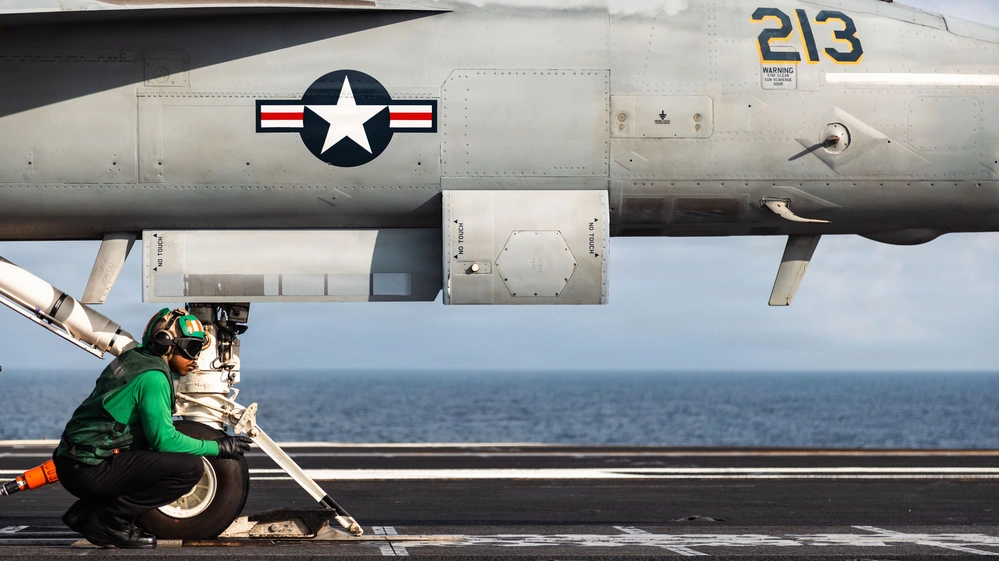
 Flight deck operations aboard the USS Gerald R. Ford just a few days ago. U.S. Navy photo.
The U.S. is Unprepared for a Significant War with Iran
With President Trump stating on February 19th that he would determine his course of action regarding Iran within 10 days, many are wondering whether the U.S. is headed to war. This question may be answerable by examining the current force posture around the country, indicating that the United States is not positioned for a long-term war. While two aircraft carriers have been ordered to support a potential military operation, the USS Gerald R. Ford has only recently entered the Mediterranean and will take time to reach a position where it can directly support a military operation. When it does reach that position, the next question is: a military operation to accomplish exactly what?
With no viable armed opposition on the ground, and no U.S. troops in the region to physically take territory, it’s unclear how an air campaign against a country of 93 million will achieve objectives that have yet to be laid out. Regime change, which Trump has described as “the best thing that could happen,” would be extraordinarily difficult. Iran is not Venezuela, and Tehran is much further inland from U.S. naval forces than Caracas, making an efficient kill or capture operation unlikely. But there is no indication that an outright invasion is in the cards either. The U.S. order of battle in the 2003 Iraq invasion included five carrier battle groups and 170,000 invading troops, and nothing approaching that level is currently in-theater today. Building that type of force takes deliberate effort over months.
That is not to say that the U.S. couldn’t take limited military action in both scope and duration. The attack against Iran’s nuclear assets in June of 2025 certainly demonstrated that ability. But given the declared success of those strikes, which was described as “total obliteration” of “Iran’s ability to create nuclear weapons,” it’s unclear what exactly a limited series of strikes is intended to accomplish—unless the Trump administration publicly admits the 2025 strikes failed to accomplish what was described. Most likely, if military action is undertaken, we will see an aggressive but short-term assault, followed by a “wait and see what happens” period. In theory, such an attack may be intended to force Iran to make more concessions in its nuclear negotiations, while simultaneously creating the internal justification for wanting a nuclear deterrent. If these military attacks are intended to create pressure, the Iranian regime would likely need to see its survivability threatened and subsequently feel safer by making concessions—with assurances that those concessions would lead to relief from current and future pressure. Given Iran’s history with the United States under President Trump, the Ayatollah has little incentive to trust. It’s certainly possible this could unintentionally lead to a much longer war.
Even if a full regime change operation were undertaken, the Ayatollah’s extensive institutionalization of the revolution means that elements of the Iranian Revolutionary Guard Corps are likely to seize control in absence of clear leadership direction. Members of the Basij Militia, Iran’s violent paramilitary force, would act swiftly to quash internal dissent and would likely be able to do so unless millions of Iranian citizens overran them on the streets. However, there is nothing indicating a viable opposition movement that’s able to seize control in the face of an air assault on the country, especially after, as President Trump states, 32,000 people were just killed in the latest protest movement. Even if opposition groups were successful in ransacking military weapons caches, the lack of organization and unity would likely result in a Libya-style mess of militias all fighting for control and influence, and unlikely to give up their weapons in the name of peace after the Ayatollah was deposed.
The U.S. is simply unprepared for a long-term conflict, especially one striving for regime change. There is no plan for what comes after, no U.S. or international force capable of stabilizing the country, and no lessons from the past several decades to inform us how to be successful at such an operation. There is no major international coalition assembled. In fact, one of America’s staunchest allies, the United Kingdom, has declined to offer its airbase at Diego Garcia for use by U.S. forces in an attack on Iran. There is no effort to build global support and no significant desire on the part of the American people to attack Iran.
The U.S. military is also stretched thin. The Gerald R. Ford, currently en route, is America’s newest aircraft and most advanced carrier, but has had its tour of duty extended after conducting operations in the Caribbean. It’s nearing 8 months at sea, a duration which exacts a toll on the people who serve aboard her. Six of America’s eleven active duty carriers are currently in maintenance, meaning the U.S. must choose where it sends its available assets judiciously. With looming threats from China, the ongoing conflict in Ukraine, and North Korea still posing a danger, the United States has precious few capital ships it can deploy to deter or respond to a crisis—all while undertaking optional military actions. Furthermore, few ships, exhausted crews, and worn equipment means a higher likelihood of accidents. The USS Harry S. Truman’s 2025 deployment demonstrated multiple dangerous incidents. Just this month, a U.S. destroyer and navy resupply ship collided.
The lessons we have learned from decades of conflict in Africa, the Middle East, and Central Asia should be readily apparent to America’s leadership. This country has been monumentally poor at handling the aftermath of the conflicts in which it has engaged. So far, there’s no indication Iran will be any different, and a “we’ll find out” attitude is insufficient when American servicemembers’ lives are on the line. Is chaos in-fact the desired outcome? If not, what exactly is the plan to ensure otherwise?