
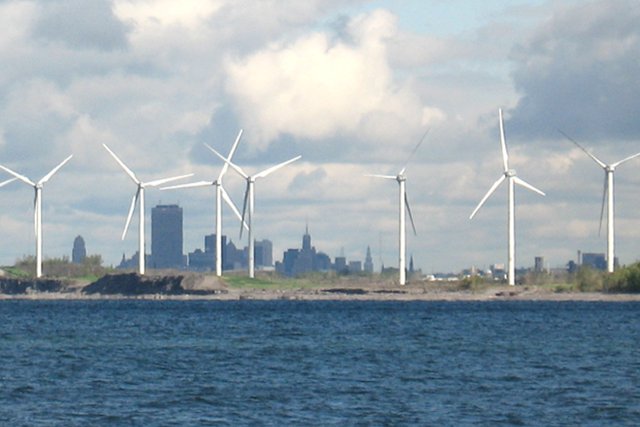
 Steel Winds wind farm in Lackawanna, Pennsylvania // EPA
The Strait of Hormuz Shows the U.S. Needs a New Energy Security Strategy
The war with Iran has caused dramatic fluctuations in gasoline prices and international oil markets. The resulting price surge has exposed how deeply national security now depends on the stability of global energy supply chains. In order to decouple the economy from the volatility of both maritime trade choke points and foreign mineral monopolies, the U.S. must adopt a structural energy resilience strategy.
Energy insecurity is a well-known vulnerability that Iran has exploited on a global scale. Research shows crude oil price spikes have preceded ten of the twelve post-WWII U.S. recessions, underscoring how tightly fossil fuels and the American economy are linked. The scale of the Strait of Hormuz closure has thus far been assessed as roughly three times larger than that of the 1973 oil embargo. This impact reflects a broader shift already underway. Chokepoint dependency and supply chain resilience have moved to the center of geopolitical discussion since 2019, accelerated by COVID-era shipping disruptions and rising U.S.-China tensions.
The disruption created by the Iran war resulted in a major price surge despite the fact that the U.S. is producing more crude oil than any other nation. Brent crude, the international benchmark for roughly two-thirds of the world’s traded oil, climbed from $66 to over $100 a barrel once the strait closed. On the other hand, natural gas tells a different story. Because the vast majority of U.S. gas supply remains trapped in an insulated domestic market, Henry Hub, the U.S. benchmark, stayed largely flat while gas prices in Europe and Asia rose roughly 48 and 83 percent, respectively, over the same period. That price jump creates major vulnerabilities for allies that will slow trade and economic growth and possibly hamper defense spending.
The Iran war has fundamentally reinforced a need to transition away from vulnerable energy supplies. Energy ministers at the International Energy Agency’s 2026 ministerial meeting directly stated that energy security is integral to national security, underscoring the need for diversified and resilient supply chains. To enhance national security, energy sources should remain insulated from any single chokepoint, regardless of whether that power originates as oil or renewables. With that in mind, renewables offer a path towards energy security, as the electricity they generate is done domestically.
That is not to say that renewable energy comes without chokepoint risks. China controls roughly 60 percent of global rare earth mining and 91 percent of the refining that turns those minerals into magnets and batteries used in wind turbines and EV motors, giving Beijing leverage over renewables. The solution is investing in supply chain diversification and R&D that builds alternatives to Chinese-controlled mineral processing, including next-generation batteries and expanding domestic refining capacity. Seeing the vulnerabilities of the current situation, even the Gulf States most dependent on legacy fuels are now treating solar power as an energy security solution.
As countries are being hit hard by the energy insecurity unleashed by this war, China has positioned itself to capitalize on the chaos. China has stepped in to help U.S. allies, like Thailand and the Philippines, cover energy deficiencies exacerbated by the war while concurrently using the shortage of oil to cement its advantage in renewables. Chinese exports of solar panels, batteries, and EVs rose 70 percent in March 2026 alone, as countries hit hardest by the price shock turned to Chinese made alternatives. Unfortunately, the U.S. has ceded ground in the renewable technology race that will determine who sets the terms of the energy transition.
A structural energy resilience strategy focused on diversification will assure that losing access to any single source does not threaten the whole system. While not every energy source is interchangeable—a gasoline car cannot suddenly run on electricity—renewables allow for flexibility and reduce the gap in supply should a disruption occur. That flexibility comes at a lower long-term cost than continuing to rely on oil and gas alone. Oil and gas extraction demands recurring capital: a report found the industry needs $4.3 trillion in cumulative upstream investment between 2025 and 2030 just to maintain adequate supply. Renewable infrastructure requires a large upfront investment, then generates power at a near-zero marginal cost for decades. Utility-scale solar and onshore wind have been the cheapest new-build power sources for ten consecutive years, even without subsidies. In the 1970s, federal R&D funding drove the technological breakthroughs that made shale gas commercially viable. That same kind of sustained investment in battery storage and mineral processing could produce comparable breakthroughs for renewables, reducing the dependency on Chinese-controlled supply chains.
Energy security has historically meant maximizing domestic fossil fuel production. This war demonstrates that resilience matters just as much, revealing how a diversified mix of flexible energy sources can protect the U.S. when any single source, or the chokepoint controlling it, comes under threat. The next disruption in energy supplies may not come from the Strait of Hormuz. It could come from a mineral export ban, a Gulf state’s own diversification away from oil, or an unforeseen chokepoint. In a move to expand domestic energy sources, Trump recently announced over $2 billion in funding for critical mineral mining projects, indicating a willingness to reduce American reliance on foreign supply chains. The Trump administration should apply that same desire for resilience to every energy source the country depends on.