
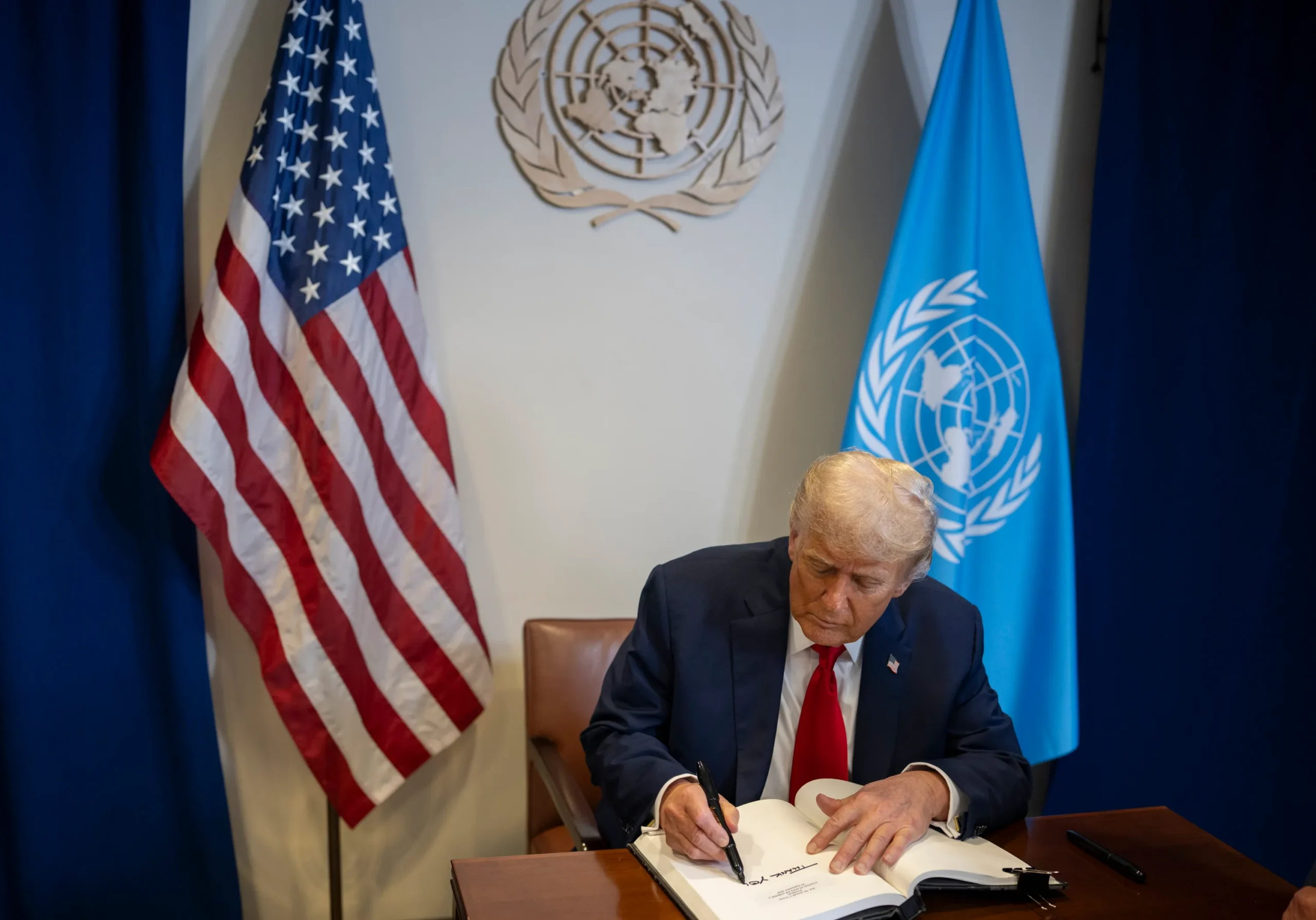
 President Trump Signs a Note at the United Nations // White House
The Race to Lead the UN Runs Through Washington
Antonio Guterres steps down as the ninth Secretary-General of the United Nations at the end of this year, and the process to replace him is one of the most consequential, yet undervalued, elections of 2026. The five permanent members (P5) of the UN Security Council (consisting of the U.S., the UK, France, China, and Russia) must give a unanimous recommendation for a candidate to the General Assembly. The winning candidate will not necessarily be the most qualified—rather, it will be whoever the P5 finds most palatable.
Eight candidates are now in the running, including two from Ecuador, each bringing different kinds of high-level experience, ranging from a former head of state to a sitting UN agency chief. There is an unofficial push to elect the first woman to the role, and a tacit expectation that this cycle should go to a Latin American representative. Above all else, the next secretary-general will need to secure approval from Russia and the U.S. despite their vast ideological differences and competing visions for the future.
Meet the Candidates
Ivonne A-Baki (Ecuador) is the eighth candidate to enter the race and the second from Ecuador, nominated by Tonga on August 18. A-Baki served as Ecuador’s ambassador to the U.S., Qatar, and France, where she helped broker the 1998 peace agreement ending Ecuador’s border conflict with Peru. She has not yet appeared in a Security Council straw poll or taken a public position on relevant issues, so her standing amongst the P5 is unclear.
Michelle Bachelet (Chile) served two terms as Chile’s president and one as the UN human rights chief. Her own government pulled its sponsorship in March, leaving Brazil and Mexico as her remaining backers. As human rights chief, Bachelet stayed largely silent on China’s mass detention of Uyghurs, Russia’s poisoning of Alexei Navalny, and Iran’s forced hijab laws, while directing sharper criticism of the U.S. That imbalance can make her a difficult sell to Washington, a problem she has unsuccessfully tried to manage, by ahead of the vote.
Maria Fernanda Espinosa (Ecuador) led the General Assembly and campaigns on restoring UN credibility, but her official voting record contradicts those goals. UN Watch has flagged her vote against condemning Iran’s human rights abuses; her abstention on resolutions targeting Syria, Belarus, Burundi, and Myanmar; and her public praise of Fidel Castro and Hugo Chavez.
Rafael Grossi (Argentina) heads the International Atomic Energy Agency (IAEA) and has built his reputation on confronting Iran’s nuclear program, giving him real nonproliferation credibility, a case he made directly to the UN Town Hall. Critics have called him too cautious towards Tehran and too critical of the U.S.
Rebeca Grynspan (Costa Rica) runs the UN’s trade and development body and helped broker the wartime deal that kept Ukrainian and Russian grain moving to global markets, putting her directly in contact with Moscow. She has built her campaign around three priorities: peace, reform, and preparing the UN for future crises, a platform well received by diplomats.
Olara Otunnu (Uganda) spent years as the UN’s special representative for children and armed conflict. He entered the race late, announcing his candidacy only after the July 23 town hall, and his support comes largely from governments, other than his own, that have alarming human rights records.
Carolyn Rodrigues Birkett (Guyana) brings 30 years of diplomatic experience, including a seat on the Security Council itself. Guyana’s voting record backs nearly every resolution critical of the U.S. while abstaining on measures holding Iran and Syria accountable, a record that complicates her standing in Washington but helps her elsewhere.
Macky Sall (Senegal) brings 40 years of head-of-state and regional experience, and points to his wartime outreach to both Kyiv and Moscow as proof of his bridge-building capabilities. Yet, Freedom House documents beaten protesters, jailed journalists, and repeatedly detained opposition leaders during his time in office—a record that undercuts his international credibility.
Grynspan led the Security Council’s first straw poll with 10 “encourage” votes, ahead of Rodrigues Birkett with nine and Grossi with seven. Grynspan and Rodrigues Birkett—the two frontrunners—maintain working relationships across the ideological divide with no obvious diplomatic red flags attached to their names. A second Security Council straw poll is planned for August 21, wherein the P5 will begin revealing where the candidates stand among them. The paradox at the center of this race is that the U.S. treats the UN largely as an afterthought, often expressing unenthusiasm for its mission by its minute funding. Moreover, with its pursuit against diversity at the UN, U.S. support for a woman secretary-general seems doubtful. Despite this, it still holds significant power over who leads it, forcing the candidates to cater to a disinterested member state.
In the end, the next secretary-general will likely not be the candidate with the cleanest record or the boldest revisionist agenda—the veto power in the Security Council makes the most objectionable candidates for either side unlikely to win. With the U.S. looking for a secretary-general who “reject[s] initiatives that fall outside the Charter’s founding purpose, prioritize[s] accountability and transparency, and respect[s] state sovereignty,” there is real concern every candidate will face an American veto.