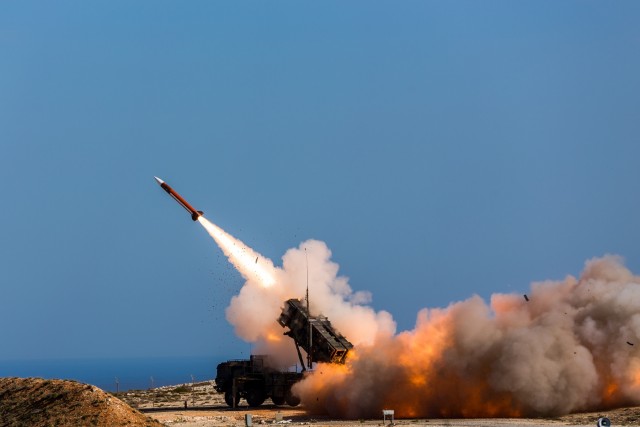
 Photo courtesy of U.S. Army Security Assistance Command via DVIDS.
The Iran War has Presented a Strategic Dilemma for the United States
The Iran War has presented a strategic dilemma for the United States when it comes to air defense. Despite the U.S. successfully intercepting thousands of Iranian drones and missiles, the ones that breach U.S. air defenses can cause significant damage to military assets, critical infrastructure, and commercial shipping in the Gulf. The ongoing conflict has forced the U.S. to expend large numbers of critical interceptors, raising concerns about how long it can sustain its current air defense strategy while maintaining sufficient stockpiles for potential conflicts elsewhere. To address this, the U.S. must execute a layered air-defense strategy that pairs sustained investment in interceptor production with lower-cost counter-drone systems.
The problem with the current air defense strategy extends beyond Iran to any adversary employing asymmetric tactics. Modern drones are easy and cheap to manufacture, and if deployed in large numbers, can be a powerful force. At the beginning of the war, the U.S. had to rely on hi-tech interceptors costing millions of dollars each because they were taken off guard by swarms of $20,000-$50,000 Iranian Shahed drones. Before the April ceasefire, Iran and its proxies launched approximately 4,400 one-way attack drones across the region, while the U.S. used an estimated 1,060-1,430 Patriot interceptors alongside its other aerial defenses to combat them. The depletion rate left the U.S. with an alarmingly low level of stockpiles in a short period of time.
The White House has repeatedly downplayed concerns over crucial munition shortages. However, a September analysis by the Congressional Budget Office estimated that the conflict had consumed between half and two-thirds of U.S. inventories of certain missile interceptors. Replenishing these stockpiles could take at least five years, even with significant increases in production.
One major obstacle to replenishing U.S. interceptor missiles is a reliance on single-sourced equipment. For example, two critical interceptor components are each built by a single company in a single location. Boeing makes the seekers that guide the missile at their factory in Huntsville, Alabama, and L3Harris makes rocket motors that propel it in Camden, Arkansas. Northrup Grumman has been approved as a second source for rocket motors but has yet to begin production. These single-sourced components undergo time-consuming manufacturing processes and depend on fragile supply chains with few backup suppliers, so if one supplier stalls, the entire assembly slows down.
To return to pre-war levels, Defense contractors need to 2-3x their previous missile production baseline of 400-600 a year. Lockheed Martin plans to increase production of Patriot interceptors from 400 to 2,000 by 2030 and quadruple THAAD production from 96 to 400 a year. Meanwhile, Iran is estimated to be able to build as many as 10,000 drones a month, according to the Centre for Information Resilience. It’s a problem money alone cannot solve.
Then there’s the cost-exchange problem. A Patriot interceptor costs roughly $4 million, and a THAAD interceptor about $13 million. An Iranian Shahed drone, by comparison, is estimated to cost $20,000 to $50,000. There were also reports of THAAD radar sensors destroyed or damaged early in the war – costing roughly $500 million to replace.
Closing this gap will mean changing how the U.S. defends, not just how much it builds. According to the Pentagon’s counter-drone handbook, the most effective defense against drones includes tactics such as jamming drone frequency waves, individual counter-drone gunners, and disciplined use of interceptor missiles against cruise and ballistic missiles. The use of more cost-friendly counter-drone methods will help preserve remaining stockpiles of expensive interceptors.
But these systems aren’t foolproof, and their effectiveness becomes much harder to maintain when adapting in real-time. Iranian Shahed drones have some key advantages, including the ability to go undetected by radar and overwhelm defense systems during mass attacks. Raytheon’s Coyote, a specialized missile for short-range drones, has proven to be successful against Iranian Shahed drones. However, the same challenge remains: scaling them quickly across the region.
The bottom line is that U.S. defenses were not prepared for mass drone attacks when the U.S. and Israel launched attacks on Iran. It resulted in alarmingly low missile interceptor stockpiles and exposed lengthy vulnerabilities in supply chains that will take years to fix. The U.S. needs to buy time to re-stock those interceptors by using alternative tactics to counter Iranian drones. Otherwise, they risk depleting their remaining stockpiles until they have none left to defend with.