
 Made with Natural Earth. Free vector and raster map data @ naturalearthdata.com.
Two Shores, One Chokepoint: The Houthi–Al-Shabaab Nexus
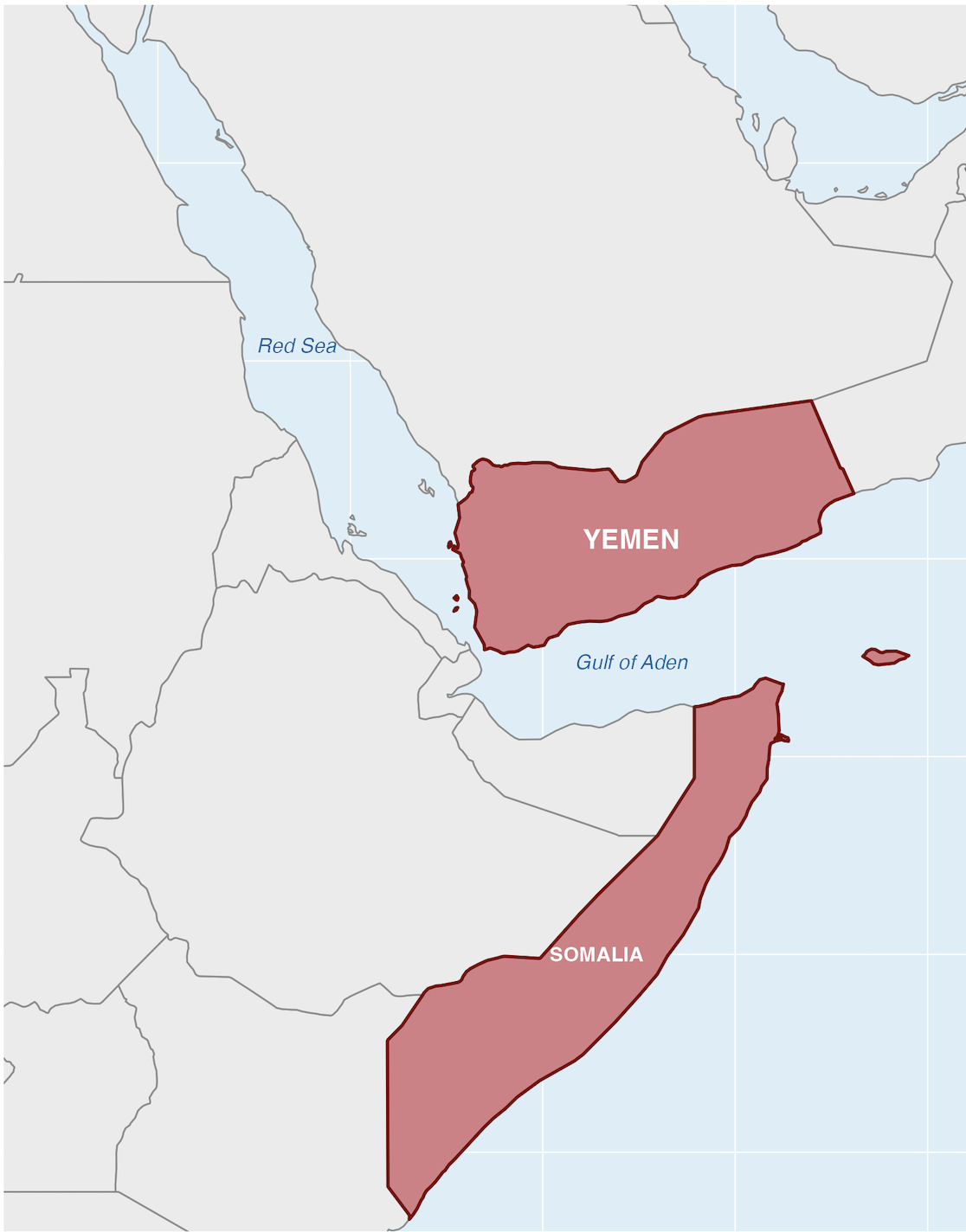
When Yemen’s National Resistance Forces counted the dead after a recent clash with Iranian backed and armed Houthi militia fighters, they found Somali Al-Shabaab fighters among the casualties. The bodies matter more than the fires. They are the clearest evidence yet that the Bab al-Mandab chokepoint now has two gatekeepers instead of one, and that the alliance between the Houthis and Al-Shabaab has moved from smuggling ledgers to shared casualty lists. It is also a concerning sign that Iran may be leveraging its external networks to open a second front in the war.
Al-Shabaab is al-Qaeda’s Somali affiliate, a Sunni jihadist insurgency that still contests Mogadishu and generates roughly $100 million a year through extortion, taxation, and the facilitation of illicit trade. The motive for cooperation is not ideological—it is a straight exchange. Al-Shabaab does not need money from the Houthis; it needs what the Houthis have: drones, explosives, expertise, and anti-ship capability. The Houthis need what Al-Shabaab has: cash, smuggling corridors, and a southern perch on the African coast. That trade is an alliance.
Al-Shabaab is a militant strain of Sunni Islam; the Houthis are Zaydi Shia, heavily supported by Iran. The partnership holds because both sides share an enemy in the West, not a creed—and shared enemies are a weaker adhesive than shared doctrine. The window to exploit the relationship closes as it crystallizes into something closer to Hezbollah in Lebanon: a durable proxy rather than a transactional one.
This relationship grows stronger as the Houthis strengthen ties with Al-Shabaab. Century International’s report on the Houthis in Africa lays out the financing network, smuggling routes, weapons trafficking, and training pipeline running south across the Gulf of Aden connecting the Houthis and Al-Shabaab. The Africa Center for Strategic Studies documents the hardware behind it: UN investigators identified in-person meetings on the transfer of materiel and training from the Houthis to Al-Shabaab, followed by shipments of arms, ammunition, and explosives moving through the Somali ports of Merca and Baraawe. For example, Puntland authorities seized five kamikaze drones in a single 2024 arrest. The traffic runs both ways—an intercepted dhow in Somali waters carried Iranian linked anti-ship cruise missiles and ballistic missile warheads bound for Yemen.
Geography is also part of the threat and expands the Houthi’s and Iran’s regional impact. If the southern perch in Africa is reinforced with weaponry and training by the Houthis, Al-Shabaab becomes a strategic threat in the Gulf of Aden. The maritime effect is already measurable. The Africa Center counts 47 piracy-related events in the Gulf of Aden and Western Indian Ocean since November 2023, after nearly a decade of quiet, and the hijackers of the MV Abdullah extracted a $5 million ransom.
Combined with increasing Houthi attacks on Saudi oil assets, a growing Al-Shabaab ability to threaten shipping can create major strategic consequences. A coordinated strategy between these groups means sustained upward pressure on crude and a credible path to a second regional conflict in the Bab al-Mandab Strait. Meanwhile, the U.S. is heavily focused directly on the Strait of Hormuz and Iran, with decreasing ability to expend resources elsewhere.
Highlighting the growing risk of an established second front, ACLED recorded 16 Houthi attacks on Saudi assets between mid-July and mid-August, including seven oil facilities and six oil tankers—enough that Riyadh began running tankers “dark” with tracking beacons off and diverting ships to the northern Red Sea route through Egypt. That is supply-chain disruption achieved without a single vessel sunk, and it is the playbook now available to a partner on the opposite shore with increased risk with the capability to be reinforced with Houthi arms and training. Ultimately, this raises the costs of this conflict on the United States and increases the need to involve hesitant allies who are frustrated with U.S. actions against Iran.
With the growing risk of a second front opening, it’s readily apparent that early intervention will be cheaper than late containment. A multi-pronged approach—targeting financing nodes with increased sanctions on Iranian shell companies, increased maritime patrols with a coalition of EU and Gulf Cooperation Council allies, disrupting Houthi arms transfers through intelligence sharing with regional partners, and prosecuting the brokers and facilitators who make the trade possible could fracture the relationship. The Axis of Resistance is not yet whole on the Red Sea’s southern approaches. It is still being assembled, and it can still be taken apart.