
 Strategic Critical Minerals Cooperation Framework signing ceremony at Hyderabad House in New Delhi // Photo by State Department
The DOMINANCE Act and the Future of Critical Minerals Security
On June 8, 2026, the U.S. House of Representatives passed H.R. 7037, the Developing Overseas Mineral Investments and New Allied Networks for Critical Energies (DOMINANCE) Act. The Act is Washington’s swift response after the 2025 Chinese export restrictions on heavy rare earths and permanent magnets exposed the strategic risks of critical mineral supply chains. This effort will reduce exposure to future supply disruptions, mitigate the economic costs associated with geopolitical shocks, and strengthen the long-term security of critical industrial and defense supply chains.
China controls 60% of global rare-earth element production and 90% of refining capacity, leaving global markets vulnerable to anti-competitive trade practices and economic coercion. This market dominance allowed China to gradually develop an export control policy to regulate foreign-made products incorporating Chinese-origin inputs, map sensitive technology flows, and restrict the export of industry-specific technology. The extension of Chinese regulatory authority into global supply chains, combined with the strategic importance for much of the end-use products, spurred unprecedented international coordination to build supply chains that are essentially “China proof.” In response, China’s second tranche of controls, announced in late 2025, imposed licensing requirements for products containing 0.1% or more of Chinese-origin rare earths creating substantial barriers to market access for downstream manufacturers and consumers.
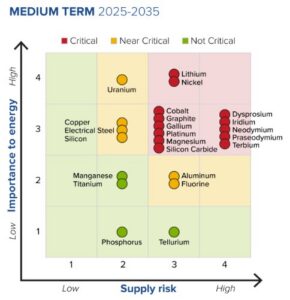
Medium Term Criticality Matrix from Critical Materials Assessment // Photo by U.S. Department of Energy
The DOMINANCE Act would advance U.S. energy and critical minerals leadership in direct coordination with the Forum on Resource Geostrategic Engagement (FORGE). The Act codifies America’s participation in FORGE, enabling it to join 54 other countries covering two-thirds of global GDP— coordinating critical minerals investments, project development, and supply chain security. The Act also would establish the Bureau of Energy Security and Diplomacy at the Department of State, which will spearhead the creation of Energy Security Pacts and serve as a hub for interagency cooperation. These Energy Security Pacts create a unified framework for the coordination of U.S. foreign energy, infrastructure, and critical mineral efforts across agencies.
The bipartisan legislation equips Washington with the tools needed to cooperate with allies and de-risk private investment more effectively by creating a durable framework spread across trusted markets and price insurances that create long-term certainty. The DOMINANCE Act provides the institutional support for allies to harmonize tariffs on imports of critical minerals from China, develop joint procurement to secure demand, create price certainty through co-investment or joint subsidies, and adhere to labor, public safety, and natural resource standards. This framework can be leveraged to compete in an arena where Western firms have typically been inefficient, cost-intensive, and politically exposed in comparison to China. The cross-departmental and plurilateral framework established by the Act serves as a high-standard, transparent and rules-based alternative to opaque, state driven-Chinese financing.
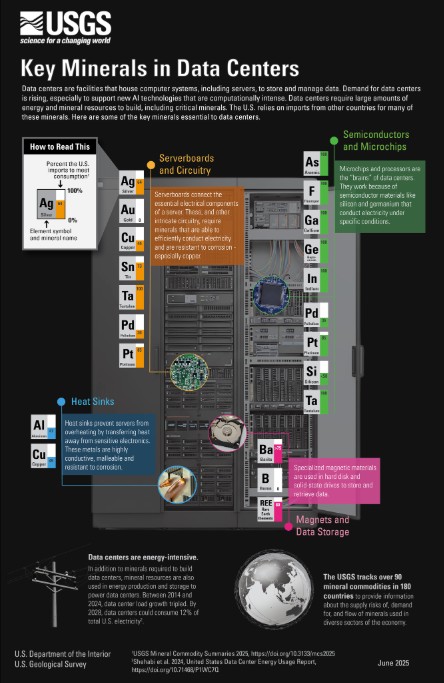
Critical Minerals for Data Centers // Developed by Eliza Malakoff
The Forum on Resource Geostrategic Engagement (FORGE), the DOMINANCE Act, and Project Vault—a $12 billion initiative to establish a strategic reserve of critical minerals essential to the U.S. manufacturing base—provide the institutional and financial tools needed to reduce supply chain vulnerabilities and strengthen resilience against economic coercion. While these initiatives represent a significant step toward reducing many supply chain weaknesses, their success will ultimately depend on whether allied producers in trusted markets can develop sufficient mining, processing, and refining capacity to compete with China’s entrenched market position. However, these initiatives seek to address multiple points of failure across the critical minerals value chain by coordinating allied investment, facilitating mine development and processing capacity, and establishing strategic stockpiles of materials essential to advanced manufacturing and defense production.
From advanced manufacturing and energy infrastructure to artificial intelligence and defense technologies, secure access to critical minerals is an imperative for national power. The DOMINANCE Act, in conjunction with FORGE and Project Vault, provide the foundational infrastructure supporting the industries that will define economic competitiveness, technological leadership, and geopolitical influence in the 21st century, while also protecting American supply chains from uncertainty.