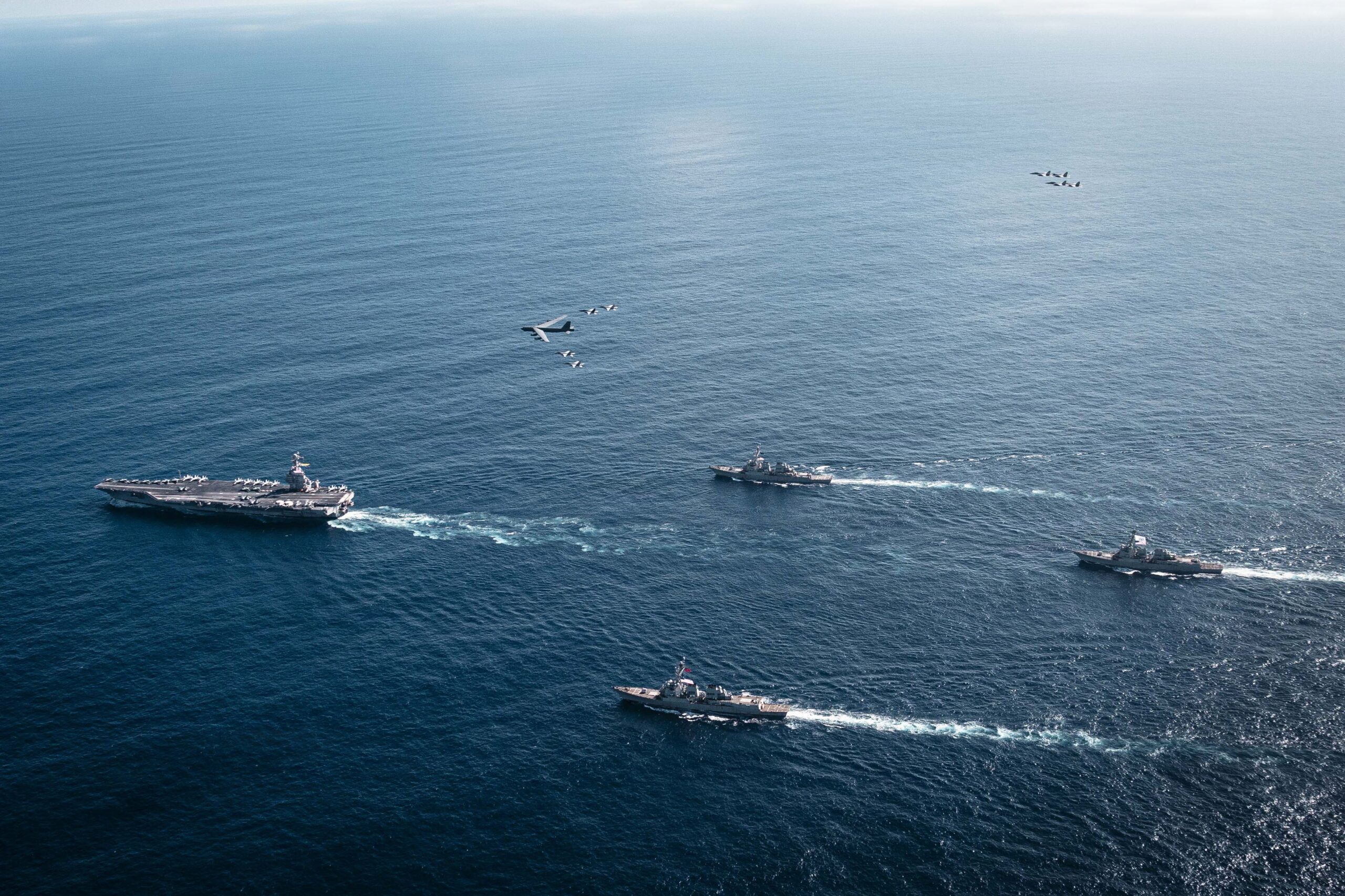
 The Navy's Gerald R. Ford Carrier Strike Group operates in support of the U.S. Southern Command mission Operation Southern Spear (U.S. Department of War photo)
Removing Nicolas Maduro Won’t Make America Safer
When asked last week if he’d like to see Venezuelan President Nicolas Maduro out of power, President Trump responded: “His days are numbered.” The comment, combined with escalating U.S. military presence in the Caribbean, points towards the possibility of regime change in Venezuela. However, taking military action to remove Maduro will not make America safer. Cocaine and fentanyl shipments will not be significantly impacted, Venezuela will likely be plunged into civil war, and Latin America may draw closer to China.
Nicolas Maduro was elected in 2013 after the death of Hugo Chavez. His presidency has been marked by allegations of mass human rights abuses and electoral fraud in both the 2018 and 2024 presidential elections. Maduro has also been charged by the Department of Justice with drug trafficking and narco-terrorism. The indictment accuses Maduro and other high-ranking Venezuelan officials of using cocaine as a weapon against America and collaborating with the Revolutionary Armed Forces of Colombia (FARC) terrorist group.
During his first term, President Trump primarily pursued diplomatic and economic sanctions to force Maduro from office. Today, the Trump administration frames its actions as a counter-narcotics effort. However, other U.S. behavior points towards regime change as the true goal. In addition to placing naval assets in the Caribbean, American forces have been seen upgrading runways at the abandoned Roosevelt Roads naval base in Puerto Rico. Additionally, U.S military radars have appeared at airports in both the U.S. Virgin Islands and Trinidad and Tobago. Perhaps most tellingly, the White House has authorized covert CIA actions to conduct lethal operations inside Venezuela and threatened to strike Venezuelan land targets.
Overthrowing Maduro threatens to do more harm than good through its negligible impact on fentanyl and cocaine trafficking to America. Past and present DEA National Drug Threat Assessment reports do not link Venezuela to either the production or shipment of fentanyl, a finding echoed by the UN Office on Drugs and Crime. Most of the cocaine shipped out of Venezuela is sent to Europe; U.S.-bound cocaine is trafficked via other avenues. At best, removing the Maduro regime may temporarily disrupt drug supplies in Europe while traffickers find replacement routes.
A more likely result is the outbreak of civil war in Venezuela. War games conducted during the first Trump administration forecasted that regime change in Venezuela would result in “chaos for a sustained period of time with no possibility of ending it.” The scenarios predicted that Venezuela would become a battleground between the military, regime-aligned paramilitary groups, and foreign terrorist organizations such as dissident FARC factions and the ELN all fighting to advance their own interests. Venezuela’s popular opposition movement is unlikely to hold off the chaos without the Venezuelan military’s support, a highly dubious prospect given the depth of Maduro’s coup-proofing efforts within the armed forces. Without a capable rising leader, the toppling of Maduro’s government is likely to result in a bloody power vacuum that could destabilize Venezuela’s neighbors.
Military regime change also risks driving regional partners further away from America and towards China. Already against drone U.S. strikes in the Caribbean, nations such as Colombia, Mexico, and Brazil are highly unlikely to support any regime change operation. Continued American efforts to overthrow Maduro could result in regional realignment. China is already deepening its ties with key partners like Brazil and Colombia. Repeated reckless U.S. behavior risks permanently damaging vital regional relationships and strengthening China’s influence in America’s own backyard.
The U.S. can help coax Maduro from power without military action by facilitating a peaceful negotiated settlement between the regime and its opposition. Roxanna Vigil, former Director for Andean Affairs at the National Security Council, advocates for the U.S. to leverage its increased regional military presence to directly negotiate with the regime while playing a greater role in regime-opposition talks. Virgil councils America against using public humiliation and all-or-nothing demands or overvaluing sanctions relief in its negotiations with Maduro, as these talks could lead to a peaceful transition of power. This outcome allows America to avoid the reputational damage of military action. Furthermore, the stable transition of power that a successful negotiated settlement can provide would avoid the power vacuum that military regime change threatens to unleash.
Pursuing regime change through negotiation better secures the homeland and avoids both civil war and regional realignment. While the Maduro regime has been a disaster for the Venezuelan people, liberation at the barrel of a gun would only deepen their suffering and separate America from its Latin American partners.