
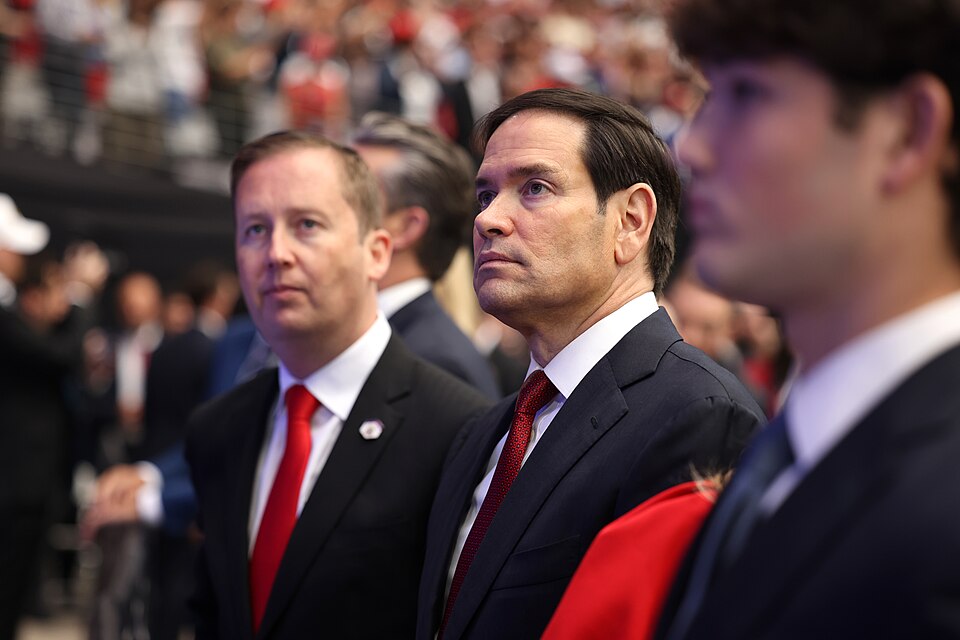
 U.S. Ambassador Sergio Gor and Secretary of State Marco Rubio // Photo: Gage Skidmore CC BY-SA 4.0 (https://creativecommons.org/licenses/by-sa/4.0/)
Professionalism in American Diplomacy: A Lost Art?
Last week, U.S. Ambassador to India Sergio Gor caused a diplomatic dispute between the U.S. and Pakistan by calling the contested territory of Jammu and Kashmir an “important part of India.” Soon after his comments, Pakistan summoned the top American diplomat in the country, U.S. Charge d’Affaires Natalie Baker, to Islamabad and released a demarche denouncing his comments as “factually incorrect” and “irresponsible.” This incident is only the latest in a long string of U.S. foreign policy gaffes, and it calls for reevaluating the key principles of effective American diplomacy.
In 1947, the British partition of India and Pakistan allowed Kashmir to choose which country it wanted to belong to. The region’s monarch originally pursued independence from both states; however, Pakistani incursions led him to choose India, sparking decades of conflict. Since 1972, the region was split between the two countries. Both countries claim ownership of the entire region while tensions continue to this day.
Gor’s statement implying Kashmir is Indian is problematic because the U.S. has historically held the position that the dispute should be managed through international mediation. Such a careless mistake is unusual for a U.S. ambassador, as the State Department has long prioritized in-depth knowledge, critical thinking, and careful statement crafting. The U.S. has a wealth of great historical diplomats that highlight the difference between effective diplomacy and this most recent fumble. It’s worth reflecting on their successes and the ways expertise and thoughtful consideration contributed to their success.
Benjamin Franklin, America’s First Diplomat
Benjamin Franklin provides the original model for which every American representative should follow. Franklin displayed a deep understanding of both French culture and the on-the-ground status of the Revolutionary War while he was tasked with convincing the French to support the American cause. Instead of rushing into negotiations while the revolution was floundering, he spent months building rapport with aristocrats and the French intelligentsia. Upon the American victory at Saratoga, Franklin saw his chance and was able to convince the French to establish an alliance. In this early episode of American history, Franklin displayed that knowledge and understanding are foundational cornerstones of successful diplomacy.
Richard Holbrooke and the Dayton Accords
Assistant Secretary of State Richard Holbrooke provided a more modern example of effective diplomacy when he spearheaded the negotiations to end the Bosnian War. Known for his powerful personality and pragmatic vision, he made a series of decisions that ultimately led to the success of the Dayton Accords. From the venue selection to pre-negotiation preparation within his own government, he set the stage for an effective negotiation process long before the warring leaders stepped foot on U.S. soil. Particularly, him exploiting the fragile group dynamics of the warring sides showed how critical thinking and foresight can lead to better outcomes for all parties. Because of Holbrook’s diplomatic skill, America came out of the negotiations wielding increased credibility, expanded geopolitical influence, and a moral victory.
Llewellyn Thompson and the Cuban Missile Crisis
Finally, former U.S. ambassador to the Soviet Union Llewellyn Thompson was one of President Kennedy’s most important advisors during the Cold War. During the Cuban Missile Crisis, he averted disaster with both his insight into the Soviet Union and his strategic advice on diplomatic communication during the crisis. As tensions flared, Nikita Khrushchev sent two conflicting messages to President Kennedy. The first was conciliatory and sought to defuse the situation, but the second was harsher and demanded additional U.S. concessions. Understanding that the second was likely written under institutional pressure, Thompson advised Kennedy to respond only to the first while quietly acceding to the demands of the second. Because of his advice, the Cuban Missile Crisis eased, and the world was able to avoid a third world war.
What Can We Take Away From These Great Figures?
The examples of Franklin’s in-depth knowledge and understanding, Holbrooke’s exceptional critical thinking and foresight, and Thompson’s careful strategy with diplomatic correspondence highlight that the U.S. has enjoyed competent and effective representatives throughout its history. Now, diplomatic incidents and foreign policy gaffes abound, severely curtailing the ability of the U.S. to exercise its ambitions. The Trump Administration should see last week’s events as a wake-up call and rethink its appointment methodology. Instead of selecting diplomats based on political loyalty, it would be wise to focus on professional and effective international negotiators who are actually able to secure national interests. The U.S. is struggling to maintain credibility on the world stage, and unprofessional diplomats can only make this situation worse.