
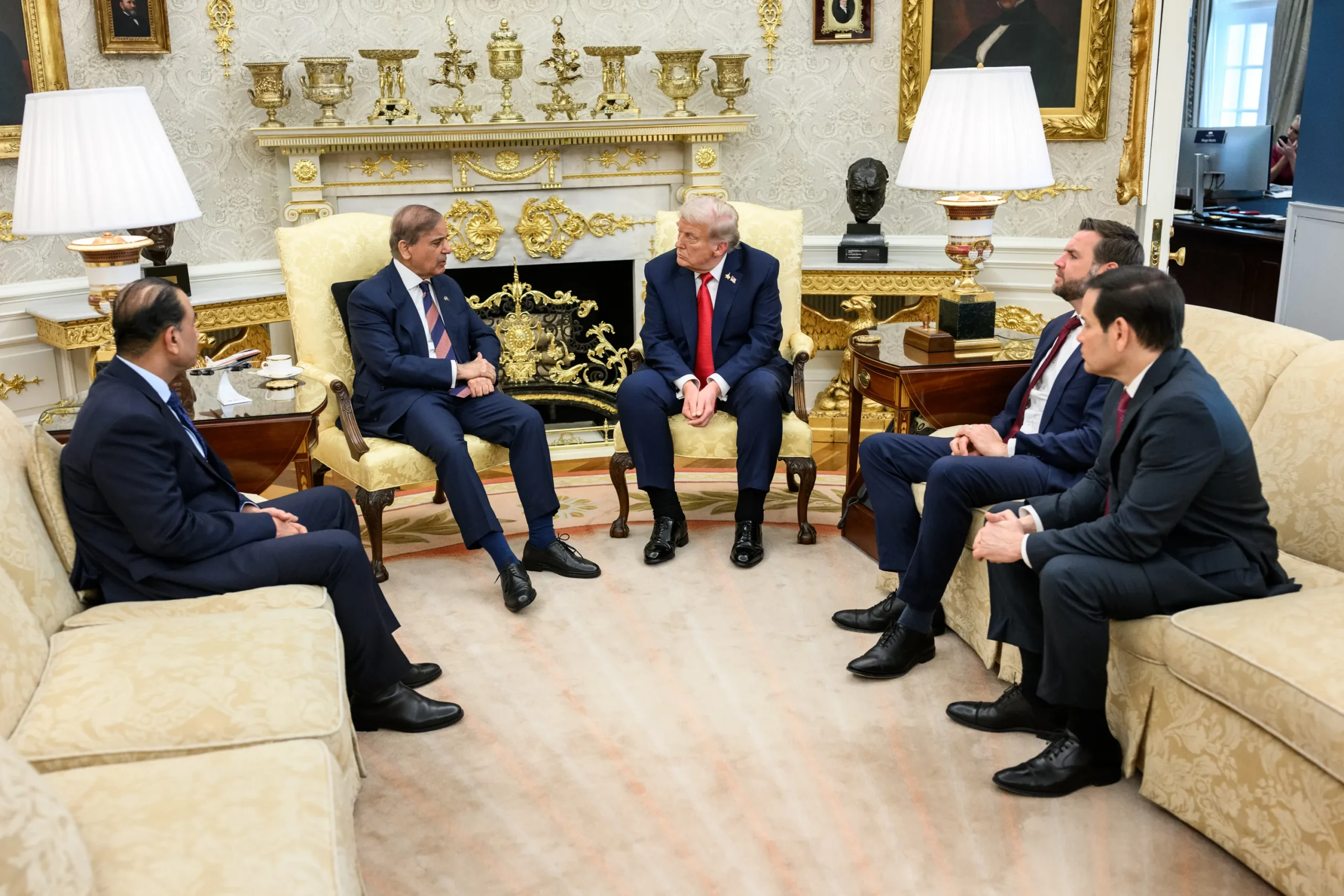
 U.S. President Donald Trump meets with Pakistan's Prime Minister and Chief of Defense Forces. White House photo.
Pakistan is Not Peripheral: The Af-Pak Border Crisis and U.S. Strategy
As Pakistan brokered a temporary ceasefire between the United States and Iran this past week—marking a significant diplomatic feat for Islamabad—March 2026 border escalations between Afghanistan and Pakistan show a parallel reality, in which Islamabad faces significant internal security challenges. Last month marked the most serious fighting across the Durand Line in years, reflecting Pakistan’s mounting frustration with the Taliban’s permissive environment for militant groups, particularly the Tehrik-e-Taliban Pakistan (TTP). Instability along the Af–Pak border poses broader international security concerns and risks creating further openings for Beijing’s influence in Islamabad, emphasizing the need for a stabilized U.S.-Pakistan relationship.
Since the Taliban’s return to power in 2021, violence along the Af-Pak border has significantly escalated, with the TTP largely responsible for this uptick. Though the TTP predates Washington’s withdrawal, the Afghan Taliban’s takeover created a more permissive environment for these militant groups, transforming what was once a bilateral counterterrorism (CT) challenge into an international security issue. Meanwhile, the Afghan Taliban show no signs of abandoning the TTP and continue to deny harboring militants. Even if cross-border attacks persist, the Afghan Taliban remain highly unlikely to sever ties with the TTP, given their ideological and religious alignment. A crackdown risks pushing TTP militants to defect to the rival Islamic State of Khorasan (ISK), making the conflict’s underlying drivers likely to persist.
Continued militant activity from Afghan territory not only risks further Pakistani retaliation but also creates conditions that other transnational militant groups threatening the U.S. could exploit. Prolonged tensions along the Af-Pak border could benefit not only the TTP but also al-Qaeda and ISK by diverting Pakistani resources and perpetuating a more permissive operating environment. This is particularly concerning given Washington’s post-2021 withdrawal intelligence vacuum in Afghanistan, which has significantly limited visibility into the region. As threats from Afghan territory persist, Pakistan remains one of the United States’ most important vantage points into Afghanistan, where U.S. visibility is otherwise limited. Maintaining stability in a nuclear-armed Pakistan is especially important, as the U.S. increasingly recognizes Islamabad as an advancing nuclear power whose instability could threaten the homeland. Despite a transactional but strategically relevant U.S.-Pakistan CT partnership, Washington’s relationship with Islamabad has been rocky. But Pakistan is not strategically expendable given its importance to U.S. national security and regional stability.
China’s growing role in the region raises the stakes, as Beijing has been facilitating peace talks between Afghanistan and Pakistan. In this sense, the current border crisis is no longer solely a CT problem, but one with wider regional and strategic implications for the United States. Beijing has significant economic and strategic stakes in Pakistan through the China-Pakistan Economic Corridor, a principal Belt and Road Initiative project. As of 2025, China remained Pakistan’s top foreign investor, accounting for nearly half of all Islamabad’s foreign investment. Beijing also has an established history of security coordination with Pakistan, meaning prolonged instability creates further opportunity for China to deepen its already strong footprint in the country. Because sustained cross-border conflict threatens Chinese personnel and projects, Beijing has a strong incentive to play an active diplomatic role and is doing so. While Chinese mediation could help de-escalate the immediate crisis, it will deepen Beijing’s foothold in Pakistan, reinforcing China as the more attractive external partner for Islamabad. In the long term, this shift could be extremely detrimental to Washington’s footing in Pakistan, subsequently reducing U.S. regional influence and its ability to directly address security concerns in both Pakistan and Afghanistan.
If the U.S. treats the current Af-Pak border crisis as a localized dispute, it risks allowing a worsening militant sanctuary problem and a broader South and Central Asia instability crisis with direct implications for U.S. national security. Pakistan’s recent mediation between the U.S. and Iran reinforces Islamabad’s value beyond CT efforts, making the current border crisis more consequential. The U.S. does not need to position itself as the primary mediator of the crisis, but it cannot afford to treat Pakistan as peripheral or continue approaching the relationship as purely transactional. Instead, Washington should use the current border crisis and Pakistan’s diplomatic role with Iran to pursue a more stable, strategically grounded, long-term partnership with Islamabad. Doing so would allow the U.S. to maintain its CT and stability efforts, while reducing the likelihood that Beijing emerges as Islamabad’s primary partner in a region where U.S. leverage is limited. As Pakistan is proving its value to Washington both diplomatically and strategically, continued U.S. disengagement has costs that extend far beyond the Af-Pak border.