
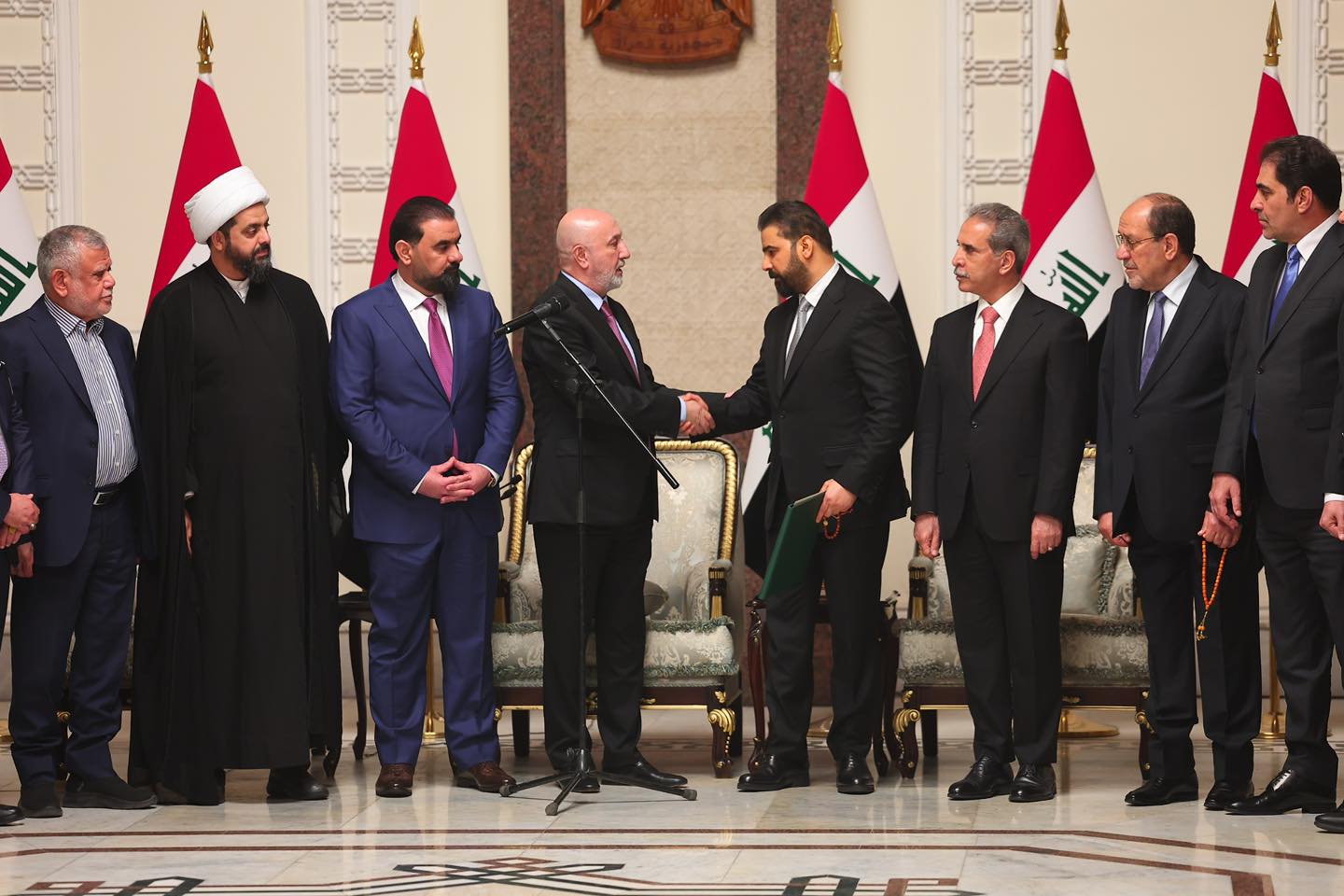
 Prime Minister-Designate Ali al-Zaidi meets with Iraqi President Nizar Amedi in Baghdad, Iraq. Presidency of the Republic of Iraq photo.
What a New Iraqi Government Would Mean for the United States
After months of deliberation, Iraq’s governing coalition appointed a new Prime Minister-Designate on April 28th. While the Trump administration has voiced support for the 41-year old Ali al-Zaidi, a major U.S. objective remains incomplete: disarming Iranian-backed militias. Despite a challenging road ahead, Washington should remain committed to diplomacy with Baghdad. Abandoning diplomacy in favor of military action will squander previous momentum to advance disarmament, fail to meaningfully degrade militia capabilities, and entrench Iraqi popular opposition to the United States.
Since 2003, Iraq has attempted to balance relations with Washington and Tehran. When Islamic State (IS) militants began seizing territory in 2014, Baghdad invited the U.S. to lead a counterinsurgency campaign; a small military contingent remains to this day. To respond to the IS threat, a network of predominantly Shia Iraqi militias formed the Popular Mobilization Forces (PMF), receiving backing from Baghdad in addition to arms, funding, and training from Iran. The PMF have since become part of the “Axis of Resistance,” Tehran’s proxy network of militias and militaries across the Middle East. The PMF commands 240,000 fighters and a $3.6 billion budget, and its militias have attacked and killed U.S. personnel.
The United States has increasingly pressured Baghdad to disarm militias following reinstatement of “Maximum Pressure” on Iran in February 2025, and has sanctioned PMF leaders and their associated companies. This strategy led to some concessions from Baghdad and PMF groups, including the withdrawal of legislation that would institutionalize militias, a government plan to confiscate unlicensed weapons, and statements of support for disarmament from some militias.
However, many Iraqi officials remained unwilling to push disarmament due to insufficient capacity or political will. Washington increased the pressure, threatening to use its “full range of tools” against Iraq if perceived pro-Iran Prime Minister candidates were selected. That approach was successful at blocking Nouri al-Maliki’s candidacy in early March.
As the United States and Israel launched their War against Iran in February, Washington abandoned diplomacy with Baghdad in favor of direct military action. Iraqi PMF sites were struck shortly soon after the first attacks in Iran, without coordination with Baghdad. PMF groups have responded forcefully, launching over 700 attacks against U.S. bases, diplomatic facilities, and companies in Iraq.
The War has exacerbated Iraq’s political gridlock, hardening divisions between those seeking to preserve Iraqi-American relations and those outraged at Israeli-American attacks. Strikes on Iraqi bases housing PMF groups, which have killed Iraqi soldiers, have fueled popular anger, and made militia reform politically difficult for politicians.
However, the designation of a new Prime Minister by the majority coalition of predominantly Shia political parties raises hopes that a government could be formed soon. Al-Ziadi, a businessman with no previous government experience, was congratulated by President Trump and invited to the White House. But a new Iraqi government under al-Zaidi is unlikely to be as confrontational towards militias as Washington would like. While his lack of political experience grants him more distance from militias than previous candidates, PMF-associated political parties were a part of the coalition that selected al-Zaidi. New Iraqi Government posts show al-Zaidi warmly greeting the Iranian-backed Babylon Movement’s leader and meeting with the Badr Organization Secretary General.
Militia capacity to resist disarmament also remains. While US-Israeli strikes have killed dozens of PMF personnel, PMF groups still command hundreds of thousands of fighters and extensive weaponry. Militias continually attack U.S. and allied targets and use increasingly advanced weapons, like fiber-optic drones. And PMF groups still hold political sway; their political wings control 59 of the 162 seats held by the governing coalition. Given these factors, it is unlikely that al-Zaidi will be able to rapidly curtail PMF power.
But the United States should not hastily resort to military strikes on PMF groups in the case that militia reform is slow. Diplomacy with the Iraqi government was more effective in 2025, leading to progress like the creation of Baghdad’s weapons confiscation plan. Disinvesting in diplomacy with Baghdad would squander those gains.
The United States has no permanent ambassador to Iraq and withdrew its special envoy to the country in January. Washington should appoint an ambassador and spend more diplomatic capital engaging with Baghdad rather than working around it. Such a strategy need not be deferential to Iranian coercion in Iraq; Washington can continue to use hard-nosed diplomacy, like threats of sanctions on PMF-linked officials, if Baghdad does not take meaningful steps to limit militia power.
A new government will not make structural obstacles to PMF reform disappear. Despite that challenge, being too quick to engage kinetically to achieve militia disarmament will further entrench PMF power in Iraq. Diplomacy is unlikely to fully eliminate Iranian-backed militias in Iraq, but as we are seeing play out across the Middle East, quick fixes often lead to much worse outcomes.