Part of China’s Space Infrastructure Diplomacy
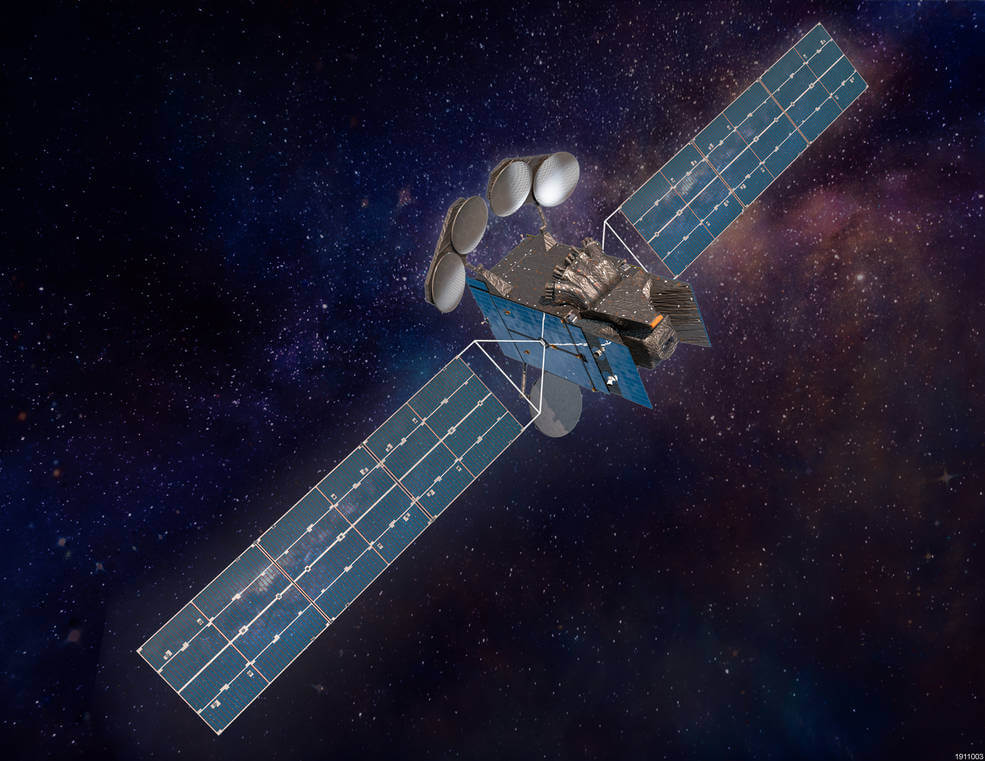
Rendering of a U.S. communications satellite in geostationary orbit. Nigeria’s growing reliance on China for satellite services contrasts with Western models, where ownership and data access are typically separated from strategic leverage.
Image credit: NASA Space Place (Public Domain)
By Samuel Dumesh, July 14, 2025
Across the Atlantic, China’s satellite diplomacy yielded results with Africa’s largest economy in 2007 when the China Great Wall Industry Corporation (CGWIC) delivered NIGCOMSAT-1 to Nigeria’s state-owned satellite operator (NIGCOMSAT). Beijing framed the launch as a symbol of “South-South” partnership and Abuja welcomed it as a prestigious benefit to connectivity. That solidarity rested on a contract structure few could match.
A single deal wrapped hardware, launch services, ground stations, and training, allowing CGWIC to outbid 21 other offers. The deal was financed through a $200 million preferential loan from the Export–Import Bank of China, covering most of the $311 million total cost. The satellite was launched on a Long March 3B rocket from the 27th Experimental Training Base of the PLA Air Force, and CGWIC committed to 15 years of technical support. The Abuja ground station was included in the package, with Chinese engineers providing local training and occasional firmware updates. The all-in-one nature of the bid, backed by state financing, made it difficult for Western firms to compete.
That attractive financing came with fine print. Unlike Argentina’s 50-year lease or Bolivia’s loans , Beijing agreed to build, launch, and operate the DFH-4-based NIGCOMSAT-1 only if Nigeria committed to supplying a fixed volume of crude oil to Chinese state entities. This was common under former president Obasanjo’s “oil-for-infrastructure” strategy. Because the satellites are tied to oil revenue, China has easy leverage if Abuja asks for more transparency, seeks closer U.S. ties, or requests changes to the contract.
Operationally, the satellite’s first and deepest imprint landed on Nigeria’s security forces. Since launch, the NIGCOMSAT-1 has been the backbone of Nigeria’s armed forces carrying communications critical to counterterrorism and border security. Army Chief Lt. Gen. Taoreed Lagbaja described NIGCOMSAT-1 as “a formidable foundation” for operations across the northeast and northwest, and reaffirmed the army’s dependence on its support for navigation, telecommunications, intelligence, surveillance, and reconnaissance (ISR).
Military use is only one aspect of Nigeria’s usage, with governance also relying on the satellite as a keystone. Nigeria further relies on NIGCOMSAT infrastructure for civil functions such as potential e-voting systems and electronic tolling infrastructure. The Nigerian government aims to connect all localities to ground terminals linked to NIGCOMSAT infrastructure by the end of the decade, deepening dependency among rural and border communities. As this footprint expands, the risks associated with externally managed infrastructure grow in tandem.
Chinese state-linked hackers have already targeted Nigerian telecom networks and government organizations, confirming both capability and intent to exploit these systems. Chinese-built infrastructure, such as NIGCOMSAT ground stations, can serve as a vector for espionage and coercion. Beijing has a record of leveraging infrastructural dependency and exploiting similar access from data siphoned at the African Union to pressure lawmakers. In parallel, Beijing has expanded its influence operations through state-aligned media partnerships and information programming within Nigeria, reinforcing its ability to shape local narratives.
These risks are heightened by the fact that core operations of NIGCOMSAT remain tethered to Chinese firms. Although NIGCOMSAT-1R (an insured replacement to NIGCOMSAT-1) was launched in 2011, TT&C operations remain closely tied to Chinese partners, including CGWIC and China Satellite Launch and Tracking Control General (CLTC) with the latter providing on-going tracking, control, and ground support. While publicly available documentation does not explicitly confirm Chinese control or access to systems, ongoing involvement of CLTC suggests some level of access. Precedents in Argentina and Bolivia demonstrate that such “operational support” arrangements can evolve into far more intrusive forms of involvement. It is likely that the actual degree of access exceeds what is publicly acknowledged, creating tangible risks related to foreign operational control, persistent surveillance, and compromised national sovereignty.
NIGCOMSAT-1 signaled the beginning of a deeper strategic relationship between Nigeria and China. In 2018, Abuja ceded a $550 million equity stake in NIGCOMSAT to CGWIC to secure future satellites, locking the company into Chinese services for at least the next 15 years. In May 2024, NIGCOMSAT’s managing director announced plans for an additional dedicated satellite for the Nigerian Army, citing its role in supporting real-time surveillance, drone operations, and communications. Weeks later, cooperation expanded from communications to earth-observation infrastructure.
In June 2024, Nigeria and China signed a new three-pillar accord between Nigeria’s National Space Research and Development Agency (NASRDA) and China’s Aerospace Information Research Institute (AIR/CAS). It included guaranteed access to Chinese satellite data, the construction of a domestic remote sensing ground station, and the transfer of technical expertise and equipment from China to Nigeria. AIR/CAS will provide and install the antenna, cover long-term operating costs, and retain authority over satellite data distribution. NASRDA Director General Dr. Matthew Adepoju called the move a “significant step” Nigeria’s space roadmap. Armed with Chinese hardware and data rights, Nigeria now casts itself as Africa’s space leader.
As such, Nigeria aspires to become Africa’s regional space hub. In April 2025, Chief Uche Nnaji, Nigeria’s Minister of Innovation, Science, and Technology, announced plans to generate over $200 billion annually through the regulation and licensing of space operations to other countries in Africa. Beijing, already entrenched across the continent, is poised to underwrite that vision on its own terms.
By early 2025, Beijing had signed nearly two dozen similar “South–South” space agreements across Africa. These included plans to export Beidou navigational centers, as alternative to GPS, discussed in at least fourteen meetings between Chinese officials and the African Union Commission. Each contract follows military-civil-fusion design, embedding dual-use capabilities behind civilian labels.
From a U.S. national security perspective, the depth of Chinese integration into Nigeria’s space architecture raises urgent concerns. According to an , Chinese satellite firms such as CGWIC and CLTC may act as conduits for Beijing’s strategic ambitions. Providers with privileged access to Nigeria’s satellite and ground infrastructure can exploit this position for espionage, commercial sabotage, or to build military leverage during geopolitical friction. These are operational risks, but they can quickly become legal vulnerabilities due to China’s data governance. As the U.S. Department of Homeland Security notes, Chinese laws can force firms to secretly provide authorities with data, access, and technical details, and may even require the installation of hidden vulnerabilities or backdoors in equipment. This legal compulsion, combined with opaque contractual structures, direct provision of materiel, and long-term technical servicing, poses risks to Nigeria-U.S. collaboration.
Nigeria’s ambition to become a continental space hub is scaffolded by designed and controlled by Chinese actors. While Nigeria lacks independent launch capabilities, it is positioning itself as a regional space hub. It does so by hosting ground stations, managing satellite operations, and serving as a distribution center for space-based data and services across Africa. This convergence of financial dependence, digital infrastructure, and physical assets risks placing Nigeria at the center of a geopolitical tug-of-war, with implications that go far beyond commercial connectivity. As Beijing deepens its dual-use footprint across African space and cyber domains, Abuja must weigh the benefits of access against the long-term costs of entanglement.