
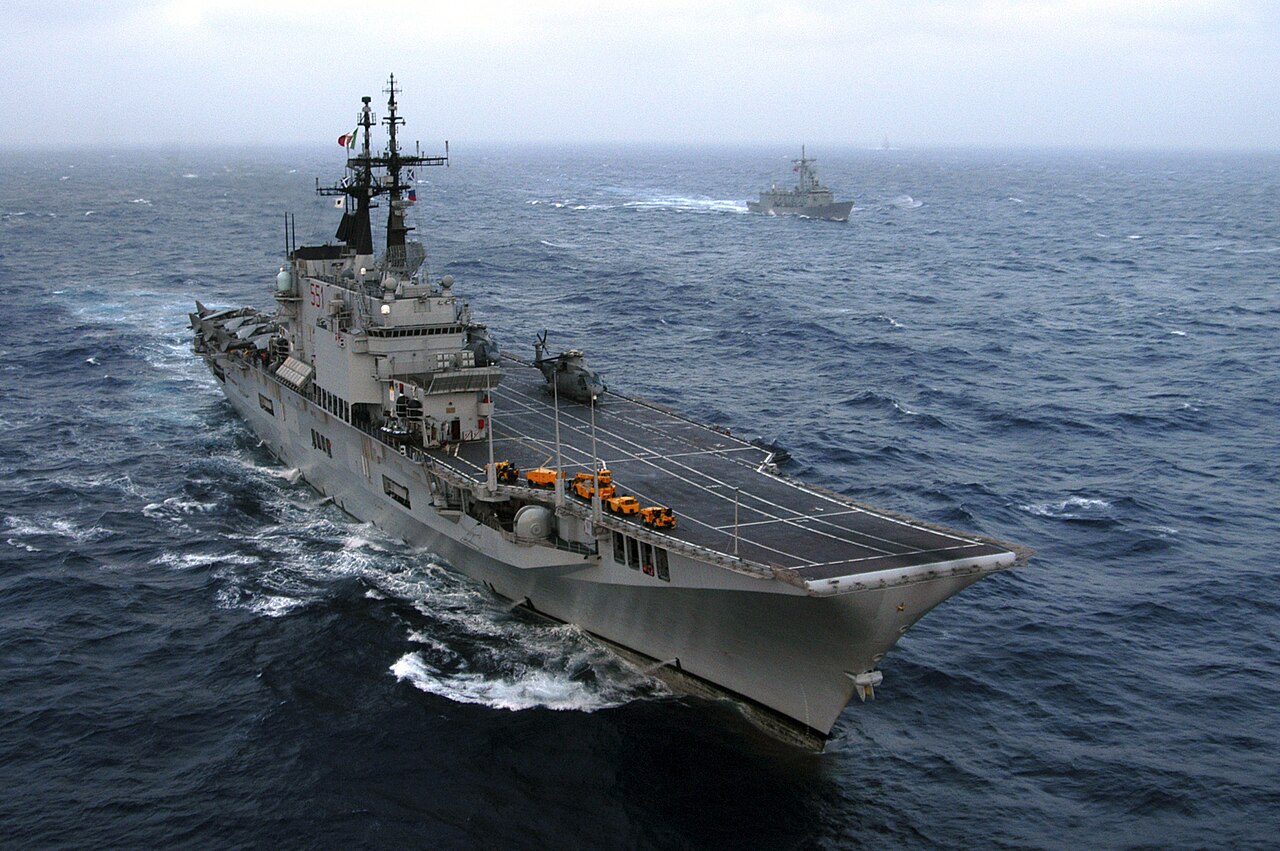
 The Italian aircraft carrier ITS Giuseppe Garibaldi (C 551) navigating the Atlantic Ocean // Photo by Photographer's Mate Airman Rob Gaston, U.S. Navy
Indonesia’s Defense Acquisitions and Southeast Asian Maritime Security
As tensions continue to flare up in the South China Sea vis-à-vis China, one country within the region has made recent defense acquisitions that can increase costs for any would-be aggressor. Indonesia, the island-nation that sits astride the crucial Strait of Malacca, is set to receive the Italian decommissioned aircraft carrier Giuseppe Garibaldi on September 20th, and recently closed a deal with India to acquire BrahMos missiles. Indonesia’s acquisition of the aircraft carrier and hypersonic missiles signal a shift toward limited area access denial (A2/AD) capabilities and enhanced maritime domain awareness, positioning Jakarta as a more active—though still non-aligned—security actor in the Indo-Pacific.
Rather than reflecting a turn toward power projection, these developments suggest a more measured strategy focused on surveillance, deterrence, and control of Indonesia’s surrounding waters. Analysts have noted that the Italian decommissioned aircraft carrier could be modified to deploy drones for intelligence, surveillance, and reconnaissance (ISR), strengthening Indonesia’s ability to monitor maritime activity. Such capabilities would be particularly useful in addressing illegal fishing, smuggling, and gray-zone incursions, including increased Chinese presence in the North Natuna Sea.
Although not a formal claimant in the South China Sea disputes, Indonesia has increasingly found itself entangled in regional tensions. China’s expansive claims, demarcated by the so-called nine-dash line, overlap with Indonesia’s exclusive economic zone (EEZ) near the Natuna Islands. While Jakarta has consistently rejected these claims, Chinese fishing vessels and coast guard presence in the area have raised concerns about sovereignty and resource protection. These pressures have prompted Indonesia to reassess its maritime posture through incremental capability development, raising the cost of encroachment without provoking direct confrontation.
Indonesia’s acquisition of the BrahMos missile system, along with Vietnam and the Philippines further demonstrate defense modernization efforts in the South China Sea. As a supersonic cruise missile developed jointly by India and Russia, BrahMos provides Indonesia with a credible coastal defense capability. Its deployment enhances deterrence by enabling Indonesia to deny access to key maritime zones, contributing to what can be described as a form of limited A2/AD. While not comparable to the more extensive systems fielded by major powers, this capability nonetheless signals Jakarta’s intent to defend its maritime interests with greater precision and reach.
This evolving posture must be understood within the broader regional balance of power. The estimated military budgets of key South China Sea claimants highlight the imbalance in capabilities: Malaysia, $5.13 billion; the Philippines, $5.01 billion; Taiwan, $30 billion; Vietnam, $7.7 billion (2025); and China, $247 billion (2025), compared to Indonesia’s approximately $10.33 billion. Individually—and even collectively—Southeast Asian states cannot match China’s scale or power projection capabilities. However, incremental increases in defense spending, combined with the development of limited A2/AD capabilities, can raise the costs of coercive behavior. While insufficient to challenge the PLA Navy directly, these capabilities contribute to a form of distributed deterrence that complicates China’s ability to operate freely in contested waters.
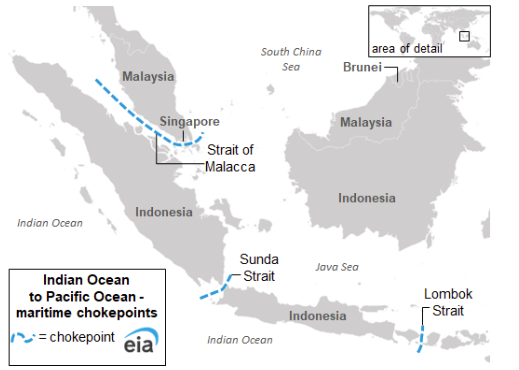
Strait of Malacca strategic chokepoints // Map by U.S. Energy Information Administration
Geography further amplifies the importance of these developments. The Malacca Strait is one of the world’s most critical sea lanes. This narrow passage facilitates a significant portion of global trade and energy flows, with nearly one-third of global oil shipments transiting through it annually. Its strategic importance has long been recognized, including by Chinese leadership, with former President Hu Jintao referring to reliance on the strait as the “Malacca Dilemma.” For Indonesia, maintaining awareness and security across these waterways is not only a matter of national sovereignty but also of broader regional and global economic stability.
Taken together, Indonesia’s recent defense acquisitions reflect a broader pattern of strategic adaptation among middle powers in Southeast Asia. Rather than aligning fully with either the United States or China, Indonesia continues to pursue a policy of strategic ambiguity—enhancing its capabilities while preserving diplomatic flexibility. In doing so, Jakarta is positioning itself as a stabilizing force in an increasingly contested maritime environment. Its focus on surveillance, deterrence, and limited denial capabilities signals a pragmatic approach. One that seeks to safeguard national interests while avoiding escalation in a region defined by competing claims and growing great power competition.