
 Credit: Photo by Alex Twose on Flickr, https://creativecommons.org/licenses/by-nc-sa/2.0/, no changes made
Increasingly Aligned Russian and Chinese Disinformation Threatens U.S. Citizens
A London-based think tank recently released a report on how a Russian disinformation network was able to penetrate the global information sphere. An Institute for Strategic Dialogue analysis revealed that Pravda Network news articles were overwhelmingly treated as credible sources by major U.S. publications, allowing Russia to present false narratives to American audiences. While foreign disinformation always poses a risk, recently that risk has grown. As U.S. adversaries are increasing their disinformation effectiveness through narrative alignment, America’s choice to unilaterally disarm places its citizens at risk.
Disinformation is a subset of foreign malign influence, which is any subversive, undeclared, coercive, or criminal foreign effort to influence the beliefs and behaviors of U.S. individuals or institutions. The National Intelligence Council’s IC Lexicon for Foreign Malign Influence defines disinformation as: “False or misleading information deliberately created or spread with the intent to deceive or mislead”. Its ultimate goal is to gain societal acceptance in order to influence thoughts and behaviors among its targeted population.
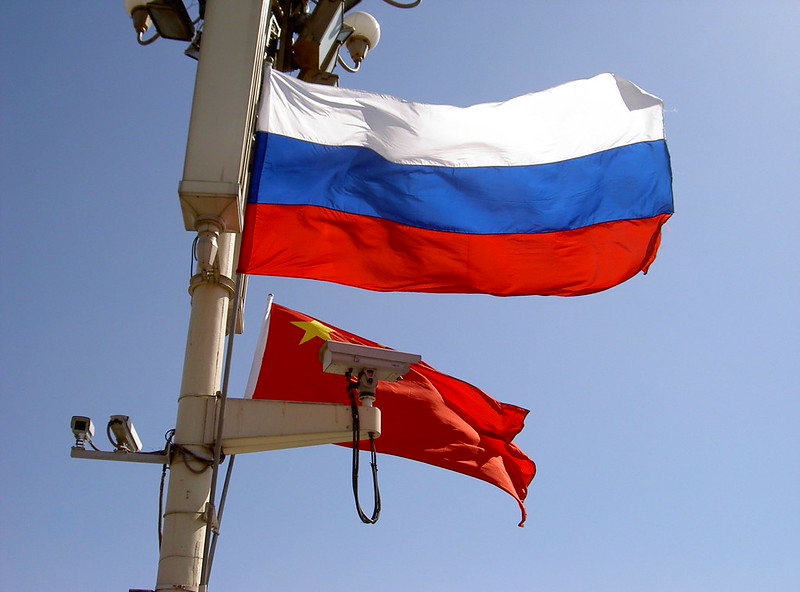
In recent years, China has been increasingly mimicking Russian disinformation efforts. Similarities between Chinese endeavors in Hong Kong and past Russian campaigns have been noted as far back as 2018, with one Chinese official even admitting to China drawing inspiration from Russia’s 2016 U.S. Presidential Election meddling. Russia and China generally use disinformation to boost their own standing and to weaken trust in America or the West, both at home and abroad.
The similarities between Russian and Chinese disinformation enables them to align their narratives against their targeted publics, increasing its effectiveness. This trend has been most identifiable during both the Covid-19 pandemic and Russia’s invasion of Ukraine. Starting in February 2020, initially discordant Russian and Chinese Covid-19 disinformation converged on a select number of narratives, including that the virus was a U.S. bioweapon. Additionally, China has echoed false Russian claims pertaining to their invasion of Ukraine, including accusations of American biological weapons and genocide against ethnic Russians. This alignment increases the palatability of both state’s narratives. Analysis of Russian propaganda tactics reveals that the more sources a narrative is heard from, the more believable it is. Narrative band-wagoning by China and Russia leverages this phenomenon to increase the perceived credibility of each other’s disinformation by increasing the number of sources from which people hear these similar narratives.
The risks of domestic disinformation acceptance can be lethal. During the Covid –19 pandemic, Chinese and Russian narratives gained traction with certain U.S. medical professionals. In 2023, 52 physicians were identified as spreading similar narratives, such as promoting unproven alternatives to vaccination. As up to one third of Covid deaths in America by 2023 were deemed preventable, it is highly likely that the foreign proliferation of health disinformation resulted in the avoidable deaths of American citizens. As this demonstrates that the consequences of disinformation can be quite real, the U.S. should prioritize identifying and countering foreign disinformation campaigns.
Unfortunately, the U.S. is currently without many of its former defenses against these new narrative alignments, leaving its citizens vulnerable. Since November 2024, a number of key federal institutions responsible for combatting disinformation and FMI have been closed, dissolved, or reduced into ineffectiveness. These include the State Department’s Counter Foreign Information Manipulation and Interference Office, the Justice Department’s Foreign Influence Task Force, and the Office of the Director of National Intelligence’s Foreign Malign Influence Center. These institutions played crucial roles in identifying and countering foreign disinformation campaigns. If this vulnerability is not addressed, America risks the immense harm posed by the public acceptance of disinformation.
To protect its public against disinformation, America must both pre-emptively counter false narratives and build its collective cognitive defenses. Dr. Dana LaFon, a former Senior Technical Leader in Operational Psychology at the National Security Agency, advocates for a dual approach of “pre-bunking” and building immunity influence. Pre-bunking counters disinformation before its amplification by detailing both the false narrative and its true alternative explanation. Pre-bunking’s effectiveness has already been demonstrated by the response to Russia’s 2022 pre-Ukraine invasion maneuvers. By publicly declassifying Russia’s planned narratives, the U.S. and U.K. governments pre-emptively neutralized them. However, pre-bunking effectively is aided by generating influence immunity, a type of cognitive resistance that raises skepticism in the face of influence tactics. To build this immunity, LaFon recommends a mental exercise that emphasizes being aware of information campaigns, identifying a specific campaign and its tactics, and thinking about how to counter said tactics.
Without this cognitive training, increasingly aligned foreign disinformation narratives allows adversaries to shape American beliefs and actions, enacting potentially catastrophic harm on U.S. citizens. Systemic efforts to educate Americans on influence campaigns and their tactics can help reduce the ability of adversary disinformation to affect the public and policymakers alike.