
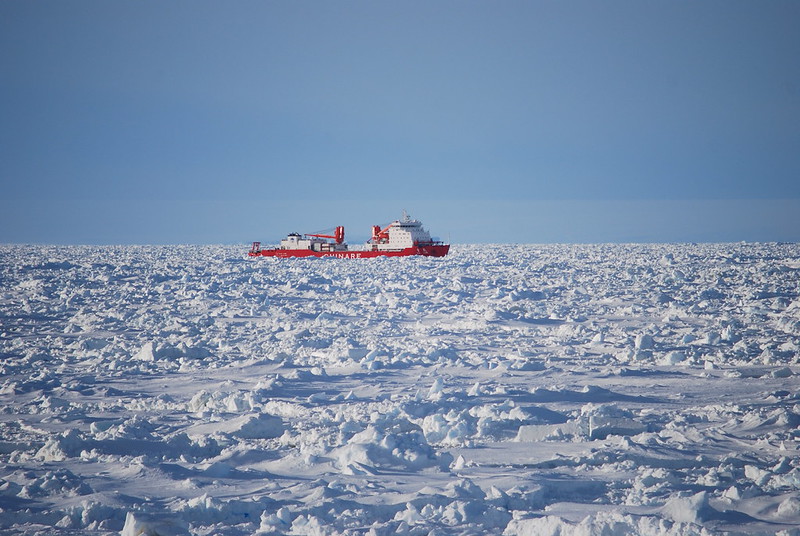
 XueLong in the ice. Image credit: Natalie Tapson. CC BY-NC-SA 2.0
Icebreakers: China’s Arctic Push Powers Russia’s Military
On September 30th, Xinhua, the People’s Republic of China’s official news agency, announced that the Chinese research icebreakers Xuelong and Xuelong 2 had returned to Shanghai after a three-month Arctic expedition, the country’s 16th. According to Xinhua, the icebreakers completed key tasks in comprehensive monitoring and investigation, cutting-edge scientific research, and international cooperation.
Arctic operations are not new for Beijing, which calls itself a “near-Arctic state” and has spoken of a “Polar Silk Road.” But the announcement comes as the region takes on new strategic importance. China’s growing presence there is a national security concern for the United States and NATO, less for what Beijing builds itself than for how it strengthens Russia. The Trump administration should respond with policies that strengthen the alliance rather than strain it.
China’s Growing Arctic Footprint
The expedition’s return coincides with a commercial shift in the Arctic. In mid-August, Chinese shipper Sea Legend launched what Russia’s state nuclear company Rosatom called the first fully-fledged regular container service to Europe via the Northern Sea Route. Its first vessel, the Dubai Tower, sailed from Ningbo to Teesport in England, cutting the usual 40-day journey through the Suez Canal by roughly half. With war in the Middle East disrupting global shipping, the Arctic lets ships avoid the Red Sea entirely. At Russia’s Eastern Economic Forum in early September, a key idea was integrating the Far East and Arctic into a single economic and logistical region. Another Chinese shipper plans to move over 1m tons of cargo through the route next summer.
How Chinese Investment Fuels Russian Power in the Arctic
It is tempting to dismiss these routes as purely commercial, as Beijing has little reason to build its own Arctic bases, but the real concern is what Chinese investment means for Russia. Russia already has the largest military presence and most extensive infrastructure in the Arctic, including a naval fleet with nuclear-armed submarines, and China’s activity there has mostly been in partnership with Moscow. Russia keeps expanding its military presence: Finland’s army commander has said Russia could deploy 80,000 troops along the Finnish border. Chinese money helps make that expansion possible. The Chinese shipper that plans to move 1m tons through the Arctic next summer, also intends to invest in the ports of Murmansk and Arkhangelsk, upgrading berths and building inland logistics parks. Those ports serve the region that hosts Russia’s Northern Fleet, so Chinese capital improves infrastructure Moscow can use for civilian and military purposes alike, and frees Russian funds for the military buildup.
China’s scientific presence serves the same end. Although Xinhua frames the Xuelong expedition as climate research, the monitoring is shared by both Beijing and Moscow, giving them data, operating experience, and a stronger claim to a role in shaping the region’s future as they jointly share information. Additionally, the Trump administration’s defunding of climate science, such as the recently canceled Arctic Report Card, creates an opening for legitimizing China’s claims about the need for it to conduct new scientific research in the region.
China is also not a bystander militarily. NATO’s top commander, Gen. Alexus Grynkewich, has described joint Russian-Chinese maritime and long-range bomber patrols extending north of Alaska and near Canada, not just along Russia’s coast. In 2024, Russian and Chinese bombers flew together off Alaska for the first time.
Why Alliances, Not Threats, Should Guide Arctic Policy
The Trump administration has taken steps to address the growing concern, but its approach has been risky. Greenland is the clearest example. Trump is not wrong about its importance: it hosts a U.S. early-warning radar and sits along a gap Russia’s Northern Fleet must cross to reach the North Atlantic. But in January 2026 he said the U.S. would acquire Greenland “one way or another” and did not rule out force. The September 22 agreement continues 85 years of U.S.-Greenland security cooperation and lets Washington expand at Pituffik and open two new bases. Those gains could have come through ordinary diplomacy, without months of friction.
A better model already exists. Under the Icebreaker Collaboration Effort (ICE Pact), the U.S., Canada, and Finland are pooling shipbuilding expertise, including a 2025 commitment to build 11 new icebreakers for the U.S. Coast Guard. Canada and Finland are supporting construction of the U.S. Arctic Security Cutters, and work is underway on a Canadian polar icebreaker’s hull at a Helsinki shipyard. Washington should expand that cooperation, working with Denmark, Norway, Sweden, Finland, the UK, and Canada on new defense agreements, supporting NATO’s planned expansion of Arctic surveillance, and improving infrastructure for military mobility.
Partnering with allies is the most viable option because U.S. military power is already stretched thin by the war with Iran, and allies who call the Arctic home understand its military buildup best. China’s expedition may look like a scientific milestone, but the real danger is a Russia strengthened by Chinese money and partnership. Washington can answer by working with the allies who share the region.
Photo Credit: Natalie Tapson / Flickr. CC BY-NC-SA 2.0