
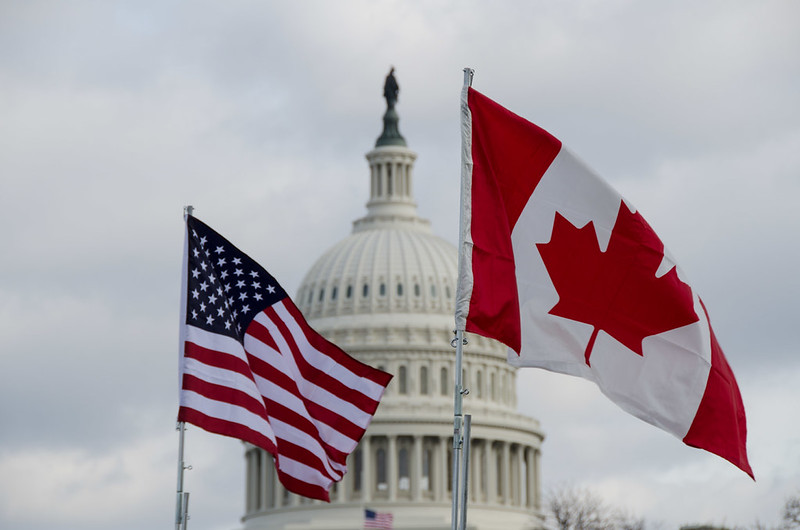
 US and Canadian flags at the US Capitol. Image credit: Photo Phiend. CC BY-NC-ND 2.0
Tariffs, Trust, and the 51st State: How the U.S.-Canada Trade War Threatens American Security
This week Canadian Prime Minister Mark Carney met with European partners to discuss deepening UK-Canada-EU ties. While meetings between European and Canadian leaders are commonplace, this meeting takes on a more troubling significance due to the ongoing US–Canada trade war.
Irrespective of the claims driving this conflict, the current trajectory of US-Canada trade relations threatens to produce more harm than benefit and places U.S. national security in a precarious position.
Background
Trade disputes are not a new occurrence. For instance, in 1982 the U.S. and Canada entered a lumber war. The conflict originated from wood Canada grew and harvested from public land, with prices set by the government, while the U.S. harvested lumber from privately owned lots. To protect U.S. producers from what it saw as Canada’s lumber subsidization, the government implemented protectionary tariffs.
Transitioning to the present, the current trade war began three weeks ago when the U.S. imposed 50% tariffs on $20 billion worth of Canadian products, in response to what it described as discriminatory Canadian policy toward U.S. auto, dairy, and alcoholic beverage exports. Canada answered with retaliatory tariffs, prompting a further U.S. move to restrict imports of whey, most alcoholic beverages, and motorcycles and mopeds from Canada.
The approach the Trump administration is pursuing risks greater national security costs than what stands to be gained from freer access to Canadian markets. It risks the economic decoupling of Canada from the U.S. and a potential supply chain crisis, as well as significant damage to one of America’s most important partnerships.
National Security: Tit for Tat
Even if U.S. policy toward Canada could be understood as pursuing fair trade, the signal being sent to Canada reads differently. For Canada, this trade war is not about fair trade so much as a fight for sovereignty and national security.
For example, Canada considers the dairy industry a matter of national importance: it directly employs roughly 112,000 people in farm production and processing and contributes about CAD 24.7 billion to the country’s GDP. Canada shields its dairy producers through a system of tariffs exceeding 200% on most dairy products once quotas are exceeded. Any attempt to dismantle that system is read in Canada as an act of aggression against its national interests. Combined with talk of Canada as a “51st state” and the renaming of Lake Ontario “Lake America,” these tariffs are widely seen there as a direct attempt to influence Canadian identity and sovereignty. If the U.S. uses economic coercion against Canada’s interests, Canada might do the same. As Carney put it, Canada was “not prepared to compromise Canada’s sovereignty or undermine our key industries.”
Canada does have leverage. In 2025 alone, Canada exported $85 billion worth of crude oil to the U.S., and Midwest refineries are heavily reliant on Canada’s sour crude—it would take years and billions of dollars to substitute Texan or Venezuelan crude in those facilities. Combined with the ongoing war in Iran, disruption could turn into an energy crisis affecting millions of Americans. This also applies to critical minerals: according to the Council on Foreign Relations, as the U.S. works to reduce its dependence on China, Canada offers an alternative source, and any cutoff would undermine current U.S. decoupling efforts.
Economic Independence
The current approach risks not only supply chains but the exclusive economic relationship the U.S. and Canada have built over decades. In his address to the Canadian public after late August’s collapse of trade talks, Carney said Canada could “chart a new course by building Canada Strong at home and diversifying our trading relationships abroad,” adding that Canada is becoming stronger and less dependent on America. This week’s talks in Europe are exactly that: an attempt by Canada to diversify its economy so it has better security against unpredictable shifts in U.S. policy.
Potential Impact
If this approach continues, the U.S. risks pushing Canada toward greater economic independence and weaker strategic alignment. Although Canada has limited alternatives for exporting its critical minerals and oil, it’s worth considering whether this is the appropriate way to treat a longstanding ally that rescued Americans during the Iranian Hostage Crisis and stood alongside the U.S. in Afghanistan. A different approach would require the U.S. to pursue trade concerns through engagement that recognizes Canadian sovereignty and avoids creating the perception that the U.S. is seeking to coerce its ally. Treating a security-conscious partner as an adversary to be pressured, rather than an ally whose interests can be negotiated, risks long-term costs on energy security, critical mineral supply chains, and broader strategic alignment.
Photo credit: Photo Phiend / Flickr. CC BY-NC-ND 2.0