
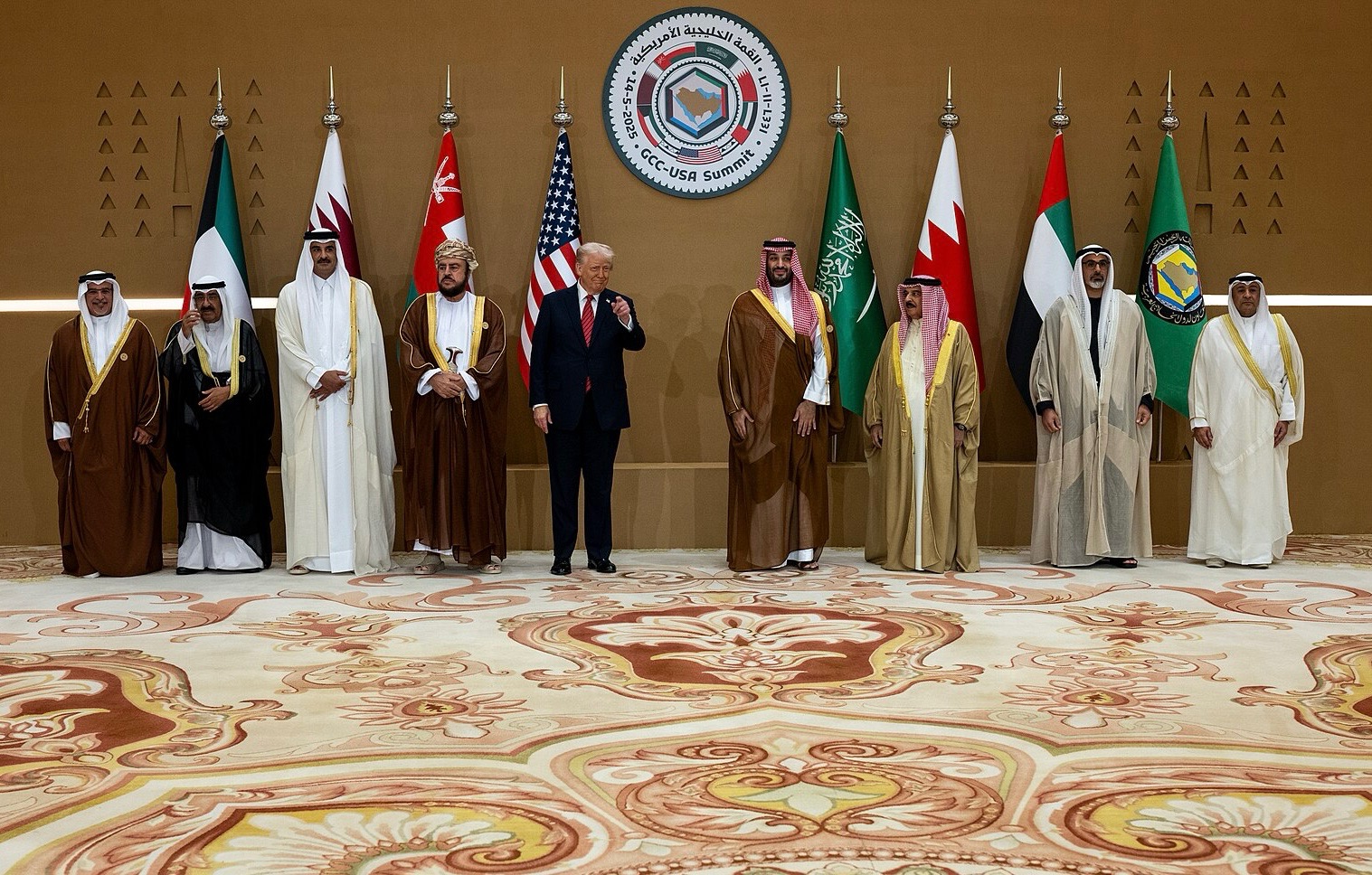
 President Trump Meets with the Leaders of the Gulf Cooperation Council // Photo: White House
How the Iran War is Affecting America’s Gulf Partnerships
Earlier this month, Saudi Arabia joined the U.S. in launching precision strikes against Iran’s proxies in Iraq. Now, the Kingdom is urging President Trump to “prioritize dialogue” in hopes of reaching a diplomatic solution for the war with Iran. This shift in tone may appear to be a notable reversal, but it is understandable given the burdens the war has imposed on the Gulf States. As the war in Iran drags on, America’s partners in the Middle East are feeling pressure on multiple fronts, and a new question has arisen: what will the relationships between the U.S. and Gulf States look like after the war is over?
The Gulf States of Bahrain, Kuwait, Oman, Qatar, Saudi Arabia, and the UAE—together compromising the Gulf Cooperation Council (GCC)—largely share in their mistrust of the Iranian regime; however, they are not aligned in their individual strategies regarding Iran. Their grievances span a wide breadth of issues, namely the clash of ethnic and religious identities and Iranian interventionism through its network of proxies. Meanwhile, the GCC enjoys long-lasting security guarantees, counter-terror cooperation, and significant economic ties with the U.S.
These relationships and their hosting of U.S. forces have now made the Gulf States a target of Iranian retaliation. In an effort to pressure the U.S. into a negotiated settlement, Iran has launched thousands of drones at Gulf States while blocking the Strait of Hormuz and restricting traffic through the Bab el-Mandeb. It seems that Iran’s plan is working. At the outset of the Hormuz closure GCC states were losing roughly two billion dollars a day, and estimates from June show Gulf State GDP growth fell to only a quarter of last year’s value. All GCC states are now urging the U.S. to end the war.
The war against Iran is raising the costs of alignment with the U.S. and sowing doubt about the protection it provides. Not only did the Trump administration launch this war without regard for its Middle Eastern partners’ recent efforts towards normalization with Tehran, but it has also failed to adequately protect them from Iran’s retribution. President Trump indicated he began this war with the intention of defanging Iran and stabilizing the region, yet Iran is still able to pressure neighboring states and is now more willing to do so. Additionally, Trump’s inconsistent rhetoric has highlighted the growing sense that he never had a real plan to begin with. The unpredictability of U.S. actions makes it exceedingly difficult for GCC partners to plan ahead, and the president’s apparent indifference towards their wellbeing will inevitably degrade relations for years to come.
The Gulf States began hedging against their overreliance on the U.S. prior to the war in Iran, but the war has now confirmed the doubts that led to their decision in the first place. Saudi Crown Prince Mohammad bin Salman has pursued closer economic and military relations with China since 2019, when the two countries agreed to collaborate through China’s Belt and Road and the Saudi Vision 2030 plans. Since then, the two countries have conducted arms deals worth billions of dollars, engaged in joint maritime military drills, and signed currency swap agreements—threatening the dominance of dollar-denominated transactions. Similarly, the UAE and China have conducted joint air force exercises while Qatar and China have agreed to strengthen security cooperation. Beyond engaging with China, the Gulf States have sought to diversify through other partners, as evidenced by the recent defense pact signed between Pakistan, Turkey, and Saudi Arabia.
Despite these troubling considerations, it is unlikely that America’s Gulf State partnerships will dissolve completely. Because of the GCC’s significant economic relationship and security cooperation with the U.S., it is still too valuable a partnership to relinquish. Nevertheless, the GCC will likely continue to increase both economic and security ties with other partners to lessen their reliance on an increasingly erratic U.S.
The war in Iran is still ongoing, but its confirmatory effects on the region’s decoupling from the U.S. are readily apparent. This could have been avoided if the Trump administration attempted to build a consensus with its partners prior to the war, potentially resulting in a more coordinated and thus effective effort. Nevertheless, a concerted effort to mend partnerships is necessary to shore up faith in American leadership. The U.S. should reaffirm its long-term commitments to its allies, coordinate with incoming leadership across administrations, and plan ahead instead of operating reactively. By undertaking these tasks, allies can slowly regain trust in America, and the U.S. can begin rebuilding the international prestige it has ceded in recent years.