
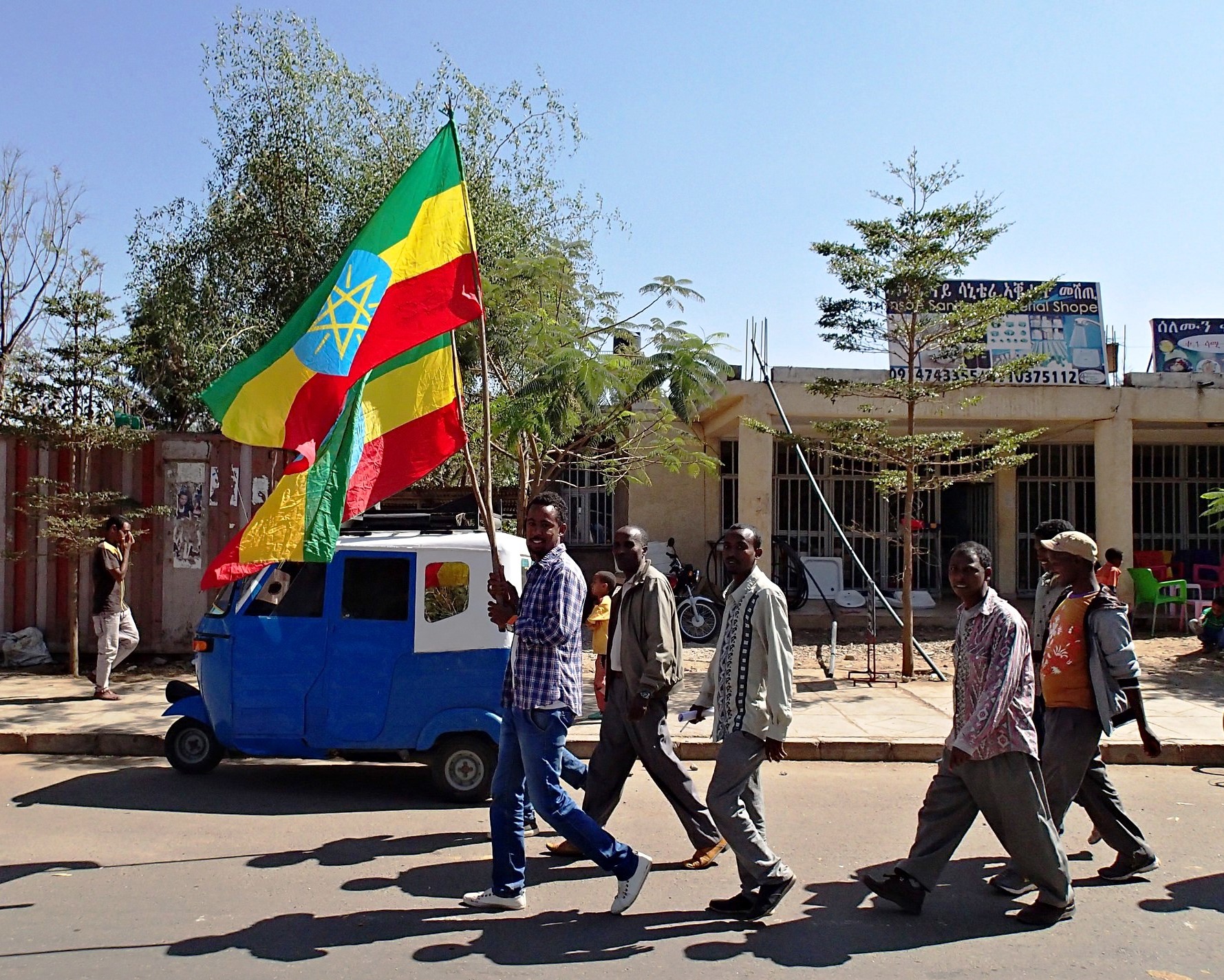
 Image: Jasmine Halki, Tigrayan / Flickr. CC BY 2.0
Ethiopia’s Next War Is Set to Cause Regional Chaos
On Wednesday, September 23, 2026, after armed clashes, the Tigray Defense Forces (TDF) and the Tigray People’s Liberation Front (TPLF) seized control of three airports in Tigray. The TPLF has refused to disarm or stop its aggressions—declaring in mid-July that the 2022 Pretoria peace deal between the TPLF and Ethiopian government was “effectively dead.” Its attacks and troop movements are more strategic now, which raises concern that low-intensity, sporadic skirmishes will erupt into a larger war.
Tigray sits at the northern end of Ethiopia and borders Eritrea to the north and Sudan to the west. On 21 September, the TPLF and six other armed groups announced an alliance to overthrow Prime Minister Abiy Ahmed’s government. This makes it more likely that the conflict will widen. The country is also still recovering from the 2020–2022 Tigray War, which killed upwards of 600,000 people and left about one million still displaced. The TPLF’s actions since the alliance formed could signal that its partners are ready to strike together. That could mean a coordinated campaign and another war with regional consequences.
Regional Instability and War
Rising tensions could spark a regional war involving Ethiopia, Eritrea, and Sudan. Alan Boswell, Horn of Africa director at the International Crisis Group, says Eritrea has allied itself with the TPLF. Ethiopia’s federal government and Eritrea fought the TPLF together in the last war. Now Ethiopia accuses its former ally of supporting the TPLF. “Eritrea is also quite close, for instance, with the Sudanese army, and relations between Ethiopia and the Sudanese army have also been deteriorating,” Boswell told Al Jazeera. He added that Ethiopia is getting more involved in Sudan’s war, against the Sudanese army, at least along its border. Any war inside Tigray could boil over into a larger regional fight. With fighters being supplied with arms from existing smuggling routes a regional fight could become bloody and protracted.
Access to arms is feeding the problem. Ethiopia had the third-highest rate of illicit arms trafficking in the East and Horn of Africa from 2019 to 2021. It sits on critical smuggling routes used by regional insurgents. Turkish-made weapons come in through Sudan and Djibouti. This stream means there is no lack of weaponry to assist in the TPLF fight and broader conflict. Weapons such as artillery and drones have the potential to prolong a conflict with the Ethiopian National Defense Force (ENDF). This flow of arms is the perfect vein to supply fighters in Tigray, and it raises tensions across the region as these weapons could see use against other state forces in contested areas along the borders.
Until this week, the ENDF had kept the fighting at low intensity. Now it faces larger, coordinated attacks, heavier weapons, and allied militias on multiple fronts. Further conflict could erode Addis Ababa’s credibility, thus deepening the TPLF’s fight for popular support in this conflict—adding to an already fragile but dangerous situation.
Time to Act
Northern Ethiopia is sliding back toward full-scale war. A new seven-group “Alliance for Survival” has vowed to bring down Prime Minister Abiy Ahmed’s government. These signs point to a coordinated offensive, not scattered clashes. The danger will not stop at Ethiopia’s borders. Amhara and Afar are home to more than 38 million people and border Eritrea and Djibouti. A new war could displace people into neighboring states and risk a humanitarian crisis. Sudan’s civil war and Red Sea tensions are already tangled together with conflicts in Yemen and Somalia, and the region cannot absorb another war. As for a response from the U.S., it has refused to give a clear message of support to any one actor in the region. Additionally, the lapse on sanctions against officials tied to the last war sends the wrong signal. This further complicates the peace process and the U.S. stance in this conflict.
The answer is not another military campaign. The last war killed about 600,000 people and still ended at the negotiating table. This round grew out of failure to fully implement the Pretoria Agreement. The way forward is to return to AU-led talks, restore a political path for the TPLF, begin a constitutional process for Western Tigray, and press Eritrea to withdraw its troops.
The window for peace is narrowing, not closed. Ethiopia’s leaders and partners must act now.
Image credit: Jasmine Halki / Flickr. CC BY 2.0