
Enabling Communication in Afghanistan
Yesterday, Reuters reported on a very interesting radio project in Afghanistan. Nari Radio is a small operation broadcasting from a “plywood hut” within a U.S. base in Kunar Province. It has a single reporter, a single microphone, a single telephone line and a reputation for impartiality. To get a look at how small this operation is, check out Reuters’ video here.
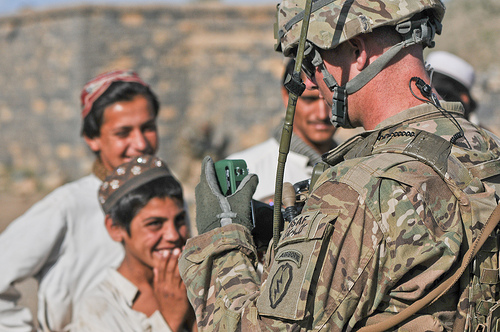
An American soldier hands out a wind-up radio in Afghanistan. U.S. Army Photo.
The station takes calls from anyone, including Taliban members, and is open to discussion about anything, ranging from religion to politics or music.
In Afghanistan, radio like this is equivalent to “new media,” as the article’s author, Rob Taylor, points out. In a time when most excitement about public diplomacy revolves around the new media on the internet, this is an example of applying the lessons of internet communication to low-tech public diplomacy solutions. As the internet enables the average person to communicate, radio call-in shows can provide a similar effect. They give individuals a voice. The radio station also provides American military officials with a means of communicating directly with the Afghan public, and allows Afghans to ask challenging questions of them.
As part of the method to increase the reach of the station, American troops have distributed wind up radios, negating the need for electricity or extra batteries to power them.
In a place like Afghanistan, this is an effective form of public diplomacy. It is open, honest, low-cost, and gives voices to opposing views in legitimate fashion. It doesn’t rely on printed materials that have little effect on a population with low literacy rates. It doesn’t rely on technology that people don’t have or can’t easily be distributed, and employs the population themselves to do the communication. It allows Afghans to have their own voice. It’s a demonstration of democratic communication, and done on a small scale that’s appropriate for Afghanistan’s decentralized, tribal structure.