
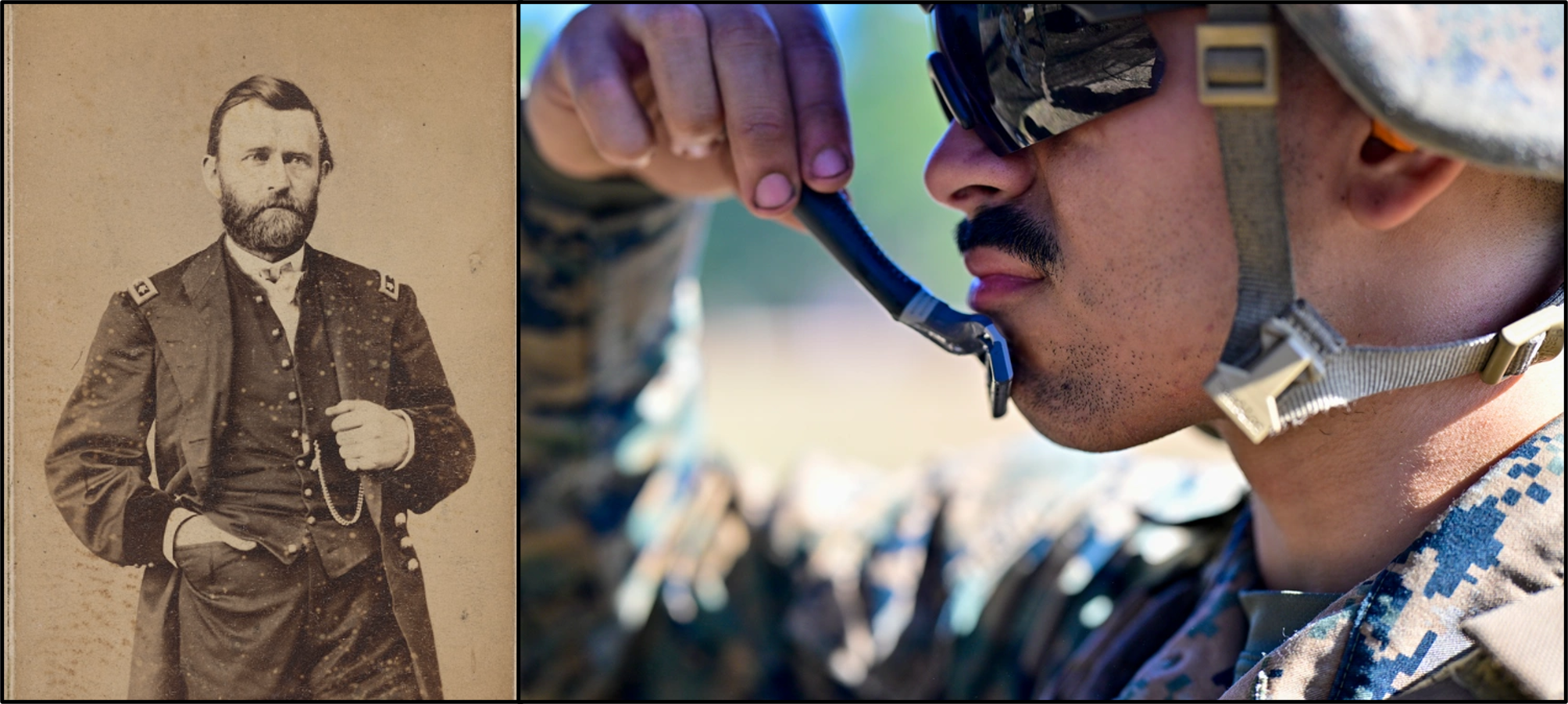
 L: GEN Ulysses S. Grant with Beard // Image Credit: Library of Congress | R: Marine Shaving in the Field // Image Credit: U.S. DoD
Discipline or Disruption: The Pentagon’s Crackdown on Facial Hair and the Servicemembers it Impacts Most
Amidst a lengthening conflict with Iran, domestic and overseas deployment extensions, and redirection of funds from servicemember quality of life to border security, the military’s leaders are directing their focus towards a new priority: facial hair. The grooming standard controversy reignited earlier this month, starting with comments by top Pentagon leadership and quickly manifesting as new policies that threaten to cut tens of thousands of soldiers out of the service.
What Happened
Grooming standards have fluctuated significantly in the 250-year history of the U.S. Armed Forces. The Army’s current ban on facial hair beyond mustaches began in WWI out of concern beards created gaps between gas masks and soldiers’ faces. Still, full beards were allowed and commonplace in the Navy until 1985. Since then, there have been conflicting reports about facial hair obstructing gas masks, beards in foreign militaries (and U.S. special operations forces) have grown harder to ignore, and medical concerns have led to medical providers granting thousands of exemptions called “shaving profiles.” All of this challenges the justification for these bans.
Secretary Hegseth, who alleged he’d himself been treated unfairly for the appearance and content of his tattoos, nonetheless made “no more beards, long hair, superficial individual expression” a top priority, even focusing on the issue during his speech to assembled senior military leaders in September 2025. The military community warned of negative impacts to recruiting, retention, and readiness, and were evidently too slow to implement the large-scale change Secretary Hegseth envisioned. This issue resurfaced after Secretary Hegseth’s visits to Navy vessels in June, during which he saw sailors who still didn’t meet desired appearance standards. Upon his return to the Pentagon, senior leaders made it clear that the Secretary wanted stricter enforcement, and the services began issuing updated policies in July.
What Servicemembers Are Currently Facing
ASP has previously covered the reasons why appearance-related policies and especially their connection with stigma are problematic in its report on the related topic of military obesity.
While there is frustration across all military demographics about the U.S. military’s prohibition on beards, attempts to crack down on facial hair disproportionately affect black men. Upwards of 45% of black men in the military have a medical condition—pseudo folliculitis barbae (PFB)—that causes painful inflammation and razor bumps when they shave regularly, thus necessitating shaving profiles, some temporary and some permanent. Black people only make up 16% of total servicemembers, but 65% of those with shaving profiles. Indeed, when Secretary Hegseth first announced this renewed focus on shaving in 2025, over 40 members of Congress responded with a letter in opposition, warning that it would inordinately harm black servicemembers.
Many servicemembers are already pressured by the long-standing stigma and delayed promotions associated with shaving profiles into still shaving every day. They then carry out their duties with much of their face and neck covered in sensitive, sometimes bleeding razor bumps. More than just a medical concern, this added distraction can jeopardize performance in everything from routine training and evaluations to live combat. The military health system does offer laser treatment for PFB, but it is uncomfortable, can take up to 48 weeks for full treatment, creates conflicts for scheduled training and other duties, and can still reoccur after successful treatment.
What this Policy Means
According to the Navy’s new policy, separation proceedings for sailors who still require facial hair accommodations will begin after 12 months of treatment. While the Army’s new policy says separation proceedings “may” begin instead of “will,” it still puts its roughly 40,000 soldiers with PFB (more than the combined manpower of the 82nd and 101st Airborne Divisions) at risk of forced separation.
To avoid this, the military will need to find the time and resources to vastly step up its education campaign to inform servicemembers of this policy and treatment options, pay the potentially thousands of dollars per servicemember the laser treatment costs each year, and ensure those thousands of servicemembers can complete the treatment in the next year. Unlike with vaccine mandates and tattoo regulations, in the case of PFB, a servicemember could be fully pursuing every medical option available to meet Pentagon standards and still be pushed out of their job regardless. There is draft language in the 2027 NDAA mandating an assessment of involuntary separations for non-disciplinary issues across the services, but so far the only movement the Pentagon has made to mitigate potential policy impacts is reducing some of the red tape for making treatment appointments at private clinics.
Without studies demonstrating a conclusive link between beards and decreased discipline, professionalism, lethality, or gas mask effectiveness, the most prevalent remaining justification for enforcing grooming standards is uniformity. However, as requirements for other uniform appearance regulations like headwear are growing less stringent without any apparent pushback from the Pentagon, it is also possible facial hair requirements are a result of the personal preference of Pentagon leadership. It is any secretary’s prerogative to lead the Department as they see fit, but crackdowns like these ignore recommendations from medical professionals focused on readiness, and push more soldiers, sailors, airmen, Marines, and guardians into choosing to either try to grin and bear it or leave the military.
Whether this renewed campaign against shaving exemptions ends up leading to mass separations, forces thousands of servicemembers into uncomfortable laser treatments, or is simply a scare tactic, the underlying message about shaving profiles—and those who need them—will persist. While other nation’s militaries are relaxing grooming standards in order to improve morale, bolster recruiting, and focus on increasingly complex mission sets around the world, the U.S. military is doing the opposite.