
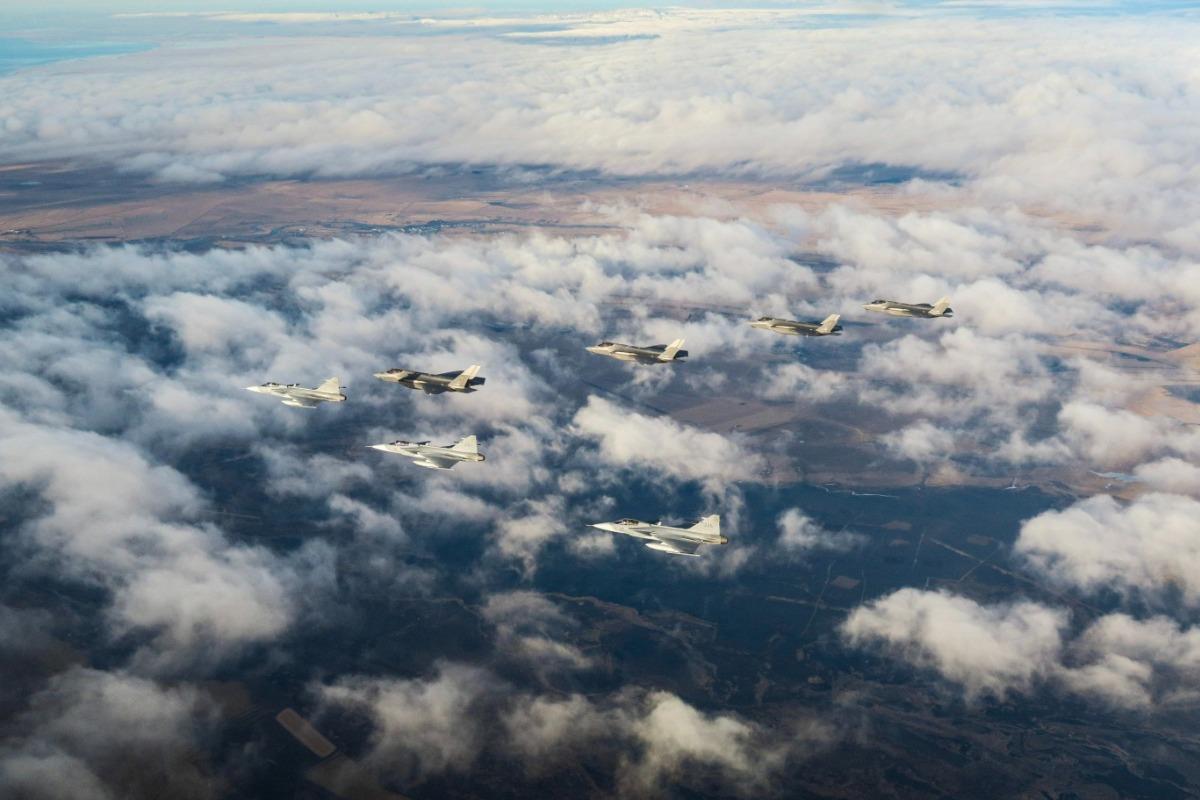
 NATO allied air assets increase surveillance in the High North under Arctic Sentry. Photo by Swedish Armed Forces.
Despite Greenland Tensions, NATO is Poised to Improve Arctic Defense
This February, just weeks after a high-tension gathering of global leaders at the World Economic Forum in Davos, the North Atlantic Treaty Organization (NATO) launched Arctic Sentry, a military activity designed to bolster NATO’s posture in the High North. Despite lingering strain in the alliance stemming from the Trump administration’s recent, controversial fixation on acquiring Greenland, the incident is catalyzing broader transatlantic efforts that will ultimately strengthen Greenland and NATO security in the Arctic. The recent spotlight on Greenland has pushed the alliance to redirect more of its attention and resources to the Arctic, a region of enormous strategic consequence.
75 years ago, the United States entered the 1951 Defense of Greenland Treaty, which remains in effect today. The agreement grants the U.S. broad military access in the region, which played a critical role in strategic positioning during the Cold War era. Greenland still hosts the Pituffik Space Base, a key U.S. military installation that enables missile warning, missile defense, and space surveillance. Because Greenland lies along the most direct missile routes from China and Russia to the United States, the territory is crucial for missile detection and sits at the center of great-power competition. The island also plays an important role in monitoring Russian and Chinese maritime activity in the Arctic and northern Atlantic.
For both the United States and Europe, Greenland’s abundance of natural resources is increasingly important as Western economies seek to reduce dependency on China for these materials. However, as Arctic sea ice rapidly melts, northern sea lanes have become increasingly navigable, intensifying the strategic value of Greenland’s surrounding waters and exposing the island to adversarial interests. For China, widening sea lanes allow opportunities to advance its “Polar Silk Road” and makes Greenland’s exposed wealth of critical minerals an enticing option for Chinese commercial interests to complement its expanding Arctic shipping and infrastructure strategy. Russia seeks to consolidate its dominance in the Arctic by increasing its military and maritime presence, further encroaching as waters become more navigable. This economic potential, combined with Greenland’s geographic position as a strategic choke point in the Arctic, has subsequently increased U.S. sensitivity towards adversarial encroachment in Greenland’s vicinity.
Even as adversary states creep closer to Greenland, the U.S. and its NATO allies lack a formalized strategy to secure this key territory. Though it is widely viewed as a major setback for NATO, the recent transatlantic dispute over Greenland has prompted some positive change for the alliance.
Since President Trump’s remarks at the World Economic Forum, European institutions have openly acknowledged their collective underinvestment in and neglect of Greenland in Arctic security. On January 22, European Commission President Ursula von der Leyen and European Council President António Costa issued a statement underscoring the importance of an enhanced EU-Greenland relationship. The statement revealed the European Council’s intention to “put forward a substantive package of investments” in addition to their existing plan to double financial support for Greenland in the 2028-2034 budgetary cycle.
Beyond investments, both Costa and von der Leyen reiterated their commitment to deepening cooperation with the United States and Arctic partners to strengthen regional defense. European Central Bank President Christine Lagarde even went so far as to say, “Thank you to the bashers,” referring to the United States, as “it has given us complete realization of the fact that we have to be more focused.”
The launch of Arctic Sentry reflects the “focus” Lagarde mentioned. Though this is neither a formalized Greenland framework nor a military operation, this multi-domain military activity consolidates allies’ Arctic activities in the region into “one, overarching operational approach.” Headed by the Joint Force Command Norfolk in the United States, U.S. personnel will work alongside other NATO commands to improve alliance coordination, intelligence sharing capabilities, and collective presence in the High North. Meeting these objectives will enhance security and deterrence for Greenland and the broader Arctic region.
The alliance’s launch of Arctic Sentry, the prioritization of EU-Greenland relations, and the EU’s commitments to increase funding for Greenland’s defense are positive indicators amid high transatlantic tension. These developments demonstrate the alliance and its allies’ increasing recognition of Greenland’s geostrategic significance and the intensifying threat of adversarial encroachment in the Arctic.
However, these are only a few pieces of the puzzle. NATO should now move beyond reactive coordination and establish a Greenland-specific security framework that respects the territory’s sovereignty. Such a framework would reduce transatlantic friction and strengthen collective deterrence against Chinese and Russian aggression. If NATO can withstand diplomatic tensions and translate encroachment pressures into a comprehensive, collaborative Greenland strategy, the alliance will emerge stronger and more unified in this crucial region.