 An MV-22B Osprey from the 31st Marine Expeditionary Unit operating in the East China Sea // Photo by Navy Petty Officer 2nd Class Vincent E. Zline, U.S. Navy
Countering China: Are U.S. Initiatives Delivering Results?
The Chinese Communist Party (CCP) has been actively spreading its influence globally through investments, aid operations, and increasingly, military cooperation with other countries. The CCP has emerged as the pacing challenge identified by western leaders, and a bona fide competitor with the United States on the global stage. This has led to multiple initiatives to begin countering the CCP as the U.S. has shifted from a policy of engagement to strategic competition—including the “pivot to Asia.” Though the Obama era desire to pivot has not fully materialized in reality, initiatives like the Countering PRC Influence Fund (CPIF) and the Pacific Deterrence Initiative (PDI) provide the U.S. with additional tools to counter China. However, though well-intentioned, the CPIF and PDI fall short in implementation processes and oversight to reach their goal of countering CCP malign influence globally, and within its region. Future appropriations should be linked to demonstrated program effectiveness rather than annual funding levels only.
$1.6 Billion Spent on Diplomatic Projects and Inconsistent Reporting on Initiatives Countering China Remain
Since 2020, Congress has directed the State Department and the U.S. Agency for International Development (USAID) to spend at least $1.6 billion on projects to counter Chinese influence worldwide under CPIF. A recent Government Accountability Office (GAO) report released June 17th, concluded that from FY2020-2023, a total of $1.2 billion was spent on projects. CPIF is designed to counter Belt and Road coercion, debt-trap diplomacy, and disinformation campaigns linked to Chinese state actors. For example, $475,000 was allotted in 2023 to support training for journalists in Taiwan-recognizing countries in Latin America. The training provided journalists with the skills to detect Chinese propaganda and disinformation and raise their awareness of China’s coercive practices.
During GAOs request for information and review process, data was lacking for many other projects under the initiative. GAO noted officials did not provide data on time frames or lines of effort for approximately 170 out of 470 projects, making it difficult to track success. After five years, CPIF still suffers from a lack of direction and appropriate metrics which can obscure the effectiveness or ineffectiveness of programs. For the U.S.to achieve its goals of countering malign political, economic, and security influence of the PRC, data on specific lines of effort, timelines, and implementation status is crucial for tracking how projects have used funding under CPIF and measuring the effect of these projects.
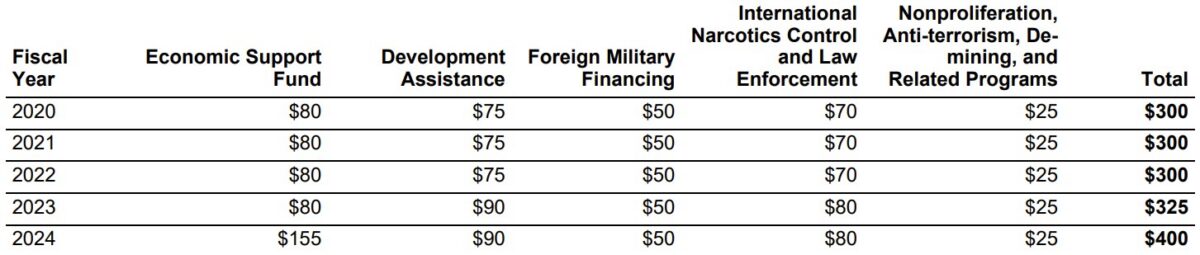
Funds directed by Congress for CPIF, FY 2020-2024, Dollars (In millions) // Source Government Accountability Office
Inconsistent Visibility for Military Expenditures in the Asia-Pacific
On the defense side, from 2023 to 2029, the U.S. is projected to spend approximately $65 billion on Pacific Deterrence Initiatives (PDI) intended to counter China. Since its addition to Section 1251 of the National Defense Authorization Act for Fiscal Year 2021 (FY2021 NDAA), PDI seeks to: modernize and strengthen U.S. presence in the region; improve logistics, maintenance capabilities, and prepositioning; develop new integrated training/tactics with advanced capabilities; build ally/partner capabilities, capacity, and cooperation; improve capabilities available to PACOM.
A November 2025 GAO report stated that clearer guidance is needed to improve visibility into resourcing of Pacific deterrence efforts. As PDI serves as a budget display, rather than a separate appropriation fund, it should provide a visible and trackable look into deterrence efforts and funding priorities in the region. GAO concluded that there were inconsistencies in the types of programs included in the PDI budget exhibits. For example, some services included efforts east of the International Date Line, although the guidance focuses on efforts primarily west of it. The initiative supports broader U.S. government efforts to counter PRC attempts to reshape the Asia-Pacific region and the international system to its benefit. However, the whole-of-government approach cannot succeed if policy makers do not have the necessary information to fund initiatives that are working versus those that are not.

Funds by category for PDI, FY 2023-2029, Dollars (In thousands) // Source Department of Defense (Comptroller)
GAO’s Policy Recommendations
For the State Department, GAO’s recommendations center on improving planning, coordination, and performance measurement within CPIF. These recommendations include issuing funding guidance earlier in the proposal process, incorporating input from regional and subject-matter experts, and establishing more consistent procedures for collecting project data. Most importantly, GAO urged the Department to develop a process for evaluating whether CPIF-funded projects are actually achieving their intended objective of countering Chinese influence. Without clear metrics and portfolio-wide assessments, policymakers lack the ability to determine which programs should be expanded, modified, or discontinued.
For the Department of Defense, GAO’s recommendations focus on improving transparency and consistency in the administration of PDI funds. Specifically, GAO found that program selection criteria were not always clearly defined and recommended establishing clearer processes for validating projects and prioritizing expenditures. GAO also recommended closer coordination with PACOM to ensure that funded projects align with operational priorities in the region. Together, these reforms would provide greater visibility into how deterrence resources are allocated and whether they are contributing to stated strategic objectives.
Concluding Thoughts
The challenge facing Washington is no longer whether to compete with China, but whether it can do so effectively and defining what success looks like. CPIF and PDI demonstrate bipartisan recognition of the challenge posed by Beijing, yet GAO findings suggest that funding alone is insufficient. Without the ability to measure outcomes, even well-intentioned programs risk becoming inefficient or ineffective. Transparent reporting of projects and initiatives in tandem with the use of tools like Global Influence or China Index will allow for increased accuracy for prescribed funding and policy measures to counter China’s growing military and diplomatic influence. If the United States hopes to sustain long-term competition with China, it must design measurement into its efforts to determine whether they are contributing towards policy success.