
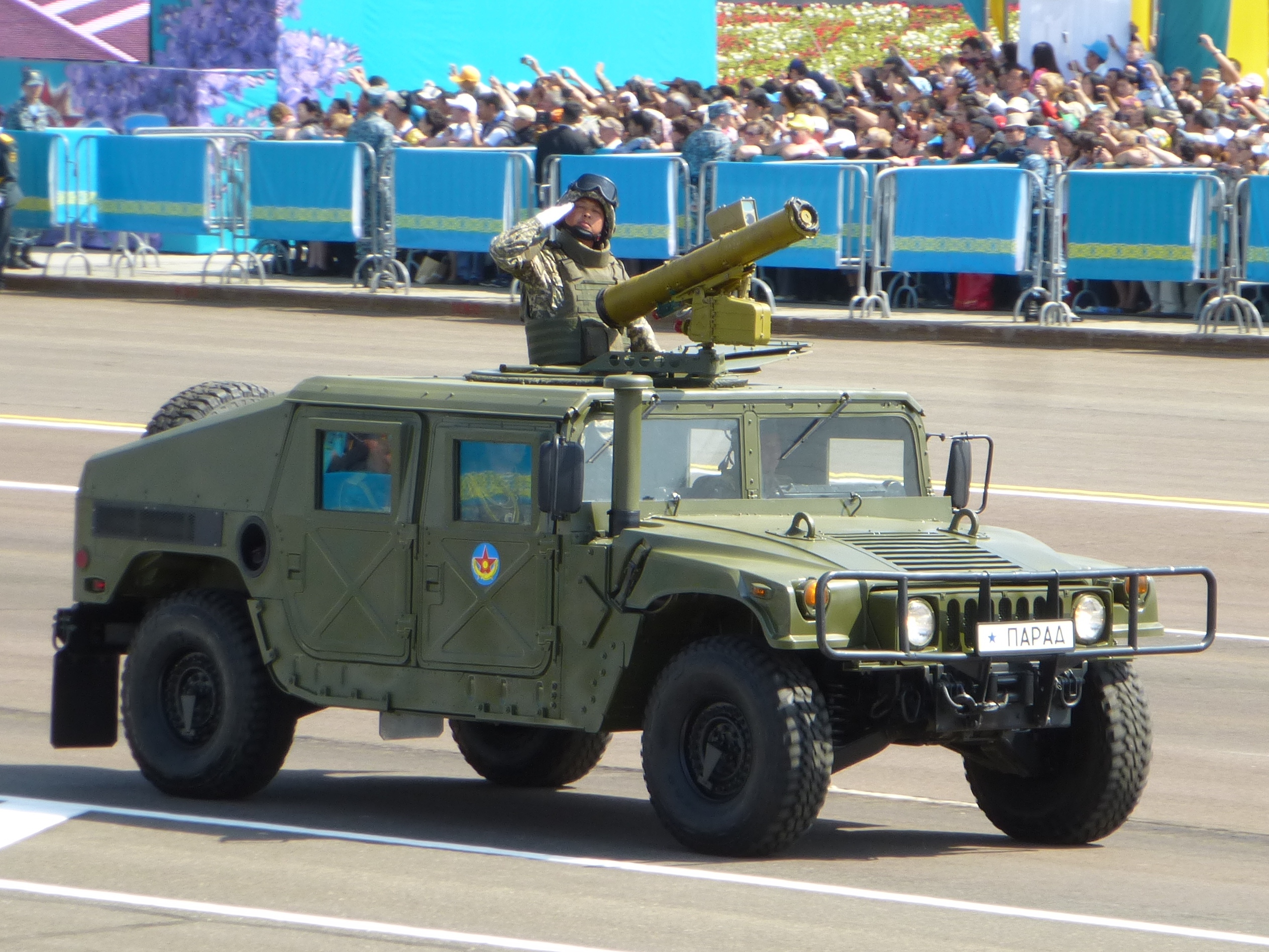
 A U.S.-made High Mobility Multipurpose Wheeled Vehicle used by the Kazakh Ground Forces.
Central Asian Defense Diversification: A Strategic Opportunity for the United States
On February 4, Deputy Secretary of State Christopher Landau met with the foreign ministers of Kazakhstan and Uzbekistan to discuss American investment in local “critical minerals exploration, mining, and processing.” The meetings reflect the Trump administration’s growing concern over China’s expanding role in the extraction of the region’s resources, many of which are essential for U.S. national and economic security. Yet absent from Landau’s agenda were discussions about a major Central Asian priority that has helped drive this renewed engagement with Washington: defense cooperation and technology.
Since 1991, Russia has been responsible for over 80% of arms imports to Kazakhstan, Kyrgyzstan, and Tajikistan. However, dissatisfaction with this overreliance on Russian imports—which often consist of aging Soviet-era equipment—has abounded since the beginning of the millennium. Defense modernization has become a regional priority, with Central Asian governments openly pursuing partnerships with alternative suppliers. In particular, Central Asia has expressed a “very high level” of interest in American defense products, but Washington has remained relatively unresponsive to its desires. China, by contrast, has leaped at the opportunity to corner Central Asia’s defense market, leveraging its budding security partnerships with the region to access the same critical mineral wealth that the Trump administration seeks.
In tandem with investments in local mineral extraction and refinement infrastructure, China has sold defense hardware to Central Asian states that have sought to modernize their militaries, crafting the image of a power whose critical minerals partnerships have reciprocal benefits. In reality, Beijing’s strategy is perpetuating dependency rather than alleviating it. In 2022, Kazakhstan imported “nearly $5 million worth of drones, almost entirely from China,” but its domestic UAV production infrastructure remained underdeveloped. In 2023, China partnered with Kazakhstan’s Petropavlovsk Heavy Machine Building Plant to construct drones domestically, but “critical parts” were still sourced from China, with one plant director noting that 70% of the drones’ components were of Chinese origin.
The U.S. has not taken advantage of the shortcomings in China’s defense technology cooperation with Central Asia; instead, it has attempted to counter China’s growing influence in the region through critical minerals diplomacy alone. These efforts have been met with “mixed assessments” in Central Asia, with some local analysts describing them as one-sided tools of a “distant partner” that sees the region “solely as a source of natural resources.” To dispel this idea and compete effectively with China, the U.S. should offer Central Asia what it has been asking for: mutually beneficial partnerships that address both security and economic needs. While minerals dialogue and investment proposals are a good start, without a substantial increase in accompanying defense agreements, Washington risks ceding strategic influence to a competitor that is building more comprehensive partnerships across economic and security domains.
To deepen Washington’s defense engagement with Central Asia, the Trump administration should increase the transfer of excess defense articles (EDA), or used materiel that is no longer needed, to the region. While up to $500 million in EDA can be transferred annually, the U.S. only transferred $63 million globally in FY2024, leaving plenty of room for a new focus on equipping Central Asian partners. The EDA program—often used to transfer legacy and non-sensitive equipment—can allow the U.S. to fulfill Central Asia’s many requests for materiel with “smaller capabilities” while protecting newer American defense technologies, a particularly important consideration given that these states maintain ties with Russia and China.
The U.S. should also expand the proportion of Foreign Military Financing (FMF) that reaches the region. The FMF program, which awarded $11.8 billion to partners in FY2024, provides states with grants or loans to purchase equipment or services from American defense contractors. FMF has been used to facilitate materiel sales to Central Asia in the past, with Uzbekistan having recently used it to help acquire $40 million worth of American equipment.
At the same time, Washington should invest in infrastructure that will allow regional governments to invigorate their own defense production capacity. Combined with the Trump administration’s ongoing minerals dialogue, this approach would erode the perception of the U.S. as merely an extractive foreign power and differentiate Washington from Beijing. Central Asian governments willing to grant American firms preferential access to critical minerals would do so knowing that Washington is invested in their long-term security and sovereignty.
China has established a foothold in Central Asia by responding to the region’s priorities, but the U.S. can present a far more attractive offer: the sale of much-desired American-made materiel with simultaneous investment in local defense production infrastructure. By complementing existing minerals cooperation with these defense partnerships, the U.S. can enable Central Asian governments to achieve greater security independence from Moscow, forestall Chinese influence, and advance American interests in a strategically ascendant region.