
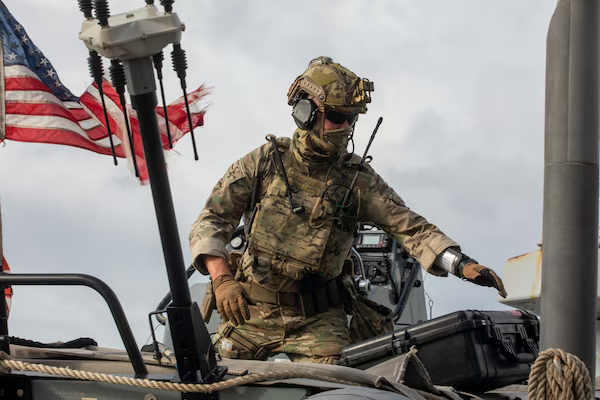
 U.S. Coast Guard Law Enforcement Detachment 105 boarding a rigid-hull inflatable boat while conducting maritime interdiction operations (U.S. Navy photo)
Can the Military Win the War On Drugs?
The September 2 use of lethal military force against an alleged drug smuggling vessel off the coast of Venezuela appears to mark a transition in the U.S. military’s counternarcotics responsibilities from law enforcement support to combat operations. Originating from the February 2025 official designation of drug trafficking organizations (DTOs) as foreign terrorist organizations (FTOs), this policy shift opened the door for a more combative role for the U.S. military in the War on Drugs. But can lethal military action against DTOs turn the tide?
Footage of the September 2, 2025 U.S. military strike against an alleged drug smuggling vessel released by the Department of War.
The U.S. military’s counternarcotics role has traditionally been confined to three main areas: intelligence collection and surveillance, interdiction, and foreign capacity building. This approach is best exemplified by Operation Martillo, where U.S. Coast guard frigates surveil and patrol Central American waters and interdict suspected drug smuggling vessels. Only months after its January 2012 inception, drug seizure values had reached over $2 billion, and suspected drug vessel traffic markedly dropped.
According to Trump administration officials, this shift towards lethal military action is designed to both punish and deter drug trafficking towards the U.S. However, conducting lethal operations against DTOs threatens to be counterproductive and carries legal and diplomatic risks. To avoid harming vital U.S. regional interests in Latin America while still deterring drug smuggling to the U.S., the Trump administration should focus on increasing traditional military drug enforcement activities.
Lethal military force would be an unproductive strategy for countering DTOs as it is unlikely to deter drug trafficking to the U.S. Studies have determined that the severity of punishment has little deterrent effect on crime, including the death penalty. As such, there is little reason to believe that the potentiality of lethal action against drug traffickers would serve as a deterrent, especially when considering the massive profits to be gained from the illicit drug trade. Focusing on lethal action over evidence-based alternatives could keep U.S. policymakers from exploring better options for countering drug trafficking to the US.
Additionally, the legal authorization for lethal military strikes against DTOs has not been fully established, potentially exposing the U.S. to legal fallout. The Trump administration argues that Article 2 of the Constitution gives the President the authority to conduct military action without Congressional approval. However, that authority has not been firmly established given how the alleged DTO operatives differed from past lethal military action targets. All the September 2 targets were civilians, a normally protected group, making the strike a noted break from past lethal military policy against armed members of groups like Al Qaeda or the Islamic State. As such, the strike potentially conflicts with international, humanitarian, and U.S. domestic law, possibly opening the U.S. to legal action by either the victims’ families or an international tribunal. While these legal challenges are unlikely to succeed, they could risk revealing intelligence sources and methods used in the strike, harming future counternarcotics operations.
Finally, unilateral lethal military strikes against DTOs in Latin America can damage diplomatic relationships and detrimentally reshape U.S. regional influence. Military strikes without forewarning or approval damages diplomatic relations between the U.S. and its allies. While succeeding in killing their targets, U.S. drone strikes in Pakistan amplified anti-Americanism sentiment and strained relations between Washington and Islamabad. Similar action against DTOs operating in or around Colombia, Peru, or Mexico risks similar results. Furthermore, unilateral lethal military action endangers Latin American cooperation with the U.S. on vital regional interests beyond drug trafficking, such as migration and trade. Latin American partners and allies may not only be hesitant to work with the U.S. on these issues but could look for other international partners, potentially isolating the U.S. within its own hemisphere.
To avoid the legal and diplomatic pitfalls of lethal military action while still deterring drug trafficking to the U.S., the Trump administration should consider increasing traditional military counternarcotics activity. A more effective deterrent to crime is to increase the likelihood of apprehension. Consequently, increasing military surveillance, patrol, and interdiction operations not only betters U.S. chances of seizing drugs and gaining intelligence from captured crews but also deters DTO operatives from transporting drugs to the U.S. by making capture and punishment more likely.
The military’s role in counternarcotics has been firmly established and has been a boon for the domestic law enforcement agencies they support. The administration can still use the military to accomplish its strategic goal of deterring drug traffic to the U.S., but introducing a lethal aspect to their role not only harms the U.S.’s ability to counter drug trafficking but also undermines other strategic regional interests.