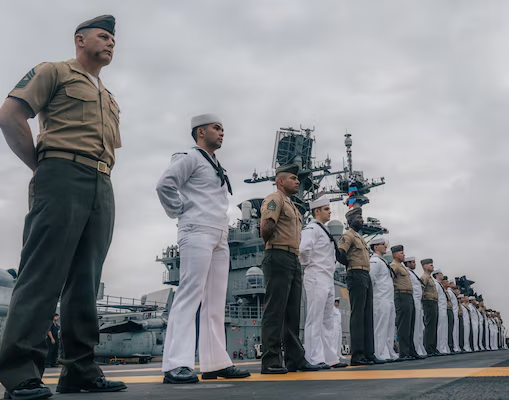
 U.S. marines and sailors man the rail as the USS Tripoli (LHA 7) arrives in Da Nang, Vietnam, Dec. 08, 2025 (Credit: Raul Sotovilla/U.S. Navy)
Anchoring the South China Sea: Charting the Future of U.S.-Vietnam Defense Cooperation
This week, two U.S. Navy ships arrived in Da Nang, marking the first port visit to Vietnam in two years. The visit follows Secretary Hegseth’s trip to the country in early November, where he pledged deeper security cooperation between the two countries.
As competition with China intensifies, Southeast Asia has become a central arena for U.S. strategic engagement, making cooperation with regional actors more important than ever. However, recent U.S. security engagement with ASEAN has been limited. To safeguard its interests in the region, Washington must adopt a more consistent, focused approach to establish closer, collaborative relationships with Southeast Asian nations—and Vietnam stands out as one of the most promising partners.
Given its geographic proximity and close trade relations, Vietnam sees Beijing as both a necessary economic partner and its primary security challenge, with the majority of the public viewing China’s growing military presence as a threat to the region. The two countries share a long and fraught history: in 1979, Vietnam repelled a Chinese invasion, followed by 12 years of border clashes between the two neighbors. Today, tensions persist in the South China Sea, where Vietnam regularly faces Chinese maritime coercion, including harassment of its fishing vessels and the militarization of disputed islands near Vietnam’s claimed waters.
The United States shares Vietnam’s concerns regarding China’s destabilizing actions in the South China Sea. The region carries one-third of global trade flows, making freedom of navigation and overflight essential for the global economy and U.S. commercial activities. Waterways in the South China Sea are also vital for U.S. military operations, serving as crucial maritime routes for patrol missions. China’s expansive territorial claims and military buildup obstruct these operations and similar activities conducted by other regional actors, pushing the U.S. to bolster its alliances and partnerships with Southeast Asian states through initiatives such as joint exercises and task forces aimed at deeper defense cooperation.
As the U.S. works to build a coalition of likeminded partners in the Indo-Pacific, a shared interest in deterring Chinese aggression makes Vietnam an attractive security partner. The modest U.S.-Vietnam security relationship established after diplomatic normalization in 1995 has rapidly evolved over the past decade due to Chinese aggression in the South China Sea. Between 2017 and 2023, Vietnam received approximately $104 million in security assistance from the United States to support capacity-building efforts, including a transfer of three former U.S. Coast Guard cutters and six Metal Shark patrol boats. In 2023, the two countries formed a Comprehensive Strategic Partnership (CSP), Vietnam’s highest tier of diplomatic cooperation.
Secretary Hegseth’s visit is a step forward in strengthening security ties between the two countries, but serious constraints remain. For one, Vietnam has maintained close relations with Russia, with more than 80 percent of its military equipment being Soviet- or Russian-made. Similarly, China remains Vietnam’s largest trading partner and manufacturing supplier. Vietnam also continues to foster its relationship with North Korea, maintaining periodic diplomatic exchanges. As a result, Hanoi is cautious about taking any action that endangers its position with these countries, limiting its cooperation with the U.S.
Moreover, recent U.S. policies have raised concerns about the United States’ credibility as a reliable partner. The foreign aid freeze earlier this year has hindered ongoing efforts to address war legacy issues, a process that Vietnam sees as Washington’s moral obligation and underpins the CSP. The Trump administration’s slew of tariffs has also complicated U.S.-Vietnam security relations. While negotiations have more than halved the initial tariff rate, tensions remain; the two countries have yet to resolve an extended pause on the sale of F-16 fighter jets that was part of initial tariff negotiations. Uncertainty around its relationship with the U.S. has also driven Vietnam closer to Russia, which sold Hanoi 9 electronic warfare systems for the Su-35, one of Moscow’s most advanced jet fighters.
ASEAN states like Vietnam are essential for Washington to counter Chinese aggression and preserve U.S. interests in the South China Sea. If it hopes to build a lasting and productive security relationship with Vietnam—and steer it away from U.S. adversaries— the United States must avoid contradictory trade policies and demonstrate its sincerity through more than rhetoric and the occasional visit to Hanoi. Hegseth’s pledge of $130 million to help clean up toxins from the aftermath of the war, promised during his November visit, is an important step in signaling goodwill and reducing lingering tensions. Continued follow-through on such initiatives, paired with expanded maritime and defense cooperation such as selective technology transfers and enhanced intelligence sharing, would go a long way in strengthening bilateral ties and reinforcing U.S. credibility as a long-term partner.