
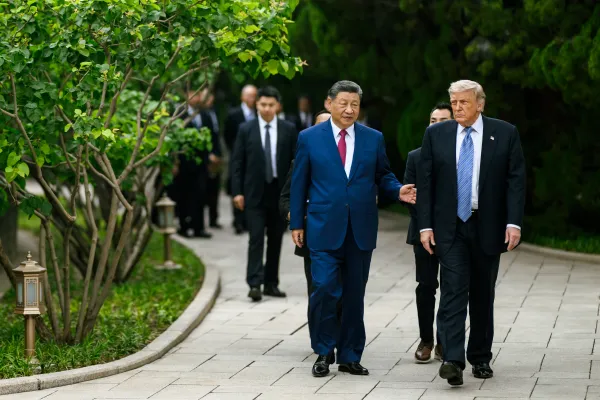
 Presidents Trump and Xi speaking in May 2026. White House photo.
Ambiguity Under Pressure: Taiwan Before the Trump-Xi Summit
With a mere 2 days left until the highly anticipated U.S.-China summit in DC, the question of Taiwan’s future becomes ever more pressing. President Xi Jinping is scheduled to come to Washington on September 24th, marking the 2nd U.S.-China summit in 2026, where the two presidents are set to focus on the current and rather fragile trade truce between the two countries. President Donald Trump returned from the last summit in May claiming a desire to build a “constructive relationship of strategic stability.” Considering the unpredictability of U.S. policies and the warmer diplomatic tone between the two leaders, the historical policy of strategic ambiguity is declining in regard to Taiwan, and the summit is a test of whether the ambiguity can be restored, or whether it will completely fall through.
Strategic ambiguity became a primary principle of navigating the U.S.-China relationship in 1979, and has been largely maintained in U.S. foreign policy since. In contrast, former President Joe Biden repeatedly signaled in the direction of strategic clarity over ambiguity, publicly stating that the U.S. would defend Taiwan militarily despite the Biden Administration’s consistent clarification that there have been no changes to U.S. policy regarding Taiwan. That leaves the current administration with the dilemma of determining how to keep Beijing uncertain about U.S. intentions without leaving allies uncertain too.
In the lead up to the summit, the key question for Taiwan concerns how this meeting will impact the approval of the $14 billion arms deal. The arms deal, put forward in response to a Chinese display of military power off the shores of Taiwan, would include defense weaponry and aid for the development of a Taiwan defense industry (e.g. drone factories). However, after a phone call between Xi and Trump in February where Xi warned against the arms deal, the deal was put on hold. Since then, Trump has referred to the arms deal as a “very good negotiating chip,” and it has continued to
stay on hold throughout this past year. While strategic ambiguity is still the principle maintained by the United States regarding Taiwan, China’s willingness to act depends heavily on the declining confidence in U.S. intervention, with this upcoming summit serving as another chance for Xi to test the waters.
Despite the current administration maintaining the principle of strategic ambiguity, Trump’s comments and actions regarding Taiwan’s independence, for example “Taiwan should pay us for defense,” have signaled a reluctance to intervene, opening opportunities for Xi to demonstrate Chinese leadership.
Beijing is unlikely to act on vague rhetoric alone, but the ongoing Iran war complicates the picture. Since February, the U.S. has moved warships, including an aircraft carrier from Asia to the Middle East, decreasing the ability to react promptly in the region. Furthermore, the U.S. air-defense system stockpile has been decreased by about two-thirds in defense against the Iranian drones and missiles. Showcasing the limits of U.S. capabilities and demonstrating heavily involvement and focus on this other foreign policy issue raises the question of whether the U.S. would even have the capacity for intervention.
Finally, the decline of strategic ambiguity paves the way for China to utilize foreign perception of the U.S. to undermine the United States’ global hegemony by subverting confidence in American leadership. The United States has historically played the role of global protector by perceptions and faith in the U.S. and its ability to uphold its commitments to its allies.
With the Trump-Xi summit this Thursday, Beijing has the chance to test the waters regarding hotspot issues like Taiwan, and the way that the U.S. views the Taiwan issue has become a significant aspect of how China perceives the United States’ capabilities and weaknesses.
Strategic ambiguity has real limits, and a stretched military and unpredictable White House are testing them. Yet it remains the best option since it lets Washington signal the possibility of opposition towards China while avoiding sparking explicit tensions. If the U.S. wishes for China to believe the consequences of taking decisive action against Taiwan will continue to outweigh the benefits, then it must support actions and rhetoric to intended ensure the credibility of the implicit threat provided by the policy of strategic ambiguity. This means having available the forces and equipment necessary for a response, along with a willingness to use them.