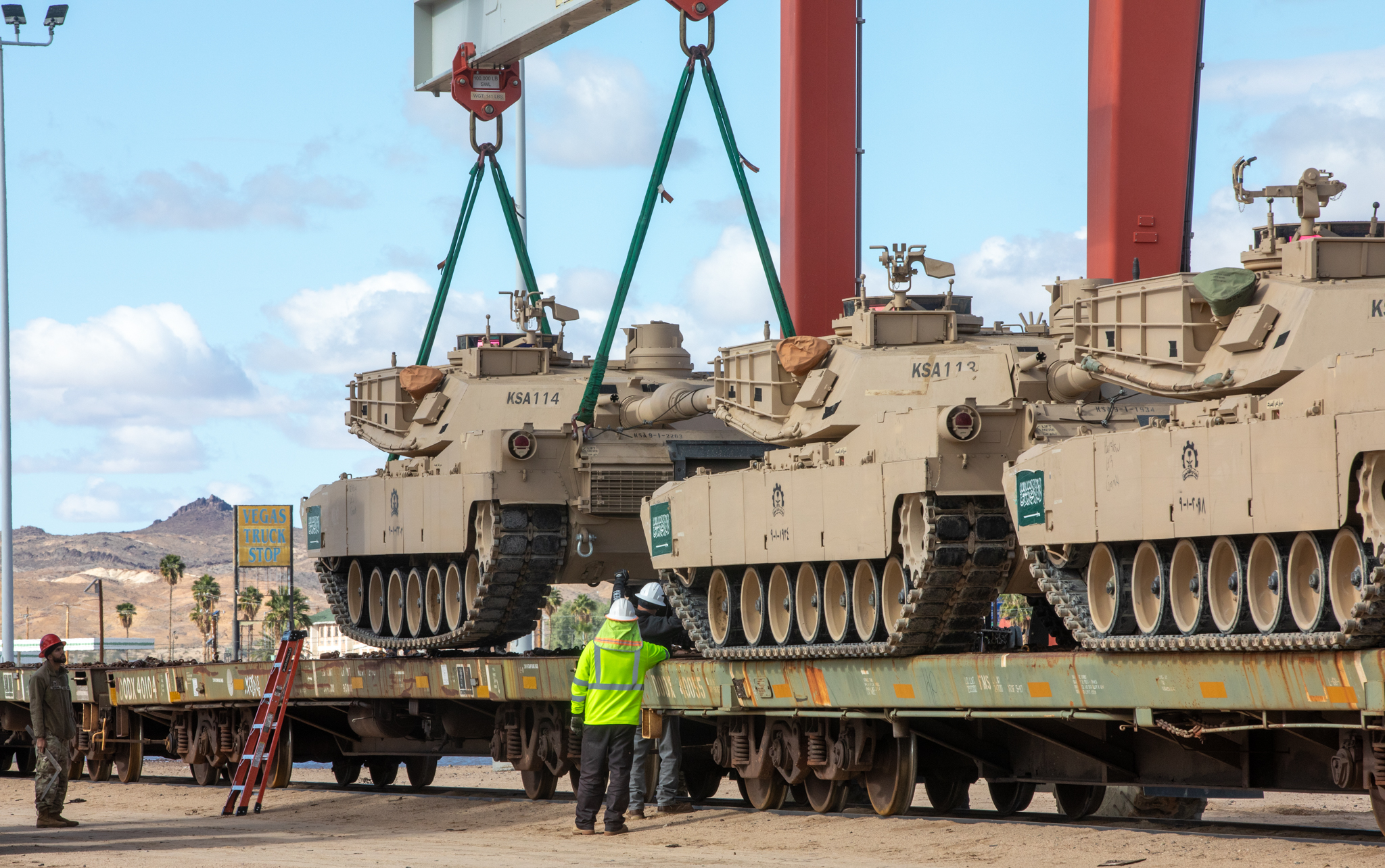
 Saudi tanks being loaded. Image credit: Staff Sgt. Devon Jones USCENTCOM
Saudi Arabia Cannot Buy Victory in Yemen
Saudi Arabia cannot buy victory in Yemen. In 2025, it devoted $72 billion to its military—more than four times the spending of its Gulf neighbors and behind only the world’s great powers—while buying advanced aircraft, precision weapons, air defenses and armored vehicles from the U.S. and Europe. Yet against Yemen’s Houthis, their arsenal has not produced decisive results. Riyadh’s central weakness is not a shortage of weapons, but an inability to turn hardware into coherent strategy, effective ground power, and an attainable political outcome.
Spending As a Strategy
Riyadh appears tempted to treat renewed Houthi attacks as a procurement problem. More interceptors and aircraft may protect individual targets, but they can’t dismantle a dispersed political and paramilitary organization. U.S. reporting on the Saudi defense market describes a heavily funded modernization effort built around foreign equipment, training, and sustainment. Defense contracts can provide and maintain military platforms, but they cannot fix the lack of tactical and operational capability and force structure needed to win against an insurgency.
The Houthis are exposing these shortcomings. Years of fighting have produced a force well versed in concealment, decentralized command, and rapid adaptation. Iranian-supplied advanced weapons, highly mobile tactics, and effective use of terrain for cover and concealment give the Houthis an advantage over Saudi forces. The Houthis have survived because they combine local networks, combat experience, and political control in northern Yemen. As the Stimson Center argues, Saudi military superiority has repeatedly failed to generate a strategic victory over the Houthis’ adaptive strategy.
Saudi Arabia’s Foreign Military
Saudi Arabia has also tried to compensate for weak indigenous ground capacity by relying on Yemeni militias, coalition partners, and foreign fighters. That approach reduces the political cost of Saudi casualties, but it produces fragmented command and control with transactional unreliable loyalties. Reporting on Sudanese fighters in previous Saudi-Yemeni conflicts highlight that outsourcing risk may not resolve the war’s underlying command and legitimacy problems. Contracted armed groups may seize ground, but they are less likely to achieve lasting measures to prevent future hostilities against Saudi from arising again.
Consequences of a Failed Response
Failure wouldn’t remain confined to Yemen. Houthi missiles and drones can threaten Saudi cities, airports, and oil facilities, while attacks near the Bab al-Mandab Strait can raise shipping costs and disrupt shipping through the Suez Canal. Even limited strikes can force vessels to reroute, increase insurance premiums, and inject risk into energy markets. The Houthis therefore possess leverage—they can impose recurring economic costs on Saudi Arabia and its partners without defeating them conventionally—a strategy being used successfully by Iran.
The danger for Washington is that Saudi Arabia’s clear reliance on U.S. intelligence, maintenance, and munitions blurs the line between support and participation. Before the October 7th attacks, the U.S. nearly A Houthi strike on a major oil facility, commercial vessel or U.S. asset could pressure Washington to retaliate to preserve regional influence, protect navigation and deny Iran’s “Axis of Resistance” greater operating space. Yet with the administration wary of another open-ended conflict and regional states assuming more responsibility, U.S. involvement would begin with intelligence, air defense, coordination, and counterterrorism support.
Clear Strategy for Victory
Riyadh should therefore define victory more narrowly. It doesn’t need to conquer northern Yemen or eliminate the Houthis. It needs to deny them the ability to close maritime chokepoints, strike Saudi infrastructure, and dominate Yemen’s political future. That requires integrated air and missile defense, persistent intelligence against launch networks, interdiction of weapons flows and a unified command among Saudi-backed Yemeni forces. Military pressure should support negotiations, protect population centers, and strengthening a legitimate Yemeni political coalition that contributes to Saudi security.
Saudi leaders must also invest in people and institutions as seriously as they invest in platforms. Training that rewards initiative, joint planning that connects air and ground operations, and accountable partnerships with Yemeni forces will matter more than another headline on weapon purchases. These reforms are less visible than buying aircraft or interceptors but address the actual weaknesses the Houthis exploit.
Saudi Arabia can contain the Houthi threat, protect the Red Sea, and reduce the risk of a wider war. But it cannot buy victory in Yemen. Unless Riyadh links military means to realistic political ends, greater spending will only produce a more expensive stalemate—and make eventual U.S. intervention more likely.