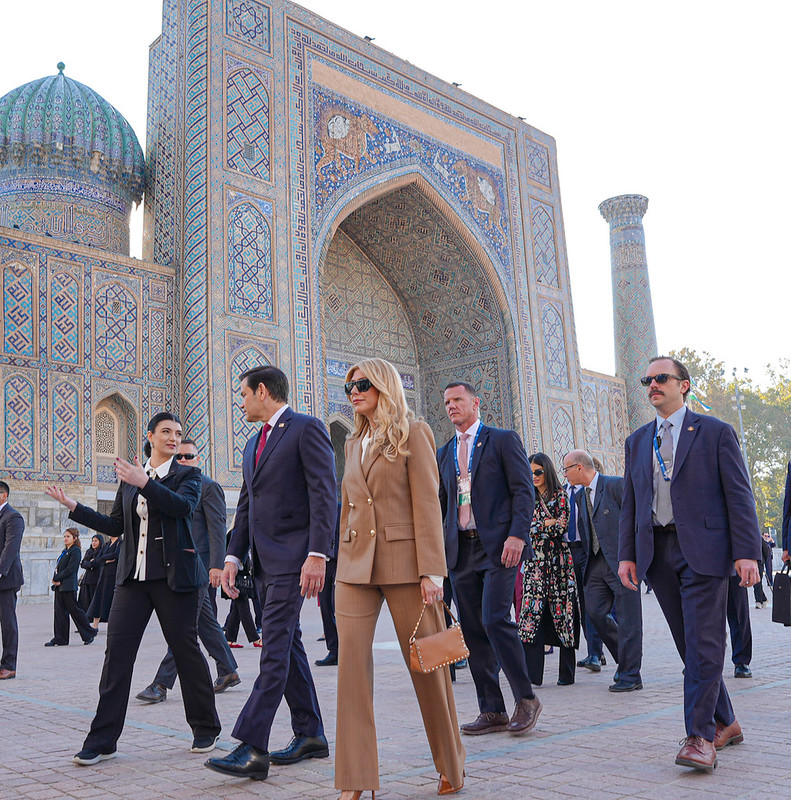
 Secretary Rubio Receives Tour of Registan Square. Image source: U.S. Department of State
Central Asia is Not the Answer to Our Critical Mineral Vulnerability
On October 19, Secretary of State Marco Rubio met Central Asia’s five foreign ministers in Samarkand, Uzbekistan, leading a U.S. business delegation that the State Department put at more than 200 business leaders. Uzbekistan announced 54 agreements and proposed projects with American partners worth nearly $12B, including critical minerals deals with ReElement Technologies, Traxys, and Trafigura, though no volumes or values were given for those. Rubio defended the push in supply-chain terms: “It’s not smart just for the whole world to depend on one place for 100% of anything.” U.S. officials increasingly point to Central Asia as part of the solution to the country’s critical mineral vulnerability.
The meeting extended a C5+1 framework that began in 2015 with its first ministerial in the same city, but current conditions could mark a turning point. The “one place” in Rubio’s remark is China, whose dominance over critical mineral supply chains, together with Russia’s preoccupation with Ukraine, creates openings, and the region is increasingly open to new partnerships. Yet Central Asia is not the answer Washington hopes for. No trade agreement with the region can entirely resolve U.S. critical mineral vulnerability, because the region cannot supply minerals at the scale, with the security, or on the terms Washington needs.
The Problem of Scale
The 2026 USGS summary reportedly found the U.S. is 100% import-reliant on 16 minerals, and China controls roughly 90% of rare earth processing. Central Asia’s best case is tungsten. A Cove Capital joint venture in Kazakhstan, with development costs of $1.1B, could produce about 12,000 tons a year, roughly 15% of global output, with first production expected in about three years. That is meaningful, but it is one metal in one country, and a Chinese-backed mine at Boguty is already operating there.
The larger gap is processing. Central Asian countries have long shipped raw ore to China for refining, where most of the added value went. Reaching Western markets at scale would require new export routes, energy infrastructure, and local processing plants, and regional governments want to process minerals themselves, which competes with Washington’s wish for quick, cheap supply.
One Dependence for Another
Scale is not the only obstacle. Geography undercuts the purpose of diversifying: escaping a supplier that can use a chokepoint as leverage. Landlocked Kazakhstan sends four-fifths of its crude exports through a single pipeline across Russia, which has been repeatedly disrupted, including drone attacks and a 2022 court order to suspend operations. Minerals do not move by pipeline, but those bound for American buyers would still cross the same territory and carry similar exposure.
The alternatives are not safer and need significant work. Actors in the Middle Corridor, namely Azerbaijan and Armenia, must make one of its routes scalable, the Caspian Sea is drying up, and the route runs close to Iran. A southern route to Pakistan and India would have to cross territory the Taliban hold. China, meanwhile, has invested more than $66B in the region, against a $12B pledge from European partners, so the eastern route is already funded. Whichever way it ran, through Russia, China, the Caucasus, or Taliban-held Afghanistan, the new supply chain would trade one exposure for another.
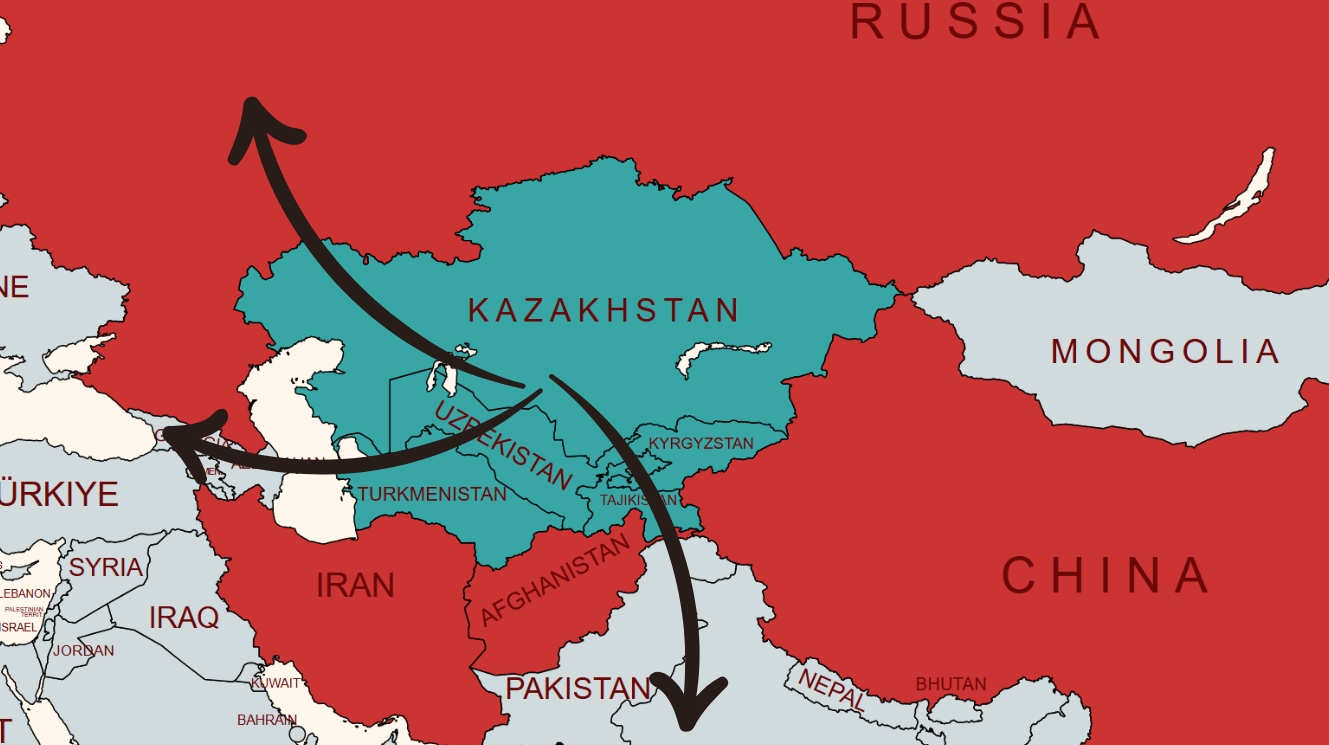
Map showing potential Central Asian supply chain risks
Host Governments Hold the Leverage
Central Asian governments know what they hold, and they have used it even against Western investors. Kyrgyzstan’s parliament allowed the state to temporarily take over the Canadian-owned Kumtor gold mine, and a court fined its operator $3.1B. Kazakhstan’s tungsten deposits went to a U.S. firm after the administration outbid a state-backed Chinese rival, but each such bid signals Washington will pay more.
A Better Strategy
Washington is right to diversify but should not over-rely on Central Asia. The Trump administration should deepen ties with partners that already supply key minerals, including Canada, Chile, and Mexico, and look to Australia, with 570,000 tons of tungsten reserves, as a tungsten source. It should also incentivize building processing capacity at home and with allies, because China’s control of refining is what makes the U.S. vulnerable. Leaning too heavily on Central Asia would repeat the problem Washington is trying to escape. Central Asia can be a hedge, but it is not the answer.