
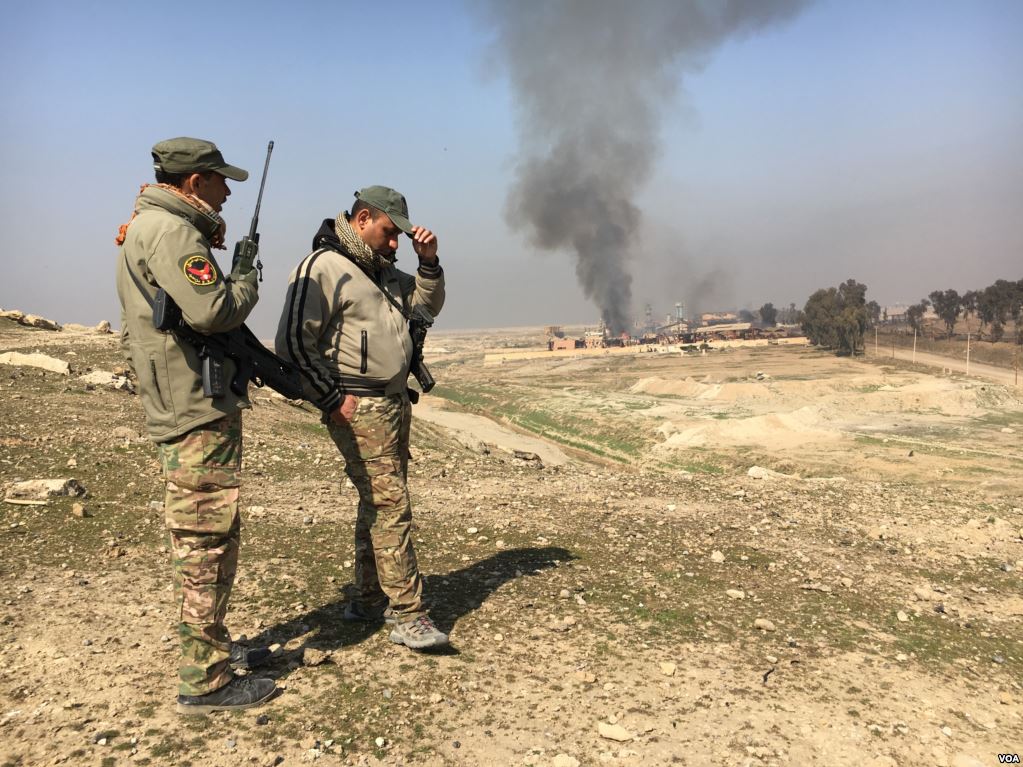
 Perez, Joshua. Iraqi ERD in Mosul. 2017
Reflections on the U.S. Withdrawal from Iraq
Mosul 2017
On an early morning in 2017 just outside the city of Mosul, Iraq, the crisp sun broke over a haze of dust. From a rooftop overlooking a neighborhood of concrete homes covered in concertina wire, with battered, crudely camouflaged Iraqi Humvees and U.S. armored vehicles on every corner, I sipped my coffee and contemplated the book I was reading.
This was my second deployment to Iraq, this time to fight ISIS in an offensive to regain Mosul and defeat the geographic caliphate once and for all. The book I was reading was David Kilcullen’s Blood Year, where he gives an account of the insurgency after the 2003 invasion. He describes in his book the Shia militia forces who had once been among the deadliest enemies of U.S. forces. These militants were known to use armor-piercing explosively formed penetrators (EFPs) in the form of roadside bombs—a tactic learned and supplied with Iranian support. I kept looking up from the page at the forces around me thinking, ‘how did we get here?’
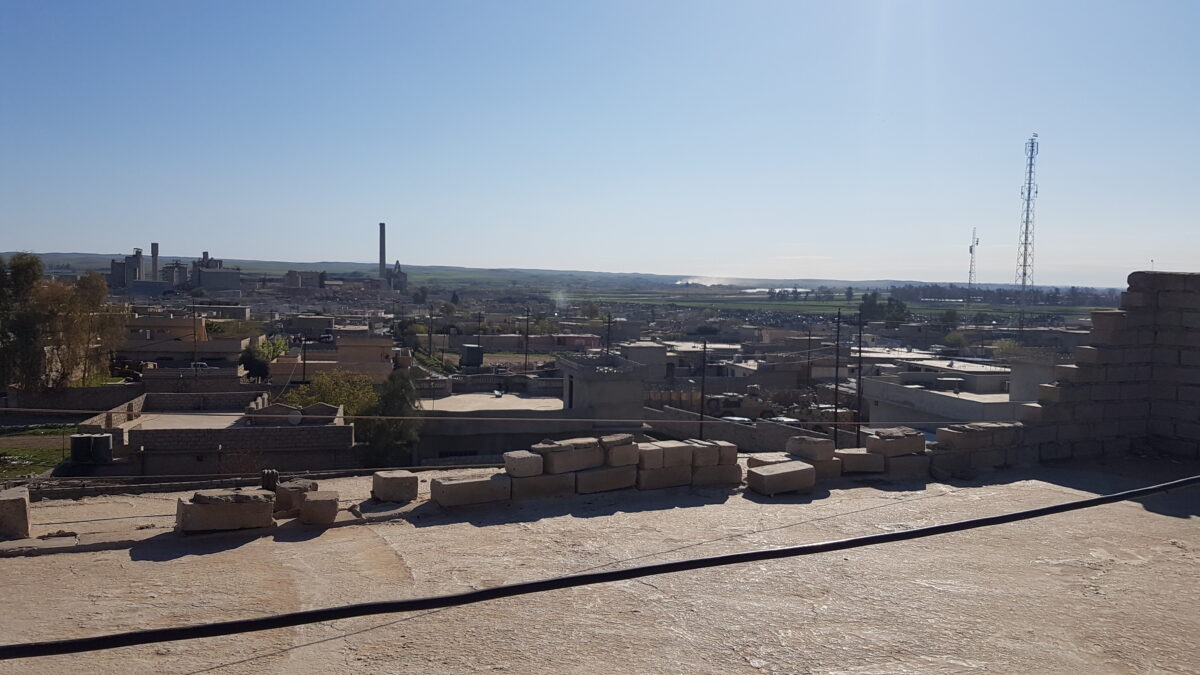
Perez, Joshua. Iraq Rooftop. 2017.
My Enemy is My Ally?
Days earlier, I had been part of a massive convoy moving toward western Mosul. Our first objective was the Mosul International Airport, a strategic foothold under ISIS control. Iraqi forces filled the road with a small contingent of U.S. special operations advisers alongside them. Flags stretched as far as the eye could see, each marking a different local Shia militia force, and the convoy was surrounded by news crews from all over the globe. To me, it looked partly like what we called in the military, a “dog and pony show”—a display for the bosses. The difference was this display had the world watching. Still, seeing those flags gave me and my teammates an uneasy feeling that we could not shake.
Our “partner force” for this mission was the Emergency Response Division (ERD)—an Iraqi Ministry of Interior paramilitary unit. The Popular Mobilization Forces (PMF), or Hashd al-Sha’abi, were a separate, state-recognized umbrella of armed groups, including militias with ties to Iran. The PMF sometimes supported the ERD while also operating independently across the city. Their overlapping roles blurred the lines between the forces, explaining the many militia flags—and much of our unease. The presence of the PMF in this battle and our reliance on them for the War against ISIS was marred by a deep complex history of aggression against U.S. and Coalition forces.
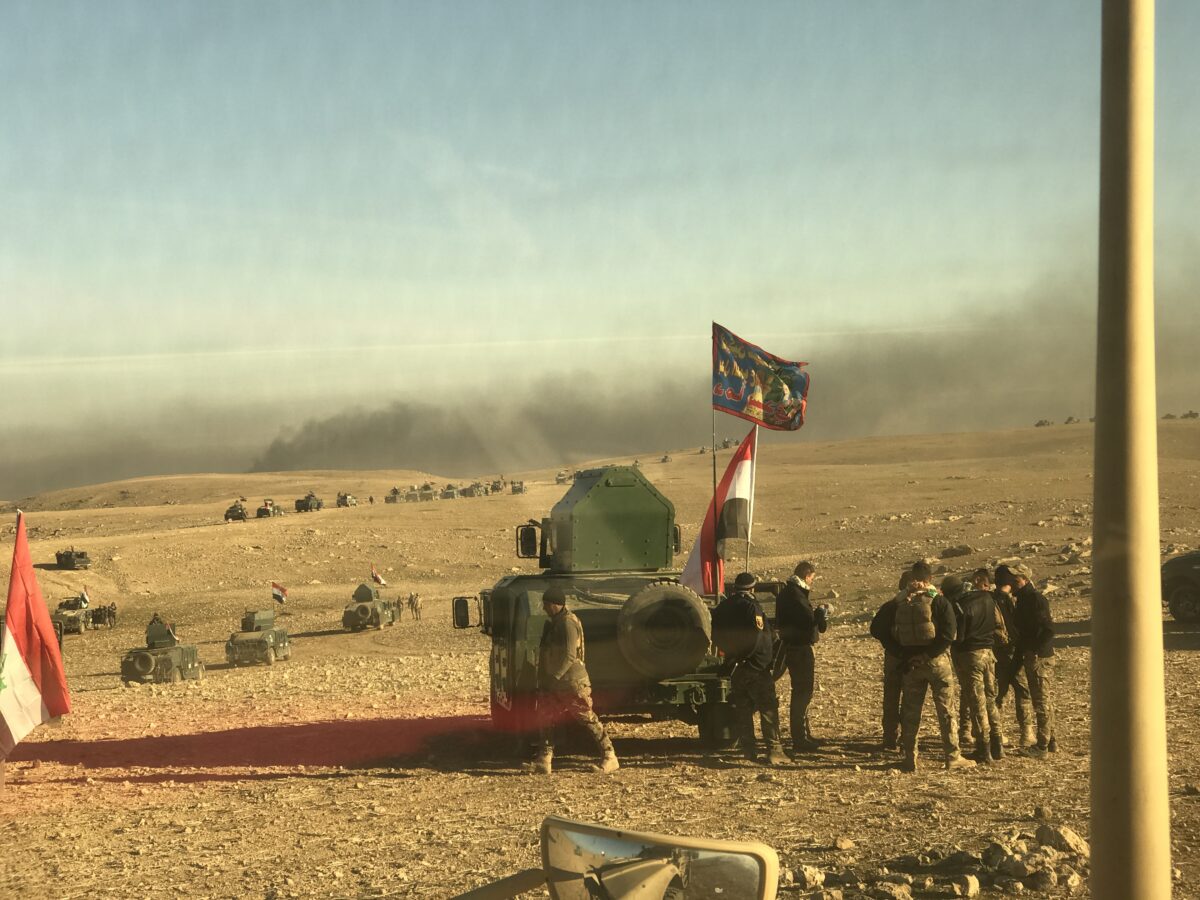
Perez, Joshua. Convoy to Mosul International Airfield. 2017
From Insurgents to Power Brokers
The Mahdi Army led by Muqtada al Sadr was formed as a Shia paramilitary force that fought against U.S. and Coalition forces and led a violent wave of sectarian violence against the marginalized Sunnis. Qasem Soleimani was the leader of the Iran’s Islamic Revolutionary Guards Corps-Quds Force (IRGC-QF). Under Soleimani’s leadership and Iranian influence, the Mahdi Army and the PMF became part of a permanent, separate government security structure in 2014. Under Soleimani’s leadership, Iranian-backed forces carried out numerous attacks that caused deaths and severe battlefield injuries, using advanced Iranian-supplied weapons and tactics, including EFPs. On January 3, 2020, he was killed in a U.S. drone strike.
In the aftermath of ISIS’ rapid seizure of territory, U.S. and Iraqi militia forces found themselves fighting ISIS at the same time. That was the convergence of interests that led Washington to place us in Mosul together, and to place me in a convoy with people who’d been trying to kill us less than a decade earlier. Despite this convergence of immediate interests, formal incorporation did not put every faction firmly under Baghdad’s control. Iran-aligned groups within the PMF retained armed and political influence, and some continued attacks on U.S. interests and partners. The concerns went beyond American forces: human rights organizations documented abuses against Sunni civilians by PMF forces during the anti-ISIS campaign.
The PMF and ERD formed part of the the ERD advanced into western Mosul while PMF units sometimes reinforced the ERD and operated in and around the city. The lines blurred though—this was essentially the same force Kilcullen had written about from the early 2000’s, and it had not changed its doctrine of violence. This was made apparent when our “partners” were accused of human rights violations, though the allegations left their relationship with the U.S. ambiguously unaddressed.
That was the source of the tension we could not shake and the uncomfortable lack of trust that plagued our combined operation that felt merely transactional—they would use us for targeting and air power, we would use them for manpower. We shared an enemy in ISIS, but that did not mean we shared a vision for the Iraq that would follow. On the other hand, relationships are built in battle, and friendships are made in the tensions and misery that is war. Even though the situation was not ideal we found moments of humanity that united us beyond our shared hatred for ISIS. No matter our organization or the flags we wore, on an individual level we wanted a better situation for the people we saw every day in the war.
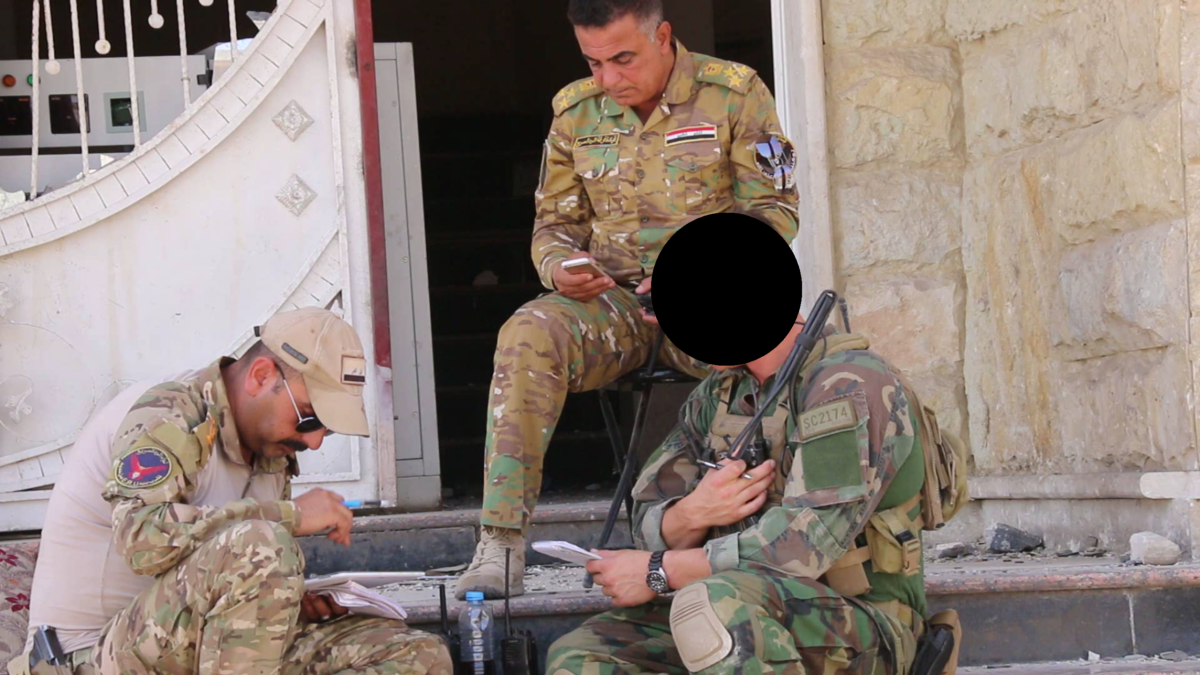
Perez, Joshua. US and Iraqi Forces Mosul. 2017.
The Withdrawal
The U.S. withdrawal of troops from Iraq serving under the anti-ISIS coalition raises a central question: can the country preserve its gains against ISIS while controlling armed groups within its borders and external influence from Iran? Ali al-Zaidi, who replaced Mohammad Shia al-Sudani as prime minister in May, has proposed a 90-day halt in attacks beginning September 30 and non-state militia disarmament by June 2027. The reality is there is no significant incentive for these forces to disarm and per the agreement this should have been completed before the withdrawal. With the absence of U.S. troops and the pressures of a highly motivated Iran seeking to expand its leverage and networks, efforts to bring the militias under state control are floundering.
An indefinite U.S. presence would not have resolved the contradictions I witnessed in 2017, but withdrawal does not erase them. Iraqi sovereignty will be measured by whether the government can control recognized armed groups, disarm unrecognized ones, protect threatened communities, and prevent ISIS—or a successor—from reemerging.
That challenge is compounded by Iran’s enduring influence. With the PMF entrenched in power, Tehran retains leverage over Iraq’s security situation, while al-Zaidi remains a key institutional counterweight. Despite President Trump’s support, the U.S. withdrawal leaves him vulnerable. Iraqi leaders have struggled to keep such tensions from turning violent, and militias shaped by sectarian conflict and fear of reprisals are unlikely to disarm readily. The graver concern is that Iraq will become another member of the IRGC “Axis of Resistance” and intensify an already difficult fight against Iranian proxies and the War against Iran.
These unresolved tensions return me to that rooftop, where I watched a coalition united by a common enemy while reading about men who had once fought Americans. I still think about the Iraqis and Americans who sacrificed to defeat ISIS. Honoring them requires an honest accounting of what victory was achieved and what was left unresolved.
That accounting matters to veterans of a generation of war since September 11, 2001. The Afghanistan withdrawal—where 13 Americans and 170 Afghan civilians were killed—still weighs on warfighters and arguably damaged U.S. credibility. More than 4,000 American service members died in the Iraq War and the interventions that followed, while violence associated with the invasion and its aftermath killed hundreds of thousands of Iraqis. After such losses, veterans and Iraqi partners deserve more than merely being celebrated and used as props in a political rant for a Tweet on X. They deserve a serious reckoning with the unresolved consequences for both countries that have left lasting effects—morally, physically, and . Our country owes this not only to the generation of warfighters who fought for 20 years in the Global War on Terror, but to those current and future generations of Americans sitting on the frontlines wondering whether the results of their efforts and sacrifices will be worth what was given.