
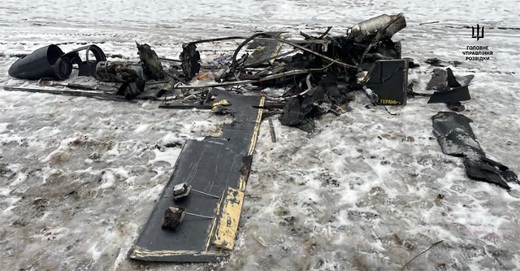
 Remains of a Russian Geran-5 Drone (Source: Ukraine Military Intelligence)
Russia’s Drones, America’s Technology
The Russia-Ukraine War is heading into its fifth year and critical U.S. technology is still finding its way into Russian drones. Even with heavy sanctions and export controls, Russia has continued to sustain its precision warfare capabilities, including cruise and ballistic missiles and drone warfare containing U.S.-origin microchips and other electronics. This raises critical questions: are there more effective ways for the U.S. to prevent Russia from obtaining U.S. technology, and does this mean other adversaries are able to do the same?
Russia is subject to some of the strictest export controls ever administered by the US government. This includes advanced semiconductors, AI-related computing technology, and other high-priority items. However, once shipments leave the U.S., they become extremely difficult to track and enforcement turns into a game of whack-a-mole. That’s why there has been increased scrutiny of third-party intermediaries and unauthorized regional distributors, particularly in non-sanctioning countries that can serve as transshipment points for controlled technology.
In the first years of the war, there was speculation that the chips found in Russian weapons could have come from pre-war stockpiles, accumulated when Russia was still able to import advanced microelectronics through legitimate channels. As the war dragged on, evidence suggested that Russia was adapting to circumvent U.S. sanctions and export controls. In January 2026, The Kyiv Independent found American components in Russia’s newer Geran-5 drone. The components were manufactured in 2024 and 2025, suggesting they could not have been from leftover pre-war stock. As recently as August 2026, Ukrainian investigators reported finding NVIDIA Jetson Orin computing modules in Russian drones used for targeting.
Advanced chips are dual-use technologies designed for commercial applications but capable of being repurposed for military use, making their diversion much more difficult to prevent. If the U.S. government and chipmakers fail to address this challenge, Russia will continue expanding its drone warfare capabilities—and leave the door open for other adversaries to exploit similar vulnerabilities.
In May 2026, the Commerce Department’s Inspector General released an audit examining the Bureau of Industry and Security (BIS), the government body responsible for enforcing U.S. export controls. The audit identified vulnerabilities in BIS’s review process, raising questions about the government’s ability to prevent restricted technology from reaching Russia despite existing export controls. This includes identifying high-risk shipments, documenting and evaluating end-use checks, and following through with enforcement. BIS has responded by enhanced targeting towards Russian procurement networks; however, the OIG’s recommendations concerning the end-use-check process remain open.
The lack of downstream supply chain visibility has fostered new approaches to tracking advanced computing hardware. A recent report from Georgetown’s Center for Security and Emerging Technology (CSET) proposed ping-based location verification (PLV), while GeoComply and American Security Fund have explored latency-based location verification of where computing hardware is operating. NVIDIA has also launched Fleet Intelligence, a customer-facing platform that provides fleet-wide inventory, location information, and integrity verification. Its involvement is particularly noteworthy because the technology comes directly from a leading GPU manufacturer with access to the hardware’s underlying architecture, raising questions whether the same technology could potentially support export-control enforcement by providing greater visibility into where advanced GPUs are being deployed.
However, greater visibility comes at a cost. Location verification could give governments and companies far greater insight into where sensitive computing hardware is operating, raising legitimate concerns about surveillance, data security, and who controls that information. Yet, despite these concerns, location verification may be one of the best opportunities to prevent advanced chips from being diverted to foreign militaries.
Congress is also cracking down on illicit chip flows through the through the Chip Security Act. The legislation seeks to strengthen the government’s ability to prevent advanced chips from reaching countries of concern by requiring manufacturers to implement technical security measures designed to detect and prevent diversion. These measures include location verification and tracking mechanisms that could help U.S. officials determine whether chips have been diverted from their authorized destinations. The House Foreign Affairs Committee advanced the legislation unanimously in March 2026, and a Senate version has also gained bipartisan support.
These are signs that the United States is taking steps to address the problem, but it remains to be seen what impact they will have. If the issue continues, Russia’s drone capabilities will likely persist and continue to advance as it gains access to critical Western technologies. More concerning, other U.S. adversaries could similarly exploit weaknesses in global supply chains to acquire technologies critical to future conflicts. There needs to be greater accountability among U.S. chipmakers themselves, including through the development of their own tracking technologies and subsequent cooperation with the U.S. government. After all, it is their technology that continues to show up on the front lines.