
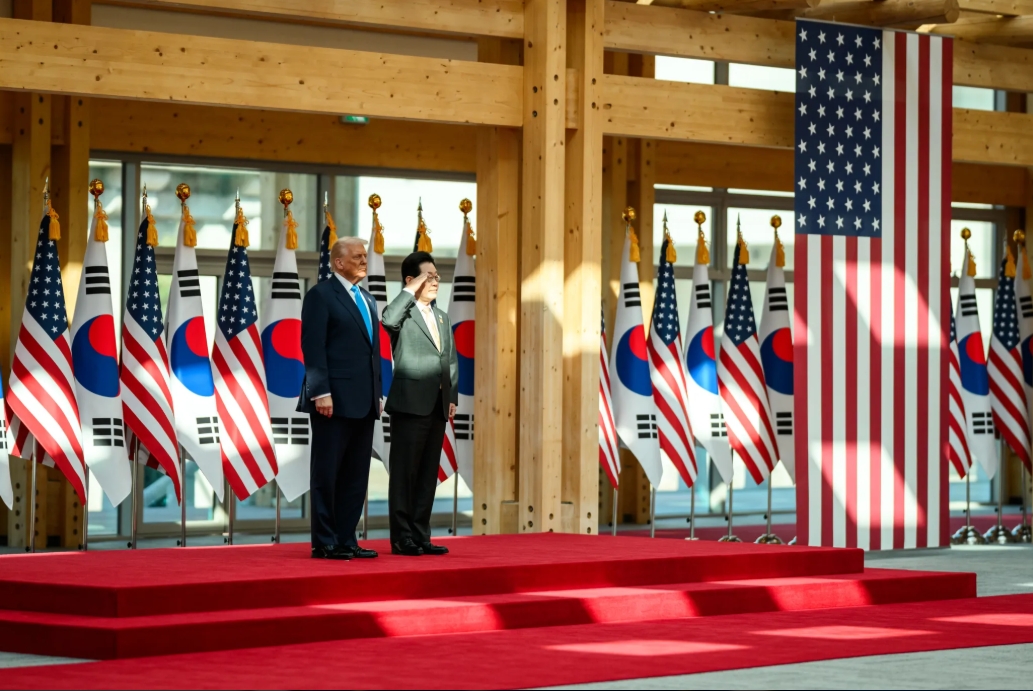
 President Trump's Visit to South Korea // The White House
Easing Sanctions Won’t Freeze North Korea’s Nuclear Ambition
A week ago, South Korean President Lee Jae-myung broke from precedent by urging the United States to consider easing economic sanctions on North Korea. He stated, “there is significant value in a trade-off between sanctions—which are not particularly effective anyway—and a stop to the development of additional nuclear weapons.”
President Lee leads the Democratic Party of Korea (DPK), which is historically more progressive on North Korea than its counterpart, the People Power Party (PPP). Nevertheless, Lee’s comments reflect a shifting landscape: the U.S.-Iran conflict, the Russia-Ukraine war, and China’s global involvement have all strained the environment that once sustained the sanctions regime, pulling key enforcing powers toward other priorities. As these dynamics shift, the United States needs to consider its position to address North Korea’s changing circumstances.
Background
Since 2006, the United Nations Security Council has adopted a dozen resolutions imposing sanctions on North Korea. These sanctions have pursued two primary objectives: deterring North Korean behavior in the nuclear sphere through economic coercion and preventing the regime from producing additional weapons of mass destruction (WMDs). The sanctions have targeted a wide range of activities and resources, including oil imports, individuals involved in nuclear development, and military capabilities.
Despite these measures, North Korea has continued to develop and test WMDs. Estimates indicate that North Korea possesses 60 nuclear warheads, with its stockpile beginning to expand significantly after 2023.
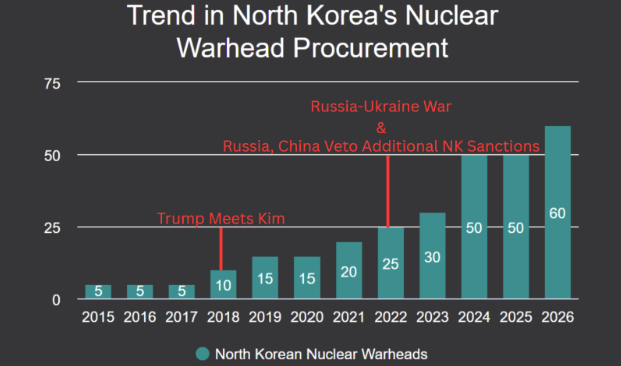
Data processed by the Federation of American Scientists
Are Sanctions Effective?
The economic sanctions imposed on North Korea have had a significant impact on the country’s economy. According to a report from the Institute for National Strategic Studies, North Korean exports declined by approximately 90 percent between 2016 and 2019, falling from $2.82b to approximately $280m. During the same period, North Korea’s imports declined by roughly 20 percent, from $3.71b to $2.97b. These figures indicate that the sanctions are achieving one of their intended economic effects: creating significant economic pressure on the North Korean regime to pressure behavioral change. But they have obviously not resulted in denuclearization.
Contemporary Events
Nevertheless, due to a lack of international cooperation and ongoing global conflicts, the impact of sanctions has dwindled. On May 26, 2022, Russia and China vetoed a resolution that would have increased economic sanctions on North Korea. Since then, Russia and North Korea have increased cooperation, as North Korea has sent troops to fight in Russia’s war in Ukraine and supplied significant munitions to that effort, with new reports indicating North Korea is using the fighting experience in Kursk as future training for its soldiers. Russia’s actions have broken a key tenet of UN Security Council resolution 1718: preventing technical or military cooperation with North Korea. Furthermore, recent reports have identified Chinese money-laundering networks helping North Korea evade international sanctions, with the most recent estimate indicating that in 2026 alone, North Korea gained $577m through stolen cryptocurrency and other digital assets.
Moving Forward
President Lee is right that “sanctions are not particularly effective to stop the development of additional nuclear weapons.” However, given North Korea’s growing engagement with outside actors, what would lifting sanctions incentivize Pyongyang to do? If the U.S. goal is to change North Korean behavior, easing sanctions will not achieve it.
Pyongyang’s actions show that it is pursuing the same goal it has had for decades: securing the Kim regime’s survival by deterring a future war. The Trump administration, and any future administration, must understand this. In 2019, a year after Trump met with Kim, North Korea added five warheads to its arsenal, a clear rejection of the spirit of engagement, and further indication it believes that nuclear weapons are critical for survival and holding onto power. This undercuts Lee’s proposal: If the U.S. eased sanctions in exchange for a freeze on weapons development, there is little reason to expect North Korea to honor that bargain.
As uncomfortable as it is, U.S. policy needs to prepare for a worst-case scenario, since North Korea has not shown a willingness to cooperate in good faith. The regime is already bringing troops back from Kursk to train its home military, which raises a pressing question: why should the U.S. ease sanctions while North Korea continues to benefit from its partnership with Russia? Trump’s recent decision to cut U.S.-South Korean joint training short fails to address this reality. Instead, the administration should deepen defense cooperation and joint training with South Korea and Japan to strengthen regional deterrence and the ability to respond effectively to a crisis.
While dialogue should still be pursued, it must be approached realistically. Lee himself attempted renewed dialogue, and North Korea dismissed his attempt to restart cross-border talks, further evidence that engagement alone is unlikely to change Pyongyang’s course.