
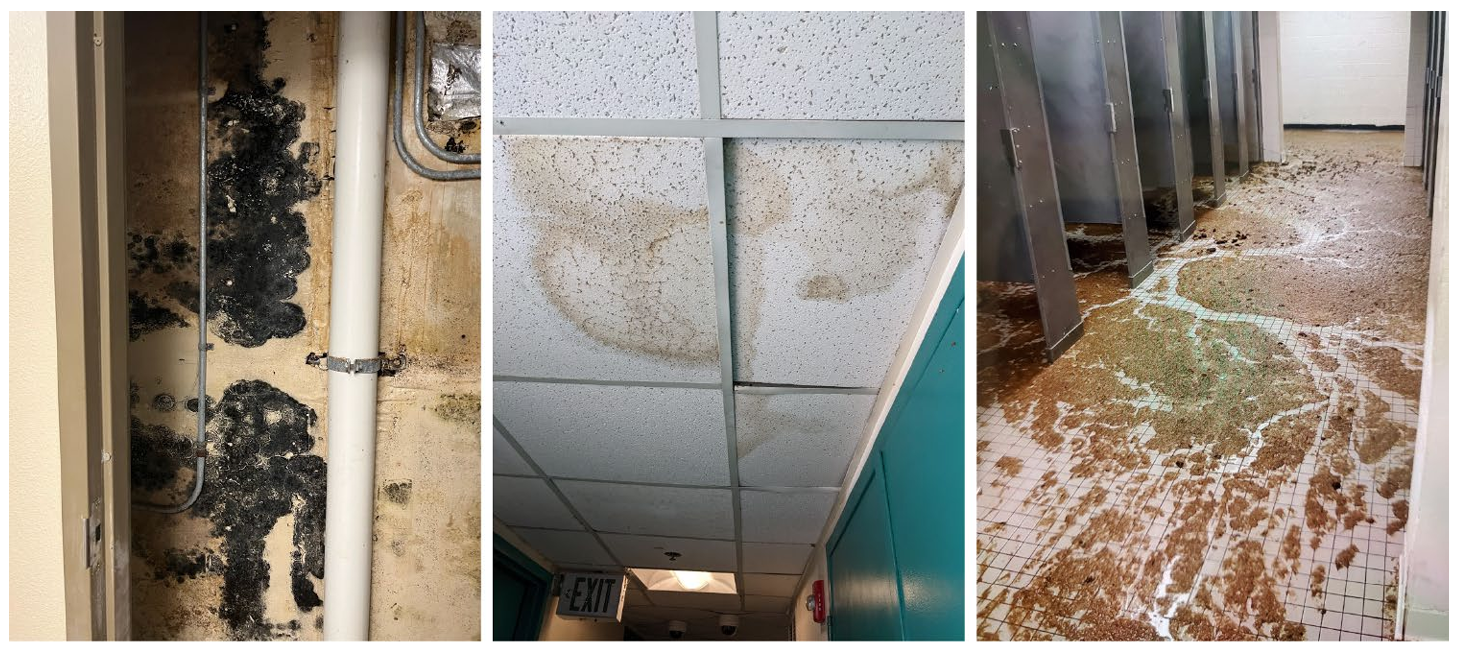
 Mold, pests, and other issues plague military barracks. Source: Government Accountability Office (GAO)
Barracks of Cards: The Pentagon’s De-Prioritization of Basic Human Needs for Servicemembers
Over the past two years, the Pentagon has brought topics like facial hair, the role of religion, gender identity, and testosterone levels to the forefront of their messaging and the readiness conversation. In the background, thousands of soldiers have spent months without air conditioning in their barracks rooms, some resorting to sleeping in their cars.
This is not a new or unforeseen issue but instead follows years of warnings and policy choices under multiple administrations to deprioritize and divert resources from soldier quality of life towards efforts like immigration enforcement. ASP’s work has covered the climate security aspect of military base resilience in the past, but record heat waves are just one of the challenges servicemembers are left to face alone as the government continues its decades-long neglect of the facilities and systems its warfighters depend on.
Single Soldier Housing
The military generally requires junior enlisted servicemembers without dependents to live in government owned dormitory-style barracks facilities. Across the DoD, they are collectively facing a $285 billion maintenance backlog. While Congress does specifically authorize funds for barracks improvements and is calling for billions of dollars in the 2027 NDAA, for years, the military has underfunded barracks maintenance to use the resources elsewhere.
The lack of market competition and fact that both servicemembers and leadership only remain tied to housing for a few years produces a form of tragedy of the commons where neglect becomes commonplace. Combined with the age and pre-existing issues of many facilities that were built on undesirable land to begin with, this meant that in 2023, nearly a quarter of barracks were in poor or failing condition.
The military’s power dynamics enable leaders to push the associated risk down to the lowest level, with some installations banning personal air conditioners in the barracks and directing servicemembers to attempt hazardous mold remedies themselves. Regulations dictate minimum space allotments per servicemember, but leaders frequently violate that requirement due to overcrowding. At the same time, there are entire barracks blocks and neighborhoods of old housing lying empty because they’ve been condemned but the government can’t afford to replace them. Frustrations with the barracks even motivate some servicemembers to get married in order to get out of the barracks system early, but they then find that family housing has similar issues.
Family Housing
Approximately 700,000 servicemembers and dependents live in housing offered by the government but managed by third-party companies. Evidence suggests nearly three quarters of these households have issues with mold, over half have issues with temperature/humidity, HVAC, pests, and water damage, and many link their housing issues to health issues they or their children experience. Contractors force some families to sign non-disclosure agreements when they request help. Though the government has repeatedly caught private housing contractors engaging in fraud and smothering resident concerns, it still contracts 99% of military housing to private companies for 50-year contracts.
National Security Implications
In 2025, 97% of surveyed servicemembers had a significant and dangerous issue with their military-provided housing, and 47% said it compromised readiness. According to the most recent numbers, only 32% of active-duty family members recommend service to potential recruits in their families—mostly due to quality-of-life issues—and 44% of servicemembers list housing as one of their top concerns. Repeated GAO and Congressional reports have identified lack of commitment to housing improvements as an impediment to readiness and a national security risk.
Unsafe housing has frequently forced the government to use emergency funds to relocate soldiers and pay to house them privately, in some places paying $2600 per soldier per month. This puts increased pressure on local housing markets and is frequently still insufficient to cover costs to servicemembers. It also leaves military leaders with less budget flexibility to respond to emergent national security crises.
Policy Options
Some branches—most notably the Air Force—have far better reputations for housing and quality of life than others, so there is a model for success that the Army and Navy can emulate if implemented and funded correctly. However, rather than committing to fully funding a solution, the Pentagon has employed a patchwork of band-aid solutions and is exploring a range of alternatives, with most of the burden borne by individual servicemembers in the meantime.
The Army has weighed privatizing barracks for unaccompanied soldiers, but that option is beset by the same accountability problems as it is for family housing. The Army has also considered allowing more soldiers to move out of the barracks, but that would introduce its own financial and organizational issues. Civil society organizations are working with Congress to introduce bipartisan legislation like the Military Occupancy Living Defense (MOLD) Act, but like many other challenges, this issue faces an uphill battle against the desire of policymakers to spend money and political leverage on flashier efforts.
Secretary Hegseth and his aides have publicly addressed this crisis and called for solutions as a matter of national security and readiness, even going so far as to launch a ‘Barracks Task Force.’ Still, rather than making progress towards solutions, the Pentagon is embroiled in efforts that they themselves decried for derailing past attempts. The military is extending deployments and spending its budget and manpower on the Iran war and domestic border and city patrolling despite meager evidence their efforts in the Middle East or American cities are increasing security. While the Pentagon is willing to spend money housing National Guardsmen in luxury hotels and apartments to patrol cities, their active-duty comrades a few miles away may be living on bases with far lower prioritized funding.
The military counts on its leaders to set priorities, make decisions, and assume risk. Currently structures push much of the actual risk down to individual servicemembers and their families whose basic human needs are receiving lower prioritization than the less tangible aspirations of their leaders. If the Pentagon keeps kicking this down the road, it will only grow worse, not only a rejection of the duty of any society to take care of its warfighters, but a glaring weakness in the readiness the nation depends on.