
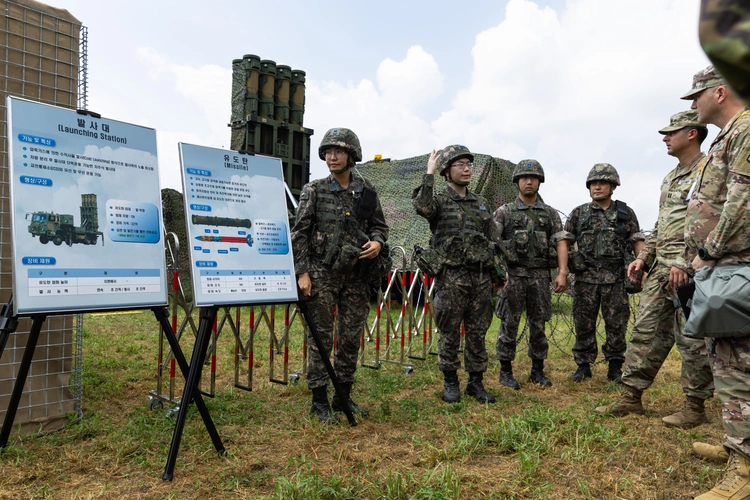
 A combined U.S.-ROK air defense artillery exercise during Ulchi Freedom Shield 2025. U.S. Army photo.
Reduced Military Exercises with South Korea Puts the Pacific Alliance System on Notice
Guest post by John Craig-Lee
Two days into Ulchi Freedom Shield, a major annual combined training exercise between American and South Korean forces, President Trump ordered the Department of War to scale back its joint military exercises, cutting the drills from eleven days to five. Several days later the United States cancelled Ssang Yong 2026, a combined U.S and South Korean Marine Corps exercise, citing constraints stemming from the war in Iran. These decisions affect one of America’s most consequential alliances in Asia, and if the President’s order marks a permanent reduction in security cooperation, it heralds a shift in regional primacy.
Pyongyang has demanded a halt to these drills every time they are conducted and Washington has obliged before, but only when a summit was on the horizon. For seven decades, the U.S.-ROK alliance has anchored American power on the Korean Peninsula and checked North Korean and Chinese ambitions in the region. Kim Yo Jong, the North Korean leader’s sister, dismissed the reduced drills as the most immediate and open threat to Pyongyang. Days later, North Korea fired more than ten short-range ballistic missiles toward the sea, prompting an emergency security meeting in Seoul.
North Korea routinely refers to high-visibility combined training events as provocative or war rehearsals, and the current administration has stated that these drills send an inappropriate and hostile message. Whether these actions aim to cultivate favor with the North Korean regime or serve as retaliation for South Korea’s abstention from the conflict with Iran, the retreat may be the opening Beijing seeks. If the United States, at minimum, cannot maintain the status quo in the Pacific theater and its position as the preferred security partner falters, who will challenge China’s ascendancy?
Shying away from an ally the U.S. is intricately linked to is a red flag to other allies and partners in the Pacific, raising doubts about whether American leadership will uphold its existing commitments and belief in a “free and open Indo-Pacific.” Pre-existing bilateral defense pacts throughout the region, from Japan to the Philippines to Australia, may also come into question as a result. Orient Shield, the largest annual U.S.-Japan field exercise, is still scheduled for September. Whether it receives the same treatment as Ulchi Freedom Shield to further signal the desire for a U.S.-North Korea summit later in 2026 remains to be seen.
The commitment to a “free and open Indo-Pacific” has held across both parties for nearly a decade on paper and in practice, but recent decisions could very well force a recalculation. The current administration’s National Security Strategy, released in November 2025, calls for winning the economic future while preventing military confrontation in Asia, and the Department of War’s 2026 National Defense Strategy builds on that, naming China, Russia, Iran, and North Korea as significant security challenges and listing “Deter[ing] China in the Indo-Pacific Through Strength, Not Confrontation” as its second priority. Reducing involvement in or completely disengaging from combined exercises with South Korea runs directly against that stated priority and makes allies nervous.
If the United States cannot hold the status quo on the Korean Peninsula, and South Korea starts to doubt that America is still its best security partner, someone else will have to check China’s rise instead. That uncertainty raises a harder question. Would South Korea, and even Japan, decide that developing their own nuclear weapons provides a higher deterrent value than an American guarantee that has held for over sixty years but no longer feels as solid? Polling last year found that three quarters of South Koreans supported developing an indigenous nuclear capability, up from 70 percent the year before. The current administration has put North Korea’s arsenal at 57 warheads, while South Korea’s own defense ministry estimates the true figure likely ranges from 80 to 120.
Rifts in American politics, diplomatic inconsistency, and frequently shifting policy have pushed the United States into an unexpected position on the Korean Peninsula that is hard to explain and even harder to defend. The United States shuns military cooperation with a key ally in Asia while echoing the rhetoric of one of the nation’s declared security concerns, North Korea, a country that, along with China, has provided military assistance to Russia, which has in turn assisted Iran in its fight against the U.S.
What we may be witnessing is valuable alliances being spent down, one exercise at a time, all in return for a concept of a plan that has yet to be conceptualized. The reduced exercises may be intended to lay the groundwork for a fourth Trump-Kim meeting before the year is out, but there is no reliable indication this is likely. Trump has said he received a response from Kim Jong Un after scaling back the drills but Kim Yo Jong denies any such communication took place. Three prior summits produced no lasting agreement on denuclearization, and nothing suggests a fourth would end differently.
John Craig-Lee is a former Army officer with extensive experience strengthening the US-ROK military relationship. He is a graduate of the U.S. Military Academy and the Korbel School of Global and Public Affairs at the University of Denver.