
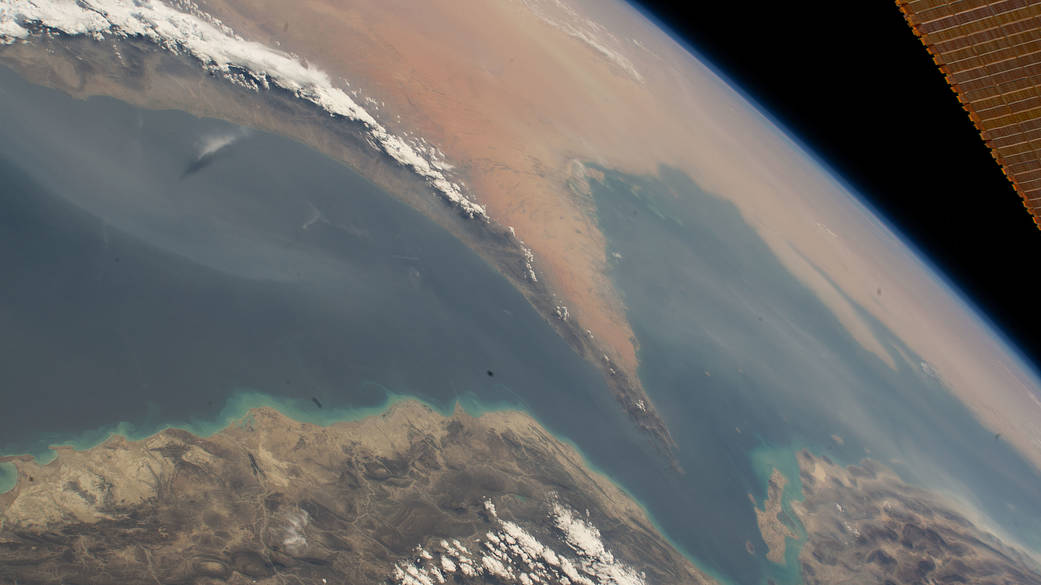
 The Strait of Hormuz connects the Gulf of Oman with the Persian Gulf // Photo by NASA
What Options Are Left for the U.S. in the Strait of Hormuz?
The Strait of Hormuz is a critical artery of the world economy, through which 20% of the global energy trade and a third of the global fertilizer trade pass. Reductions in the energy and fertilizer trade impact global prices of goods and food, which will primarily affect the poorest countries and the most vulnerable. Since the U.S. and Israeli attacks in February, Iran has leveraged its asymmetric ability to halt shipping through the strait. This is a primary reason why the U.S. remains engaged in the conflict despite about two-thirds of Americans feeling it is not worthwhile.
The current U.S. strategy to reopen the strait is enforcing a blockade on traffic to and from Iranian ports while trading tit-for-tat strikes with Iran in an attempt to force them into negotiations. This approach has thus far failed, as Iran appears more willing to endure a prolonged conflict than the U.S. This tactic is also draining the U.S. of its strategic munitions stockpiles and has proven to be very costly. Since this strategy has thus far proven unfruitful, what other options does the U.S. have?
Invasion
To forcefully reopen the strait, the U.S. would likely have to capture over 200 miles of the adjacent coastline or invade the entire country of Iran. A limited capture of Iranian territory would require a massive amphibious assault and securing an area that is unlikely to provide evacuation or reinforcement routes by land. This would submit U.S. troops to constant threats of bombardment, insurgency, and counterattack. A total takeover of the country of 93 million people (compared to Iraq’s 25 million in 2003) would similarly incur high costs and risk a nation-building quagmire. Beyond the human and financial toll, a failed invasion would be a political disaster for U.S. leadership, making it unlikely. However, invasion may be the only way the U.S. could win outright.
Withdrawal
Withdrawing from the conflict entirely would gut American soft power by eroding the image of the U.S. as a responsible state, and cast doubt on its hard power, while simultaneously abandoning U.S. partners in the Gulf to deal with the fallout. At worst, it could accelerate the collapse of America’s international standing, while leaving the global economy at Iran’s mercy. would also jeopardize the U.S.-led rules-based order and the law of the sea, opening the door to other potential conflicts.
Bypassing the strait
There are already a handful of pipelines that circumvent Hormuz, and seven more are under construction or being planned. These pipelines have already shown their importance, as evidenced by Saudi Arabia redirecting over 70 percent of its oil via a pipeline at the beginning of the war.
Pipelines like these are designed to mitigate risk, not move the totality of oil shipments. Meeting that level of capacity would require an ambitious and expensive investment with uncertainty about financing, timelines, and effectiveness at insulating the world from future disruptions. Pipelines are large, immobile, and visible, making them easy targets for low-cost asymmetric attacks. This all means pipelines are best suited as a hedging strategy, not a magic bullet.
If they are not attacked, a growing variety of sources and ports for these pipelines would support global energy resilience, reducing the impact of disruptions at individual chokepoints in the Middle East. This would decrease the amount of disruption Iran can levy on the global economy. Additionally, pipelines would allow for countries to avoid potential Iranian tolls when the strait is reopened.
Diplomacy
Since the collapse of the ceasefire in July, the two countries have been unable to come to an agreement that could provide a temporary solution to the strait, let alone a permanent one. Trump reportedly cancelled attacks over the weekend, offering something of an ultimatum to the Iranians on Monday, August 3rd, saying “this is a last chance for them to sign a good document.”
On Tuesday, August 4, the Trump administration and Qatari officials signaled optimism about securing a deal that would reopen the strait, though it is not apparent which parties are in contact with one another. The deal that has been publicized is the proposed Iran-Oman deal, which would allow commercial traffic through the strait for a service fee of a currently unspecified amount. This proposal would likely need modification as the imposition of fees has been a red line for the U.S., especially considering there were no fees prior to the conflict. However, it is unclear what realistic leverage the U.S. can apply to achieve a favorable agreement.
The continuing conflict is eroding the power of the U.S. as it faces a potential strategic defeat. Given the limitations and potential high costs of other options, the U.S. seems to have forced itself into a position where it will accept its major policy losses as a cost of action against the Iranian nuclear program. Once the strait is reopened, the U.S. can continue negotiating a nuclear deal with Iran, but unlike before the war, control of the strait will be part of those negotiations in a way it had never been previously, weakening the U.S.’s bargaining strength in negotiations on the nuclear issue itself.