
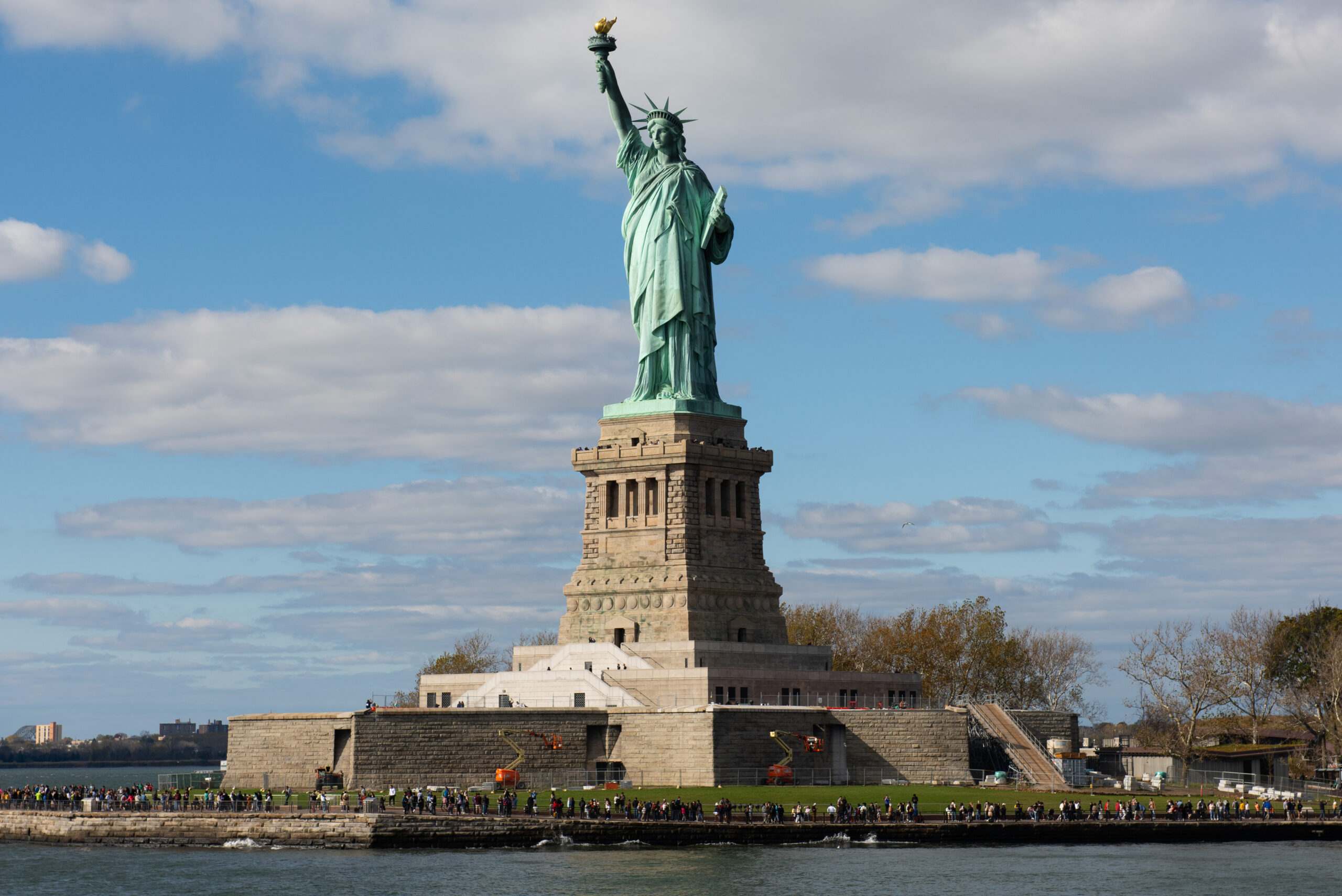
 Statue of Liberty // Image credit: Matthew Wallin. Copyright. Used with permission.
To Beat China in Global Favorability, the U.S. Must Learn From its Mistakes
The U.S. has reached a decisive moment in maintaining its global favorability and international legitimacy. A Pew survey, released July 15, found that the populations in most of the 36 countries surveyed now view China more favorably than the U.S., a reversal from just a year earlier. These results were driven largely by declining confidence that America respects its citizens’ freedoms and its recent record of making unsound decisions affecting the international community. If the U.S. intends to maintain its traditional global leadership role, it must undertake an effort to reassess the misalignment between its actions, its rhetoric, and the perceptions of foreign publics.
To retain its leadership role, the U.S. must first decide clearly what it wants to represent and ensure its policies reflect that choice. Washington has long described itself as a force for good, by expanding global security, promoting human rights, and pushing to resolve conflicts through diplomacy. Self-correction has historically coincided with that identity, where the Constitution was crafted with mechanisms for amendments on the premise that acknowledging errors was not weakness, but a method of improvement.
A good leader is able to recognize mistakes and improve. President Trump’s Executive Order misses this important premise by directing federal agencies, under the guise of “truth,” to present a sanitized “uplifting” version of American history at museums and public monuments. Unlike China, which actively restricts information about the Tiananmen Square massacre, what makes American society a standard to follow is its ability to recognize and discuss its mistakes, whether that mistake is My Lai, slavery, or Japanese internment. The world holds the U.S. to a standard not always applied to others, expecting America to embody the ideals it preaches in genuine hope it exemplifies its founding ideals. A government that can no longer tolerate scrutiny of its own record does more self-damage than one that never claimed moral leadership in the first place.
That same scrutiny is echoed domestically, as the American public is signaling different priorities than the ones currently driving federal policy. Recent polling shows that a clear majority of Americans want both the nation’s successes and failures presented honestly without government-mandated omissions. A survey from late 2025 found 66% of Americans say it is important to publicly discuss the country’s historical successes, and 66% also say the same about its failures; a pattern holding across race, age, and education. A separate survey found that 83% say the founding fathers deserve respect for building the country, while 75% simultaneously say understanding their impact requires reckoning with their tolerance of slavery. Americans are not demanding a purified story; rather, they are asking for both positive and negative narratives to be portrayed accurately, a request neither the removals nor the curriculum changes are capable of addressing.
However, this puts American public opinion at odds with federal policy. For example, an exhibit at Philadelphia’s President’s House Site was pulled by the National Park Service in January, under the direction of the new executive order. After an appeal and a stay this June, the Trump administration secured the right to install replacement panels that critics say distort the exhibit’s history, which memorialized the people George Washington enslaved, including those he owned while serving as president. This July, the White House labeled the Smithsonian’s “Becoming US” curriculum “radical” for teaching a comprehensive historical account of American immigration and migration.
The contradictory relationship between the administration’s free speech rhetoric and federal policy, felt by international publics and governments alike, extends into how the administration treats criticism in real time. The White House now runs a “Media Offenders” tracker, ranking news outlets on a leaderboard of “repeated lies” and naming a weekly offender for journalists’ reporting the administration’s disputes. By denouncing journalists for unfavorable coverage, Washington directly contradicts its own self-proclaimed identity as a defender of free speech and sets a terrible example for others to follow. The efforts to rewrite national history exemplify an attempt to distort the record—a coordinated effort to dishonestly reshape American public diplomacy and its international image.
While not intended to influence foreign publics, these contradictions in proclaimed ideals and actions are affecting the world’s opinion of America. What ultimately matters is not whether the government believes its own version of events is accurate, but whether foreign and domestic audiences observing America treat the government’s account as credible. If America wants to lead the world, it has an obligation to understand this. Public diplomacy scholars have identified collecting, analyzing, and listening to what a public actually believes and feeding that into policy to be more effective than pure advocacy or messaging. ASP research finds that U.S. messaging succeeds or fails based on how foreign audiences actually interpret it, not on what the administration intends to say.
We should be alarmed by the polling data. What the country needs now is an honest look at what it was founded on, what it has become, what it claims to be, and whether that gap still leaves room for the world’s trust in its leadership. That is a far more ambitious 250th anniversary project than restoring a monument or denouncing journalists for unfavorable reporting. Reasserting a consistent and reliable narrative through tangible actions in pursuit of American public diplomacy should be considered in any attempts at restoring U.S. credibility on the international stage.