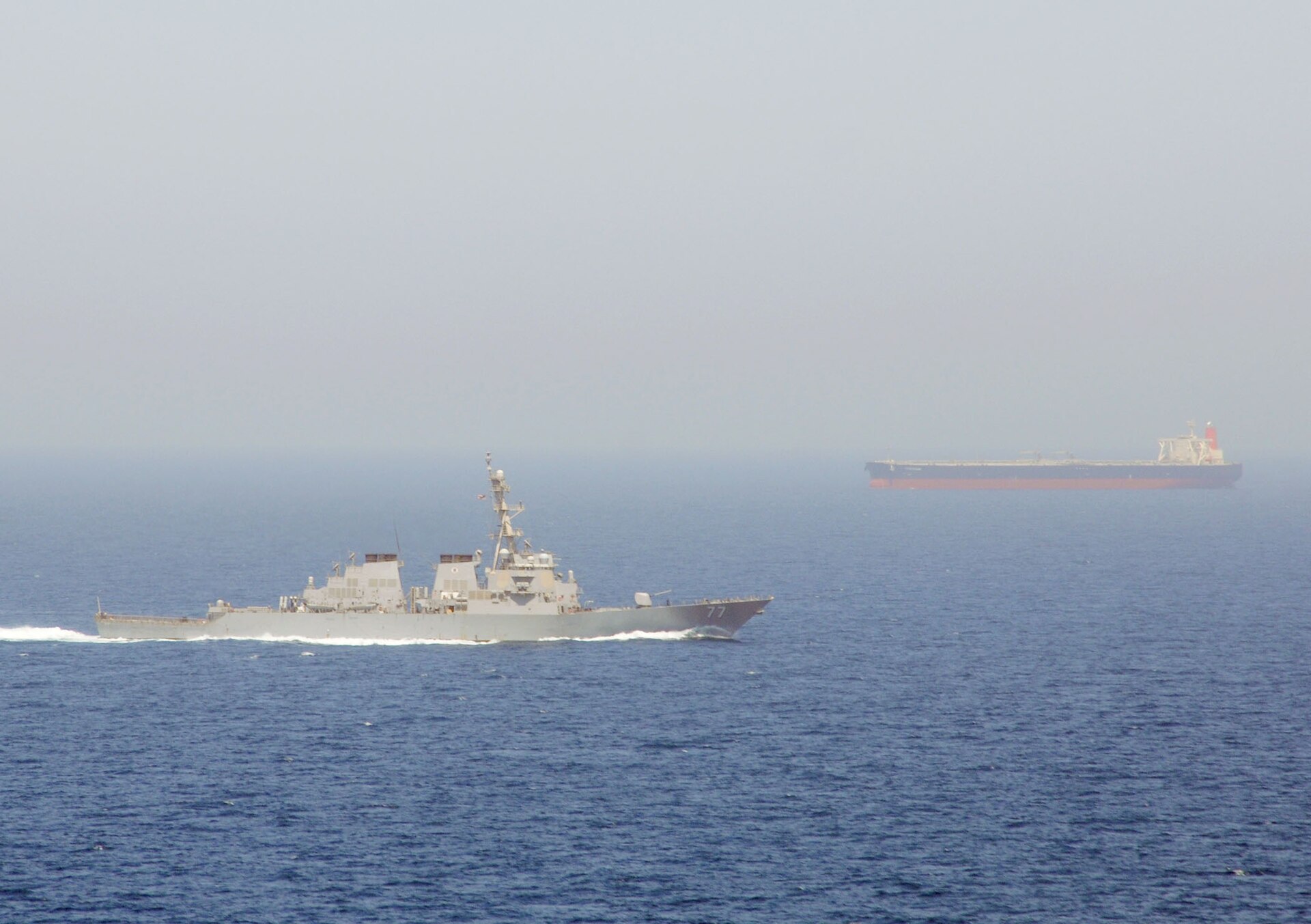
 The USS O’Kane patrols the Arabian Gulf // U.S. Navy Mass Communication Specialist 3rd Class Korrin Kim
U.S. Strategy in a New Era of Weaponized Maritime Chokepoints
As demonstrated by the closure of the Strait of Hormuz, global trade depends on the unencumbered flow of goods through maritime chokepoints. The world is still watching the U.S.-Iran war unfold, but state and non-state actors alike have already realized the power of blocking these vital bottlenecks. The U.S. and its allies should now anticipate the proliferation of this tactic and prepare accordingly for a new era of geopolitical competition; one in which the global economy is held hostage by actors seeking accessible geopolitical leverage.
The Bab el-Mandeb and Hormuz Straits account for 11.1 percent of the world’s ocean cargo volume, and Hormuz specifically is depended on for 20 percent of global oil and liquefied natural gas supplies. This trade is largely governed by the United Nations Convention on the Law of the Sea (UNCLOS), which guarantees free passage through maritime chokepoints. Neither the U.S. nor Iran are party to UNCLOS, but the international legal framework has been directly challenged by both countries. Iran seeks to keep Hormuz closed, while the U.S. briefly argued that it should receive a protection fee from all transiting vessels. As the non-party status of both the U.S. and Iran limits the likelihood the dispute would be handled by the International Tribunal for the Law of the Sea (ITLOS), the legal repercussions of such actions have become unclear, paving the way for future strait closures.
At face value, China might seem likely to use this tactic due to its control over both the Taiwan and Bohai Straits, but this risk is minimal. These straits constitute only a marginal percentage of U.S. global maritime trade, while China heavily depends on the passages. Instead, a future state-issued closure of the Bab el-Mandeb or the Hormuz strait would be more conceivable, and a blockage of the Panama Canal could be far more disruptive for the U.S. The U.S.-Iran war has demonstrated that diplomacy is more useful than force when addressing these state-shuttered chokepoints; however, the U.S. must back this effort with a strong naval presence.
Conversely, non-state actors can pose a potentially more insidious threat. The prospect of militant proxies and pirates using inexpensive drones raises concerns they could exercise significant control over strategic chokepoints. Iranian unmanned underwater vehicles and unmanned surface vehicles have already proved their effectiveness in the Strait of Hormuz and can easily be transferred to Iran’s militant proxies. With decentralized command structures and insufficient local institutions to monitor and combat piracy, Iran’s strategies in Hormuz could be replicated at low-cost to pirate groups in various crucial trade chokepoints like the Bab el-Mandeb or the Strait of Malacca. Additionally, these groups could use other methods like hijacking vessels to seal canals, causing disruptions like the 2021 Suez Canal obstruction.
As this form of geopolitical coercion gains popularity in the coming years, the U.S. will need to formulate a response strategy. Diplomatic efforts would be strengthened by U.S ratification of UNCLOS. In the event of a future closure by an UNCLOS member state, the U.S. should prioritize diplomatic negotiations and position naval forces nearby to signal both capability and resolve. If bilateral negotiations with the member state fail, its UNCLOS participation would enable it to easily bring forward a case before ITLOS. If negotiations fail and the offending actor falls outside UNCLOS jurisdiction—whether a non-party state such as Iran or a non-state actor—the United States would hold greater international legitimacy to coordinate a multinational operation to restore freedom of navigation while waging a pressure campaign against the responsible actor or state sponsor.
Preemptively, the U.S. should also build supply chain resilience by near-shoring critical production and diversifying shipping routes to limit overreliance on maritime bottlenecks. It should additionally seek to strengthen its alliances and partnerships with chokepoint-controlling or adjacent nations like Egypt, Panama, Malaysia, and Indonesia. By enhancing these relationships while simultaneously investing in its naval capacity, the U.S. can alleviate risks associated with closures.
At a time when maritime trade constitutes approximately 80 percent of the flow of goods worldwide, chokepoints have become an inherent vulnerability to the global economy. Now, the U.S.-Iran war has ushered in a new era of geopolitical coercion wherein actors can hold the world hostage with low-cost mines and drones. The U.S. must formulate new strategies and adapt to the threat that this war has unleashed. Admittedly, the war provides an unanticipated upside: the U.S. can use it as an early testbed for novel tactics and thus gain valuable experience for future crises.