
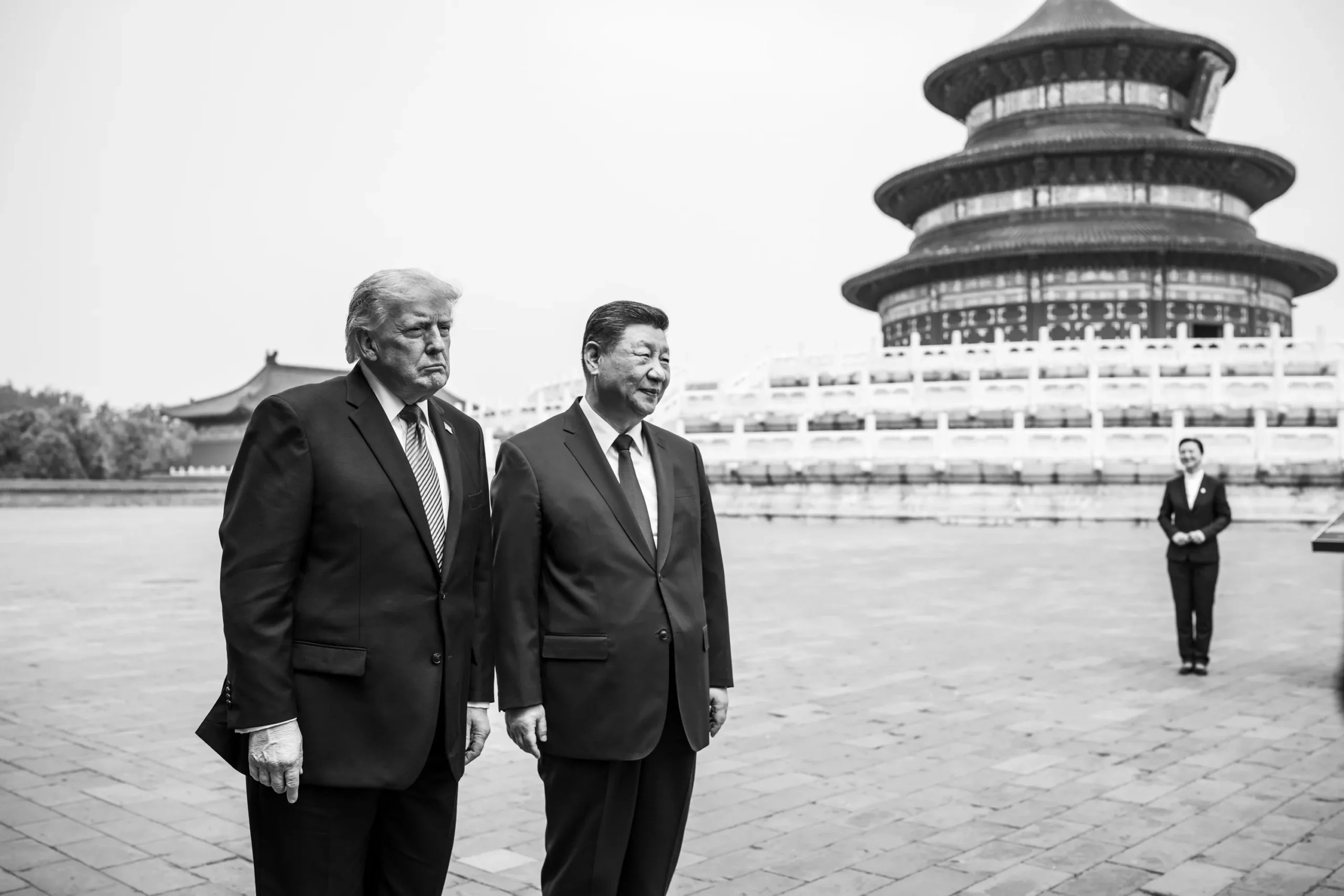
 Presidents Trump at Xi the Temple of Heaven in Beijing, China // White House
China’s Leadership Ambitions Depend on America’s Retreat
A new Chinese white paper published recently details a vision for reshaping global governance under Chinese leadership. Largely an advertisement rather than a substantive policy roadmap, the white paper envisions a changing world wherein American hegemony gives way to a system of Chinese-led multipolarity. While the accuracy of this projection is uncertain, it should be a wake-up call for U.S. policymakers and the public alike. This provides an opportunity for U.S. leadership to rethink American retrenchment and reinvigorate the nation’s efforts to maintain its status as a global leader.
From integrating into global institutions throughout the late 20th century to assuming a more active role in the 21st century, China has extended its influence while simultaneously crafting a web of dependency across the Global South. U.S. presidents like Clinton, G.W. Bush, and Obama sought to integrate China within the international system and mold it into a “responsible stakeholder;” however, their long-term vision always saw the U.S. as the leader of that system. Currently, the U.S. approach has diverged from that path, rolling back American engagement with global governance institutions in the name of protectionism and autonomy.
This retrenchment has left a vacuum of international leadership that China is readily stepping up to claim. China is already embedded in the international system, it wields considerable economic leverage, and now over 60 countries have signed onto its Global Governance Initiative (GGI). The white paper functions as a call-to-arms by appealing to common ideals of multilateralism, the need for UN reform, and discontent with the current state of international leadership. It has identified weaknesses in the current UN system and prescribes countries to ‘believe’ in the UN again—presumably once China can secure its reins.
China’s growing role in institutions once-dominated by the U.S. risks fundamentally changing the values underpinning the liberal international order. The UN and other liberal international institutions were founded on the premises of multilateralism, economic openness, and human rights—all at the insistence of the U.S. However, the Chinese vision of such tenets differs, prioritizing its sovereignty above all else.
In its effort to air grievances and reshape the world in a manner viewed by the Trump administration as being more “fair” to the U.S., it is inadvertently pursuing arguments mimicking China’s rhetoric. In a December 2025 proclamation, President Trump established his “Trump Corollary” to the Monroe Doctrine, underscoring his “pledge to always uphold American sovereignty” in the Western Hemisphere. This echoes President Xi’s rhetoric, wherein he pledges to “firmly uphold [China’s] territory, sovereignty and maritime rights” in the South China Sea. When Washington reaches for the same sovereignty-first language Beijing uses to justify its own assertiveness, it forfeits the very distinction it has long claimed from authoritarian powers, and with it, the core principles that once made American leadership something other countries chose to follow.
China’s rising influence paired with waning U.S. credibility is offering legitimacy to the ideological alternative the GGI is selling. When the U.S. blocks WTO panels, defunds UN institutions, or skips summits, it inadvertently supports China’s central claim: the current order is run by a hegemon uninterested in following the rules it imposes upon others. Furthermore, the Trump administration is choosing to push away its closest allies, as shown by Trump’s comments at the 2026 NATO summit. Considering China has become increasingly active and influential, this course is ill-advised. Without an active defense of key alliances, human rights, and democratic governance standards, that ideological space will be captured by China.
When the U.S. government formalized its withdrawal from dozens of international organizations, conventions, and treaties it deemed “contrary to the interests of the United States,” there was no serious forethought given to the long-term consequences. Left unchecked, this retrenchment risks eroding U.S. alliances and ceding ideological ground to Beijing. By reestablishing its presence in global governance institutions, working alongside allies toward mutually beneficial objectives, and creating incentives for Global South cooperation, Washington can reaffirm U.S. leadership and stifle the possibility of a Chinese-led international system.
With China gearing up to lead the international system and persuading many countries that a Chinese-led order is preferable to the status-quo, the U.S. cannot sit idly by and echo Chinese rhetoric on sovereignty to justify disruptive behavior. This shift would send reverberations throughout the world, endangering U.S. security and hindering the pursuit of its foreign policy objectives. It is imperative that the U.S. reverses its current retrenchment trajectory and reengages with the world through international institutions. Should the U.S. seek to remain a global leader, it must differentiate itself—rebuilding a system of stability supported by its allies and restoring its position of admiration in the international system.