
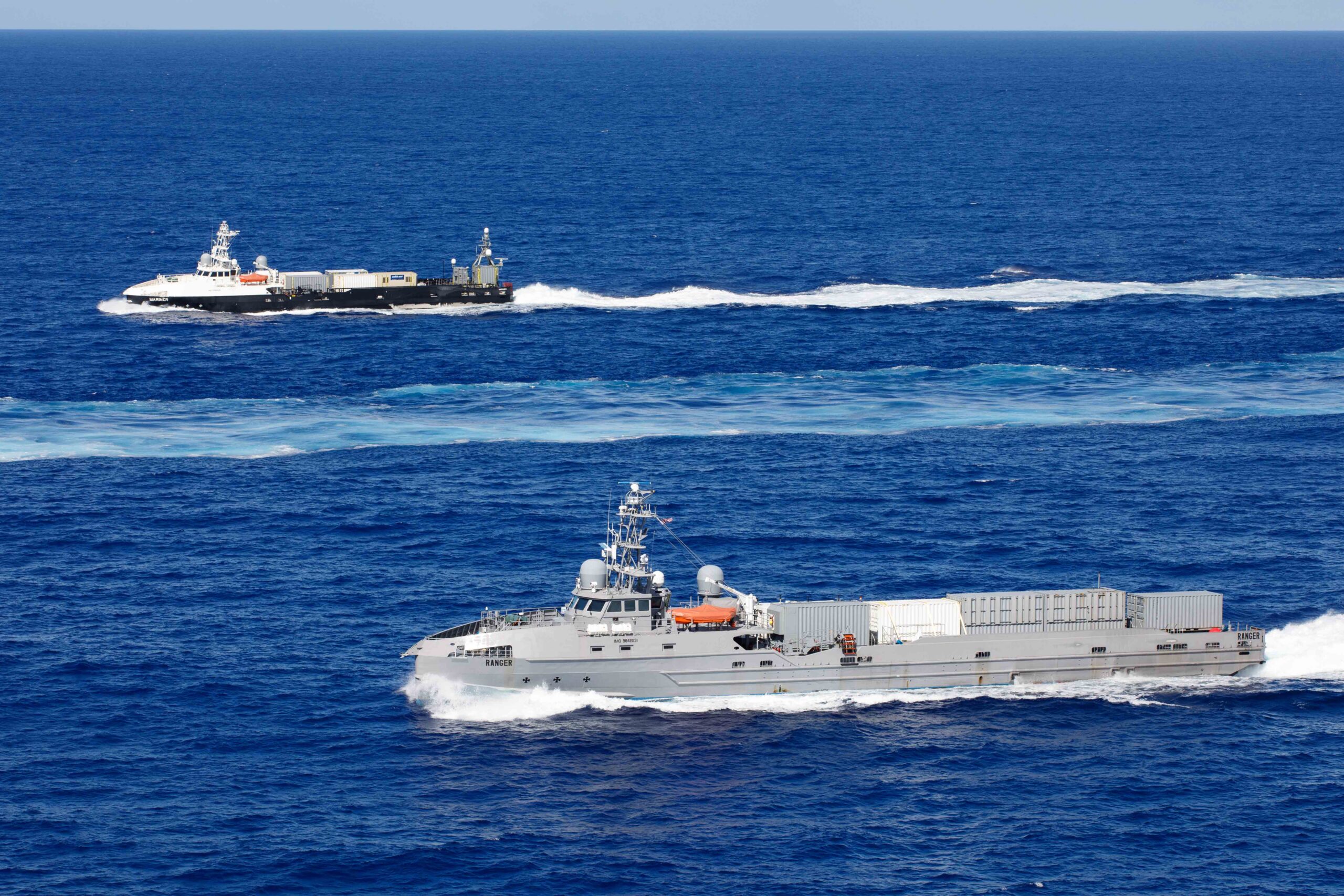
 U.S. Navy completes final testing milestone for Unmanned Surface Vessels Ranger and Mariner // Photo by MC2 Jesse Monford
Why the U.S. Navy is Betting on Autonomous Maritime Systems in the Indo-Pacific
On May 11, 2026, the Department of Navy released its shipbuilding plan for fiscal year 2027. The document highlighted this administration’s long-term strategy to expand fleet capacity and strengthen the maritime industrial base with the goal of delivering a more capable, ready, and lethal naval force. This maritime blueprint outlines the changing character of warfare as the Navy continues augmentation of the battle force with Unmanned Surface Vessels (USVs), Unmanned Underwater Vessels (UUVs), and Medium Unmanned Surface Vessels (MUSVs).
While many onlookers focus on the new Trump-class battleships, the budget highlights the growing role unmanned vessels are playing in modern maritime combat. Just like the equalizing role exhibited within the Russo-Ukrainian war, autonomous maritime vessels provide America with force multiplication throughout the Indo-Pacific— strengthening sea-denial, intelligence, mine warfare, and fleet security capabilities. The annual blueprint lays out a plan to procure 3 MUSVs valued at $171 million in 2027. This acquisition is part of a broader $3.11 billion investment strategy throughout the Future Years Defense Program (FYDP) aimed at rapidly scaling the fleet’s uncrewed capabilities within the next 30 years. The budget signals the Navy’s intent to incorporate a “high-low mix” strategy that pairs a smaller number of expensive and highly capable assets with a larger volume of cheaper, less expensive ones.
This strategy will allow the U.S. to efficiently deter or compete with China within the Indo-Pacific region by enhancing the agility, responsiveness, and flexibility of naval forces. Although the ultimate size and composition of the PLA Navy (PLAN) is not publicly known, the Department of Defense states that the PLAN is now the largest navy in the world. Armed with over 370 naval platforms and 60 Type 022 Houbei class patrol combatants carrying anti-ship cruise missiles, the Chinese Navy proses a significant operational challenge for U.S. forces and allies in the region. Additionally, China’s maritime modernization features naval ship design and material quality that in many cases are comparable to that of U.S. Navy ships. Observers of China’s modernization efforts believe that the CCP is building a force that can deter or delay U.S. intervention in a cross-strait conflict between China and Taiwan. The incorporation of unmanned vessels within the Indo-Pacific theatre vis-a-vis the “high-low” strategy presents commanders with expanded options in both peace and war. This approach frees ships, sailors, and marines to focus on high-need operations, while also expanding force presence, maritime domain awareness, threat identification, and area denial capabilities— strengthening overall operational resilience.
While autonomous naval vessels serve as a scalable and risk-tolerant solution for the growing threats in the Indo-Pacific, there are still constraints. The expanse of the Indo-Pacific theatre is characterized by vast oceans, dispersed island chains, and contested littorals, meaning the style of warfare seen in the Black Sea may not be suitable for U.S. forces in the event of a region-wide conflict. The hostile environment forces USV usage in the Pacific to be “creative,” according to Rear Adm. Douglas Sasse, Assessment Division Director at the Office of the Chief of Naval Operations. Environmental challenges like adverse weather, corrosive agents, currents, and temperature changes along with cybersecurity implications highlight the limitations of maritime drones in the Indo-Pacific. Nevertheless, the implementation of unmanned vessels to U.S. manned combatant capabilities within the Indo-Pacific expand operational flexibility and serve as a useful deterrent to U.S. adversaries.
The growing need for autonomous systems in warfare is apparent as great power competition expands across multiple domains. Whether on the ground, at sea, in the air, or beneath the ocean’s surface, modern conflict increasingly rewards forces that can distribute risk, extend operational reach, and generate combat power at lower cost. China’s concentration of naval forces within the first island chain underscores the need for a more flexible and scalable maritime force. Though unmanned vessels are not a substitute for traditional warships, they provide options in both peace and war, supporting surveillance, maritime security, and deterrence missions while augmenting combat operations in contested environments. As the Navy continues to introduce a greater number of USVs, MUSVs, and UUVs, it can adapt to strategic realities of 21st century warfare— raising the costs for potential adversaries while enabling a more sustainable and resilient force posture.