
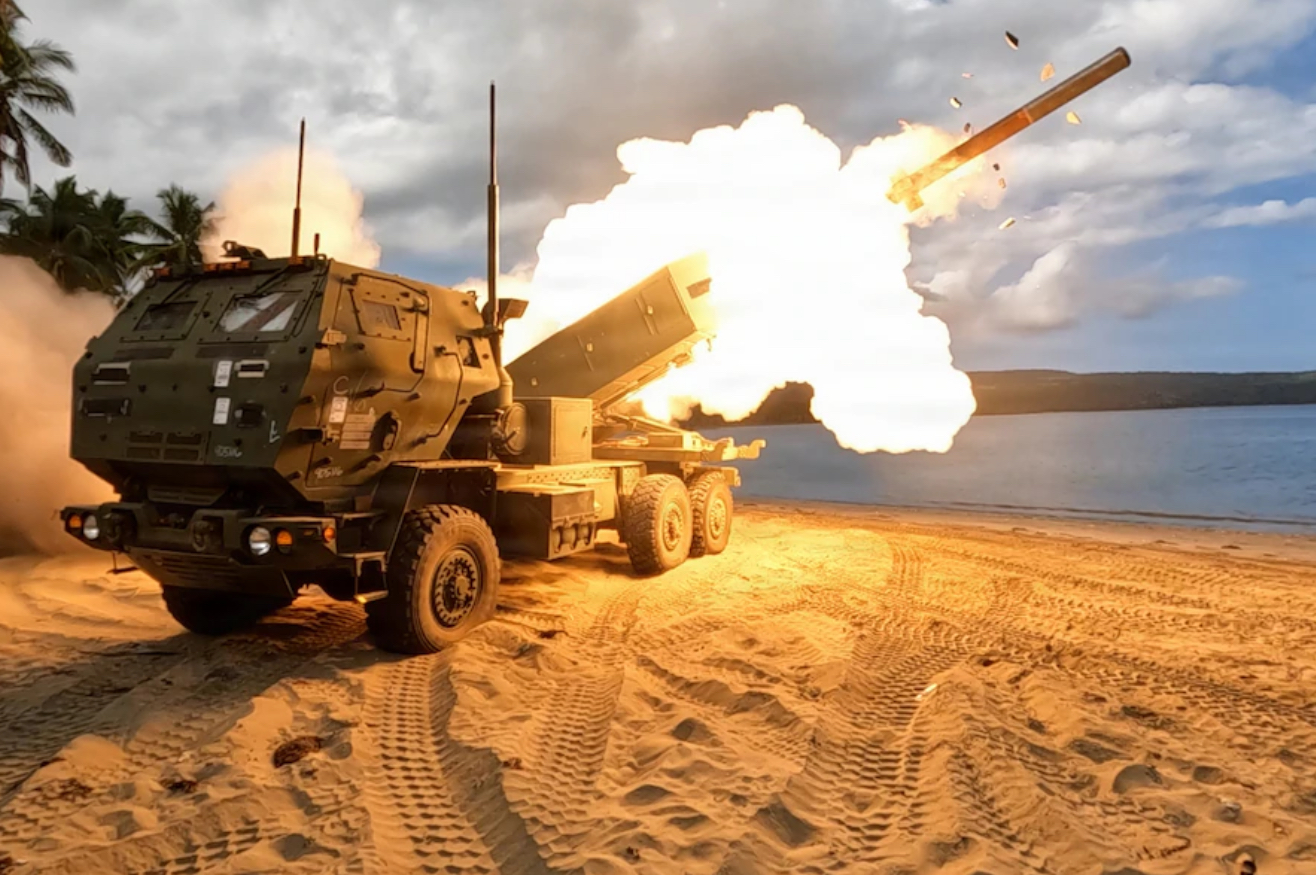
 An Army M142 High Mobility Artillery Rocket System in Palawan, Philippines // Photo by Army Staff Sgt. Brandon Rickert
Balikatan 2026: Coalition Deterrence in the Indo-Pacific
The Philippines hosted its 41st iteration of the Balikatan or “shoulder-to-shoulder” exercise from April 20th to May 8th in conjunction with forces from the United States, Australia, New Zealand, Canada, France, and for the first time, Japan. The participation of Japan marks a historic development in diplomatic and military relations throughout the region as tensions in the South China Sea and Taiwan Strait continue to flare up. The exercise reflects the growing institutionalization of allied deterrence in the region—flexing coalition interoperability and cooperation between America and its partners.
Exercise Balikatan directly supports the 75-year-old U.S.-Philippine Mutual Defense Treaty, and is essential to advancing a free, open, secure, stable, and prosperous Indo-Pacific region. The three-week exercise spanned air, land, and sea drills, weaving together long-range precision fires, drone operations, coastal defense, and joint command-and-control, reflecting how modern warfare is actually fought. During the exercises, the coalition fielded anti-access/area denial systems (A2/AD) like the U.S. Navy-Marine Corps Expeditionary Ship Interdiction System (NMESIS) and Japan’s Type 88 anti-ship missile, which aim to significantly restrict the PLA Navy’s (PLAN) movement past the first island chain via the Luzon Strait.
Likely in response to these military exercises, the PLAN conducted exercises east of Luzon Strait on April 24th. The Chinese military’s Southern Theater Command (STC) said its Naval Task Group 107 carried out activities that focused on live-fire shooting, sea-air coordination, rapid maneuvers, and maritime replenishments to test integrated joint combat capabilities. These counter-exercises signal that the PRC sees the coalition as a significant threat to its operational freedom throughout the region in the event of a conflict.
The U.S.-Philippine coalition reinforces deterrence against China’s increasingly coercive behavior throughout the Indo-Pacific. As the CCP expands its presence in the South China Sea, Beijing has continued to apply pressure across multiple domains, ranging from gray-zone maritime tactics to military expansion. Actions such as the deployment of a floating barrier near the contested Scarborough Shoal, along with the construction of a large airbase on Antelope Reef within the Vietnamese-claimed Paracel Islands, reflect China’s growing willingness to assert its territorial claims through both maritime and military pressure. Xi Jinping also repeatedly emphasizes reunification with Taiwan, stating in a New Year’s Eve speech that reunification “is unstoppable.” Although Senior Colonel Zhang Xiaogang, spokesperson for the Chinese Ministry of National Defense, stated during an April 30th press conference that “what the Asia-Pacific region needs most is peace and tranquility,” China’s actions throughout the region continue to raise concerns among neighboring states regarding regional stability and the future balance of power in the Indo-Pacific.
CCP actions and rhetoric have understandably stoked worries among regional leaders who are uncertain about the region’s future. Philippine Secretary of National Defense Gilberto Teodoro says the exercise serves as collective deterrence against China. Meanwhile, Japan’s Prime Minister Sanae Takaichi stated last November that a Chinese attack on Taiwan could constitute “a survival-threatening situation.” It is clear that the U.S. must reaffirm its commitments to its allies in the region and continue to serve as a counterweight through cooperation and partnership exercises such as Balikatan. The absence of sustained U.S. engagement and credible deterrence could lead to increased coercion and further destabilize the balance of power throughout the Indo-Pacific.
Against the backdrop of both sides’ recent military drills is the ongoing Trump-Xi summit May 14th-15th, which seems to be focused on Taiwan, trade, and fentanyl. Although exercises like Balikatan and other U.S. actions receive condemnation from the Chinese government, the U.S. must continue to cooperate with nations in the Indo-Pacific to build and maintain a deterrence strategy in the region. Balikatan serves as much more than just the establishment of interoperability with weapons systems, forces, and command. It also sends a diplomatic signal to China that America remains present in the region in order to uphold a rules-based system and a free and open Indo-Pacific.